Tuesday, 19 February 2013

The Witch's Familiar

The Witch's Familiar

During the Medieval and Early Modern periods, belief in witchcraft was rife and predominant in the evidence used against witches during the witch trials was the familiar, or familiar spirit, although the belief in familiars goes back much further. A familiar was believed to be a supernatural entity, essentially a demon, which assisted witches and cunning folk in the practice of their craft and was said to be given to witches or cunning folk by the devil, although ancient lore says that they came from the Otherworld. The basic idea of a familiar probably emerged due to a need for humans to communicate with the unseen world of spirits, with the familiar first serving as a mediator between the physical and spiritual world. This concept later evolved, with the familiar becoming a companion and ally. With the rise of Christianity, the familiar became a servant, given by the Devil, and was considered to be a 'partner in evil' who helped the witch in casting evil spells. These supernatural entities appeared in many forms; often as an animal but were also believed to appear as human or as a humanoid figure. Cats, especially black cats, were favoured, with the fear of all cats being witches familiars resulting in cat massacres which swept through Medieval Europe. The demon helper was also said to inhabit dogs, toads and other small animals. Some sources also say that 'traditional vessels for such spirits were the cat, mouse, ferret, hare, bat, snake, hound, or bird – particularly a raven or an owl.' 

The Witch's Familiar (Original)
 
This connection between humans and animals can be traced back to Palaeolithic (2.5 million and 20,000 years ago) and Neolithic (4000-2500BC) notions, and can be seen in old shamanic practices associated with animal guides. Cave art, including etchings and drawings, depicts scenes that are believed to represent magical themes, along with artefacts from these periods representing different animals and creatures. Many of the animals represented in these periods are identical to those that have later appeared as familiar spirits, suggesting that they are related to ancient beliefs and practices. 
 
The earliest writings associated with witches and familiars show the similarity of a chthonic nature, with many of them being creatures of woodlands, wetlands, and caves which links them to Underworld themes and deities including Hecate, Diana, Pan and Proserpina. These deities are often associated with certain animals: Diana with the hound, Hecate with the toad, Pan with the goat and Proserpina with the serpent. The various types of familiar are often the same creatures associated with moon goddesses, mother goddesses and ancient chthonic deities. Our ancestors believed the night and the moon to be closely connected to the Otherworld and Spirit World, with folk beliefs holding that supernatural entities of the night lived in the dark and wooded places.

Diana and the Hound (Original)

The physical senses, hearing and sense of smell, are stronger in animals than in humans, and, from an occult perspective, their psychic senses are also stronger. So it is believed that a close relationship with a familiar strengthens the sense of a witch. Witches are said to have taken great care of their familiars. Emile Grillot de Givry, in Witchcraft, Magic and Alchemy (1931), describes how witches 'baptised their toads, dressed them in black velvet, put little bells on their paws and made them dance.' The familiar also benefits from this relationship, which supposedly provides the familiar with an expanded view of reality and reinforces the familiar's energy pattern. And so the familiar becomes the mediator between worlds. With both parties benefiting, a connection between the human consciousness and nature's consciousness are said to join, forming a magical consciousness. With both consciousnesses joined, the witch and familiar are said to be capable of opening portals to other realms, accomplishing magical outcomes in both the physical and astral plane. Legends of shapeshifting witches probably originates from these beliefs. In a Lancaster trial written by G. B. Harrison, we are told: 'But the spirits which appear now as men, now as animals, are, at first sight, more difficult to explain until it is remembered that in the witchcraft ritual the members of the coven disguise themselves as animals... (the familiars) are nothing more than the evil humans who were responsible for the whole business.' Owls were often associated with witches, giving us an example of how a witch was believed capable of changing their form. The Romans actually called the owl a 'strix', which translates as 'witch', with another term used during the Middle Ages being 'night hag', referring to the belief that the owl was a witch in bird form. In reality, the familiar is the magical partner and companion of the witch, and vice versa.

Owls were often believed to be a shape-shifted witch (Original)

The oldest idea of the familiar was that it was a spirit animal of an entire species of animal, represented by a single form. This is, in some cultures, called an animal guide or a power animal. These entities can supposedly be used as a link to Nature. This belief is often connected to shamanic practices . One of the earliest signs of the relationship between animal guides and humans can be seen in the Ver Sacrum, a religious practice pre-dating the rise of the Roman Empire which is connected with the Sacred Springtime of the ancient Italic tribes. This rite required the tribe to split up in order to form new colonies, during which their sacred animal was said to guide them. For example, the Sabellians were guided by a bull , the Piceni were guided by a woodpecker and the Lucani were guided by a wolf.

Over time, these supernatural beings, along with fairies, were combined into a common mythos. Jeffrey Burton Russell, author of Witchcraft in the Middle Ages, tells us: 'The small demons that became the Witches' Familiars of the later Middle Ages were originally dwarves, trolls, fairies, elves, kobolds, or the fertility spirits called Green Men...' He goes on to say that black and green were the favoured colours of witches, with green being the colour of the fairies. Richard Baxter, a Puritan cleric, was an earlier figure that viewed familiars as nature spirits. In his treatise, The Certainty of the World of Spirits, which was published in the year of his death, Baxter argued for the belief in 'invisible powers and spirits,' with the belief that familiars, or spirits of some kind, helped witches with the casting of spells and the raising of storms. He was, however, uncertain whether these spirits 'are neither Angels, good or bad,' or whether 'those called Fairies and Goblins are not such.' The fact that fairies were often believed to be familiars of witches shows the survival of Pagan beliefs in later periods.

 Quaker Witch with Demon Familiar (Original)

Another persistent theme within the belief of witchcraft is of the witch being transported to the Sabbat with help from their familiar. Fairy lore shows similarities to this belief with the transportation of humans to the Fairy Realm, which is suggestive of the Otherworld, with the crossing between the mortal and spirit realm with the help of a supernatural entity. Oral tradition tells us of how witches avoided detection by meeting in the astral plane to hold their Sabbats. This was aided with the use of 'flying ointments' which were smeared onto the skin and, within Fairy lore, the use of some magical dust or potion.

Witches often used the induction of trances to connect with other realms and here we can see the
connection of animal spirits as the magical partner of the witch. One ancient technique to induce a trance was to listen to the croaking of frogs. The frogs movement between land and water was possibly suggestive of a supernatural power possessed by the frog, giving it the capabilities to lead the witch to and from the spirit realm. Some folklorists of the 19th century, such as Charles Leland, have pointed out the addition of bronze frog images that have been used by witches to aid them in the working of spells and magic, indicating a close connection between witches and frogs. Fairies and imps were also said to aid witches to travel 'in spirit' due to the belief that they lived within the spirit realm. They allowed the witch to enter into the Otherworld by locating the doors that link the physical to the spiritual, which is possibly why fairies and witches are often associated in folk beliefs throughout Europe and the UK. 

The Egyptian Dog Anubis (Original)
 
Another familiar believed to help a witch in their travels was the dog which was believed to be a guardian and keeper of the passage between the physical world and the Underworld. While the dog is often seen as a guardian of Underworld treasures, it is actually the guardian of secret knowledge associated with death and resurrection. The Egyptian dog, Anubis, is the attendant of the dead and the soul guide of the spirit land. Dogs are also associated with messenger gods and gods of destruction. The dog is often placed in the company of mother goddesses and healers. Like cats, dogs were regarded as witches' familiars and, according to J. C. Cooper, author of An Illustrated Encyclopaedia on Traditional Symbols, 'represent witches as rain-makers, hence 'raining cats and dogs.''

It was believed that a familiar could be used to trace a witch when dealing with curses and bewitchment. One witch trial held in 1665 for Rose Cullender and Amy Duny, both from Lowestoft, was concerned with the bewitchment of a child. It was noted that 'One of the sick child's blankets was hung up and anything found in it thrown into the fire. A toad obligingly appeared and exploded when put in the fire, after which the suspect was discovered and much scorched.' Medieval Christians believed toads to be 'familiars of witches, symbols of avarice and lust, and tormentors of those in Hell for these and other sins.' European folklore shows that the toad had a much darker position than the frog. The toad was regarded as an emissary of the 'Evil One' in 16th century England, and was often burned to death as a result. In Norway, opinions were much the same, with the toad being regarded as evil, or as the representation of evil, with unfortunate frogs and toads being thrown onto the bonfire which people had danced around and jumped over on St. John's Eve. Killing toads in this manner was believed to ward off evil spirits and trolls which were active on that night. 

In parts of Scandinavia, familiars were often associated with spirits of the land and nature. Fairies, dwarves, and other supernatural beings were believed to live within the bodies of animals. With the coming of Christianity, the practice of witchcraft went underground due to the assumption that any spirit, other than an angel, had to be a demon. During the witch trials, many domestic animals were killed due to their association with heretics and witches.

Shamanistic beliefs of animal familiars is that they are not physical beings, but are thought-forms or purely spiritual entities. They are said to travel astrally, serving as magical guardians against those who may try to psychically attack the shaman.

In 1318, Pope John XXII is said to have had nine alleged witches prosecuted for assorted magical crimes, including their contact with a familiar with the help of a polished glass. The Church made use of a collection of scriptures from the Old Testament involving familiars, although it is difficult to say what these Christian interpretations of the scriptures may have meant to the ancient Hebrews. The 'Witch of Endor' from the Old Testament (Samuel 28: 3-25) was often used as the foundation of the Church's opinion on familiars. There is, however, nothing within the original language to suggest that the woman in the story was actually a witch. The original script was translated from ba'alath ob, meaning 'mistress of the Ob', to Latin mulierem habentem pythonem, meaning 'a woman possessing an oracle spirit' which was, in the King James version, translated to mean 'possessing a familiar spirit.' The Hebrew word 'ob' was used in reference to sorcerers and necromancers who conjured the dead to answer their questions. The King James Bible translated this to 'familiaris', changing the meaning of the original scripture to that of a 'household servant'. This portrayed such spirits as being the personal servants of a witch or sorcerer. Literal translations of the Bible do not discuss familiars, dealing mainly with those that practice the arts of the occult. For example, the Book of Deuteronomy 18:10-11 tells us to avoid keeping company with a 'fortuneteller, soothsayer, charmer, diviner, spell-caster, a spirit medium, or anyone who seeks oracles from the dead. The Book of Leviticu 20:27 encouraged strict punishment for anyone connected to the occult: 'A man or a woman who acts as a medium or fortuneteller shall be put to death by stoning.' The King James Bible simply replaced these original ideas with the use of the word 'witch'.

Queen Elizabeth, in 1563, declared that anyone proved to have invoked or conjured 'evill and wicked Sprites' would be punished, while King James, in 1604, expanded on this and was more specific, saying: That if any person or persons... shall use practice or exercise any Invocation or Conjuration of any evill and wicked Spirit, or shall consult convenant with entertaine employ feede or rewarde any evill or wicked Spirit (will be punished). Court officials were often keen to convict those that were a part of the occult, often coercing the accused in order to shape the evidence in such a way that made it look as though the suspect was in clear violation of the law. 
 
The Malleus Maleficarum (1486), the witch inquisitor's handbook, gives no actual instruction concerning the familiar in the questioning and trial of a witch. This book does,however, mention familiars, stating that an animal familiar 'always works with her (witch) in everything.' It also cautions inquisitors to never leave the suspect witch alone because the Devil 'will cause her to kill herself', possibly accomplishing this through a familiar. If, during these trials, so much as a fly came in through the window during the questioning of a witch, it was believed to be a familiar. 

 Matthew Hopkins, the Witch Finder General (Original)
 
The main period for the focus of witches having relationships with animal figures was between 1550 and 1650, with Matthew Hopkins, the notorious 'Witch Finder General', using the possession of a familiar as primary evidence to prove a suspect guilty of witchcraft. As a result, many were executed simply for their ownership of an animal, along with their having a strange mark, which was believed to be a nipple used to feed their familiar. The courts often exchanged the term 'familiar spirit' with words such as 'imp', 'devil', and 'demon', so it is not difficult to understand how the oldest beliefs of familiars mutated under the direction of such religious authority.

Despite the widespread belief in familiars, the Salem witch trials gives very few accounts of animal familiars. In 1692, John Bradstreet was accused of 'inciting a dog to afflict.' As a result, the dog was tried and hanged for being a witch.

The Familiar Spirit (Original)

Descriptions of familiar spirits by witches or cunning folk who had been accused of witchcraft had similar characteristics. Despite the supposed supernatural nature of these familiars, the accounts of them are surprisingly ordinary. They often had normal and affectionate names. For example, Bessie Dunlop, one cunning woman accused of witchcraft named her familiar Tom Reid. Another accused witch, the 17th century Jane Wellis from Huntingdonshire named her familiars Grizell and Gridigut. There are accounts telling us that the familiar often arrived with its name already established, meaning that the witch was not believed to have named the familiar. Matthew Hopkins declared that 'no mortall could invent' such names, which, to him, was suggestive of something diabolical. This indication fits with the beliefs of the time, with many from this era believing that all spirits possessed names, therefore it only made sense that familiars had their own exclusive names. Familiars were described by those that had supposedly witnessed them as clearly defined, three-dimensional....forms, vivid with colour and animated with movement and sound. With their later descriptions of their smoky, undefined forms, they sound more like ghosts. 
 
They were often believed to be malevolent when working for a witch, while they were believed to be benevolent when working for cunning folk, with a witch's familiar being identified as a demon, while the latter are often classified as fairies. A familiar's main purpose is to protect and serve the witch, as they inherit their new skills. Once the relationship between witch and familiar was established, the familiar actually served a variety of purposes. Witch trials show that familiars were believed to inflict injury and to cause death to both animals and humans. They were believed to haunt and harass people, although this was limited to verbally abusing, jeering and/or threatening the victim.

In accounts taken from British cases, witches and cunning folk generally had three different ways in which a familiar would come to them. The first was that the familiar would impulsively appear in front of the individual, inside or outside of the home. For example, Joan Prentice, interrogated for witchcraft in 1589, claimed that she was 'alone in her chamber, and sitting upon a low stool preparing herself to bedward,' when her familiar first manifested before her. A cunning woman from Cornwall, Anne Jeffries, claimed that her familiar appeared when she was 'knitting in an arbour in our garden.'

The second common appearance of the familiar to a magical practitioner was that they were gifted to them, sometimes by a family member or, supposedly, by a powerful spirit. Margaret Ley from Liverpool, questioned in relation to witchcraft in 1667, claimed that her familiar was given to her by her mother when she died. Another example comes from Joan Willimot, a Leicestershire cunning woman questioned in 1618. Willimot claimed that a mysterious figure, who she referred to only as her 'master', 'willed her to open her mouth and he would blow into her a fairy which should do her good. And that she open her mouth, and that presently after blowing, there came out of her mouth a spirit which stood upon the ground in the shape and form of a woman.' Other examples include a trial that took place in Chelmsford in 1556, where the accused confessed to possessing a white-spotted cat called Satan which was passed down from witch to witch and a trial in 1582, where a 12 year old girl admitted to receiving her familiar, a cat, from her grandmother, which she later gave away to a woman named Agnes Waterhouse.
 
In some accounts, witches or cunning folk are said to have experienced difficulties in the practise of their magic until a familiar appeared to them and offered them aid. It has been noted by Emma Wilby, historian and author of Cunning Folk and Familiar Spirits, that 'their problems... were primarily rooted in the struggle for physical survival – the lack of food or money, bereavement, sickness, loss of livelihood and so on.' The familiar apparently offered them a way out of this, solving their problems by gifting them with magical powers. Some lore states that a witch received their familiar following their initiation into the Witches' sect Witches and cunning folk often made some form of pact or agreement with their familiar. This would state a length of time for which the familiar remained with the practitioner, varying between weeks and, in some cases, decades. It seems common for witches and cunning folk to summon their familiar when they were in need of assistance, although the methods varied. Joan Cunny from Essex, in 1589, claimed that she had to kneel within a circle and pray to Satan for her familiar to manifest, while, in 1653, the cunning woman, Anne Bodenham, from Wiltshire claimed that she could summon her familiars by reading books. However, in some accounts familiars are said to have had the ability to manifest even when they were unwanted or when they had not been summoned. Elizabeth Chandler, a witch from Huntingsonshire, claimed in 1646 that she had no control over her two familiars, Beelzebub and Trullibub, and is said to have prayed to God that He would 'deliver her therefrom.'

As I have noted briefly above, witches were believed to feed or nourish their familiar. It was believed that the familiar needed the nourishment of breast milk or blood, although some witches are reported to have fed their familiar on bread and milk. However, most theories of the time suggested that a familiar often craved and required blood in order to maintain a physical body, as they were believed to be spirits. While familiars were believed to take blood straight from the witch, witches were sometimes believed to provide other sources to feed the craving of their familiar. In 1324, Alice Kyteler from Kilkenny, Ireland, who was convicted as being a witch, confessed that she sacrificed red cocks to her familiar, providing it with a source of blood. Familiars, according to trial transcriptions, obtained blood by pricking the witches body and sucking out the blood. This was believed to leave a mark, which was identified as the 'witch's mark' or 'devil's mark' by witch hunters. This mark could be anything from a bruise, mole, or any skin abnormality. Most often accused were the elderly, who often had the common dark spots which we attribute to old age. These marks were believed to be insensitive to pain caused by a pin or needle pushed into them.
Outside of the witch trials, it was believed that some magicians and village healers were aided by more benevolent familiars which could diagnose illnesses and sources of bewitchment. They were also used to divine and find lost objects and treasures. During rituals, magicians would conjure these spirits, locking them into bottles, rings and stones which were sometimes sold as charms, with the magician claiming that they would ensure success in whatever the buyer sought. This was not technically illegal, with England's Witchcraft Act of 1604 specifically outlawing evil and wicked spirits.

Modern witches have their own views on familiars and no longer accept the Judeo-Christian opinion of the familiar as either accurate or valid. Familiars are now more often perceived in much the same way as some American Indians view animal guides or power animals. They are now seen as messengers that move between the mortal and spirit realm, healers and powerful allies to those with whom they form a relationship which are gifted to a witch by the Great Spirit. There are, to a modern witch, essentially three types of familiar spirit: the physical, the astral and the artificial. A physical familiar is a pet or animal to which you feel drawn. An astral familiar is considered to be an entity which exists within the spiritual realm. The artificial familiar is one that is created by the practitioner with the use of magic. In modern times, the familiar assists the witch by carrying energy for the use of healing, communicating and spell casting. They are also believed to protect both the home and personal property. Familiars can also defend a witch during astral projection and dream-work, as well as carrying information to or from the spiritual realm.
 
In conclusion, familiars have evolved and changed through the years and, in modern times, have pretty much come full circle back to the beliefs of the ancients. Familiars have been considered to be guides and helpers, aiding a witch, magician or shaman in the practice of their magic. They are said to take many forms, often as animals, with the favourites being cats. They are, however, not limited to being only animals, with many beliefs stating that the familiar is a spirit capable of living within the body of an animal or creature. They can be a readily evolved spirit or can be created through the use of magic by a witch. The evolution of Christianity saw familiars condemned, linking them to demons and the Devil and giving a primary source of evidence against an accused witch. While they have often been linked with evil, cunning folk were also said to possess benevolent familiars which could aid a person with any matter. In this case, the spirit was sometimes bottled and sold. Modern times, however, bring us back to the belief that the familiar exists to protect and aid it's witch by carrying the additional energy needed during healing, communication with other worlds and spell-casting. It is now believed that the familiar spirit connects us to the spirits of nature, much like the beliefs of our ancestors before us.

Next time: We'll take a closer look at the origins of witchcraft.

Monday, 18 February 2013

Puck

Puck

Puck (Original)
 
Puck is possibly one of the most famous and popular figures in English fairy tradition. He is also known as Robin Goodfellow and some sources believe that his roots could go back as far as the Greek God Pan and to the Pagan deity, the Green Man. The name, Puck, derives from the Middle English 'pook' or 'pouke', another word for an elf or sprite. He is similar to the German spuk, a hobgoblin, and the Dutch spook, 'a ghost', although the last is denied by some linguists. There also seem to be similarities with the Welsh 'pwca', and the Icelandic 'púki', both being imps, and with the shapechanging Irish 'phooka'.

In early England, the name Puck seems to have been used in association with the Devil, probably through the encouragement of the Church. Examples of this particular use can be found in Langland's Piers Plowman. In Ben Jonson's play, The Sod Shepherd, the term 'Puck-hairy' is used, which may originally come from the German picklehäring, a jester. 
 
To be 'pooke-ledden' in Worcestershire once meant the same thing as to be 'pixy-led' in Devon. Another phrase likened to being pixy-led is Robin Goodfellow has been with you tonight; a phrase that can be found as early as 1531. In Robert Burton's Anatomy of Melancholie, we are told 'Necromancers take upon them to raise and lay them at their pleasures: and so likewise those which Mizaldus calls Ambulones, that walk about at midnight on great heaths and desert places, which (saith Lavater) 'draw men out of the way, and lead them all night a bye-way, or quite bar them of their way,' these have several names in several places; we commonly call them Pucks.' This statement identifies Puck with the 'Jack-o'-lanthorn', 'Will-o'-the-wisp', and 'Friar Rush'; different names for a misleading spirit which, with his shifting light, manipulated travellers into bogs and bad situations, much like the hero of Robin Goodfellow. Here we find Robin, misleading travellers with the sound of his voice and causing general mischief, linking him with Puck. According to this play, Robin apparently shape-changes into a horse and tempts travellers into riding him, when he would bear them into pools and ponds. This links him not just to Puck but to the Hampshire spirit once known as the 'colt-pixy'. The colt-pixy was believed to tempt other horses into bogs and quagmires. In Chester we find the 'picktree-brag' in the likeness of the Galloway Pony, which was believed to drop strangers and travellers into stagnant ponds before retreating with an outburst of laughter. Sometimes the picktree-brag would take the likeness of a calf sporting a white handkerchief around its neck and a bushy tail, or, at times, it would appear as an ass. The Irish phooka was also believed to take the form of a horse. As the 'lob', 'lob-lie-by-the-fire', or 'lubberfiend', Puck is equated with the Irish leprechaun or lubberkin. This association probably stems from the French lubin, with Puck assuming the role of heath-dwelling domestic spirit. In this role, according to John Milton in L'Allegro:

Tells how the drudging Gobin swet
To ern his Cream-bowle duly set,
When in one night, ere glimps of morn,
His shadowy Flale hath thresh'd the Corn
That ten day-labourers could not end,
Then lies him down the Lubbar Fend.
And stretch'd out all the Chimney's length,
Basks at the fire his hairy strength 
 
Milton's Puck is not small, as he might be perceived today, but nearer to a Green Man. Joseph Ritson tells of another unnamed source that is of some relation to Milton, giving us another description of Puck, although somewhat similar to Milton's: '...she, particularly, told of his thrashing the corn, churning the butter, drinking the milk, &c. and, when all was done, 'lying before the fire like some rough hurgin bear.'' 
 
Both Milton and Ritson give the impression that Puck is also a domestic spirit. Puck would thresh the corn to earn a bowl of cream before relaxing by the fire, much like the household Brownie, Hob or Hobgoblin. The Hobgoblin or Hob was despised by the 17th Puritans. A Hob is really just a shortened version of the name Robert or Robin, which was once a term used for the Devil. However, Puck the Hobgoblin later became a much loved character of children's literature with Rudyard Kipling's Puck of Pook's Hill (1906) and Rewards and Fairies (1910). 

Kipling's Puck is extremely critical of the common modern image of the fairy: 'Can you wonder that the People of the Hills don't care to be confused with that pointy-winged, wand-waving, sugar-and-shake-your-head set of imposters? Butterfly wings, indeed!' Kipling's Puck is the oldest thing in England and not only is he critical of modern fairies, he is immune to many of the things once believed to deter them. ''By Oak, Ash and Thorn!' Cried Puck, taking off his blue cap. 'I like you too. Sprinkle plenty of salt on the biscuit, Dan, and I'll eat it with you. That'll show you the sort of person I am.  Some of us,' - he went on, with his mouth full – 'couldn't abide Salt, of Horse-shoes over the door, or Mountain-ash berries, or Running water, or Cold Iron, or the sound of Church bells. But I am Puck!' 

A Midsummer Night's Dream (Original)
 
A Midsummer Night's Dream, by William Shakespeare, gives us a summary of Puck which was probably drawn from folklore sources. 
 
Fairy: Either I mistake your shape and making quite,
Or else you are that shrewd and knavish sprite
Called Robin Goodfellow. Are you not he
That frights the maidens of the villagery
Skim milk and sometime labour in the quern,
And bootless make the breathless housewife churn,
And sometimes make the drink to bear no harm,
Mislead night-wanderers, laughing at their harm?
Those that Hobgoblins, call you and sweet puck,
You do their work, and they shall have good luck,
Are you not he?
Puck: Thou speakest aright;
I am that merry wanderer of the night.
I jest to Oberon and make him smile.
When I a fat and bean fed horse beguile,
Neighing in the likeness of a filly foal,
And sometimes lurk I in a gossip bowl
In very likeness of a roasted crab,
And when she drinks against her lips I bob
And on her withered lips dewlap pour the ale,
The wisest aunt, telling the saddest tale,
Sometimes for three foot stool mistaketh me;
Then slip I from her bum, down topple she.
And tailor cries, and falls into a cough;
And then the whole quire hold their hips and laugh,
And waxen in their mirth, and sneeze and swear
A merrier hour was never wasted there.

This verse gives us a good overview of who Puck is as a character. Shakespeare tells us that Puck is a crafty and deceitful spirit who is often called Robin Goodfellow. He also tells us that Puck scares the village maids, steals cream and frustrates housewives by stopping their milk from turning into butter. He stops beer from foaming and misleads travellers in the night. Shakespeare also tells us that Puck is sometimes called Hobgoblin and that he will help some, giving them good luck. In the same passage, Puck himself tells us that he tricks horses into thinking he is a female horse and that, disguised as an apple, he hides in the bottom of an old woman's drink before bobbing against their lips, scaring them into spilling their drink all over themselves. He also disguises himself as a three-legged stool and waits for someone to sit on him before dropping them on the ground to make people laugh. 
 
There is some difference in opinion as to whether Puck and Robin Goodfellow are one and the same. However, from the comparisons made above, in my opinion, it is easy to see that they are, at the very least, very similar and, more likely, identical. The Hobgoblin can also be grouped in with Puck. The Mad Merry Pranks of Robin Goodfellow, possibly written by Shakespeare's friend Ben Jonson, agrees with this conclusion, telling us in the introduction: Robin Goodfellow, alias Pucke, alias Hobgoblin, in the creed of ancient superstition," says Bishop Percy, "was a kind of merry sprite... Shakespeare's statement in A Midsummer Night's Dream seems to verify the matter, showing that it's appropriate to suggest that Puck can also be called Robin Goodfellow and Hobgoblin. 

The Greek God Pan (Original)
 
When we look further back, Puck or Robin Goodfellow have been linked to the Greek God, Pan. In Midsummer: Magical Celebrations of the Summer Solstice we are told, 'Robin Goodfellow is sometimes described as having the head of a youth and the body of a goat. Like the god Pan, he has a lusty nature, small horns on his head, and carries musical pipes. It may be that he is the fairy remnant of the ancient horned god or nature spirits, since there originally seem to have been a race of pucks.' 

The Green Man (Original)
 
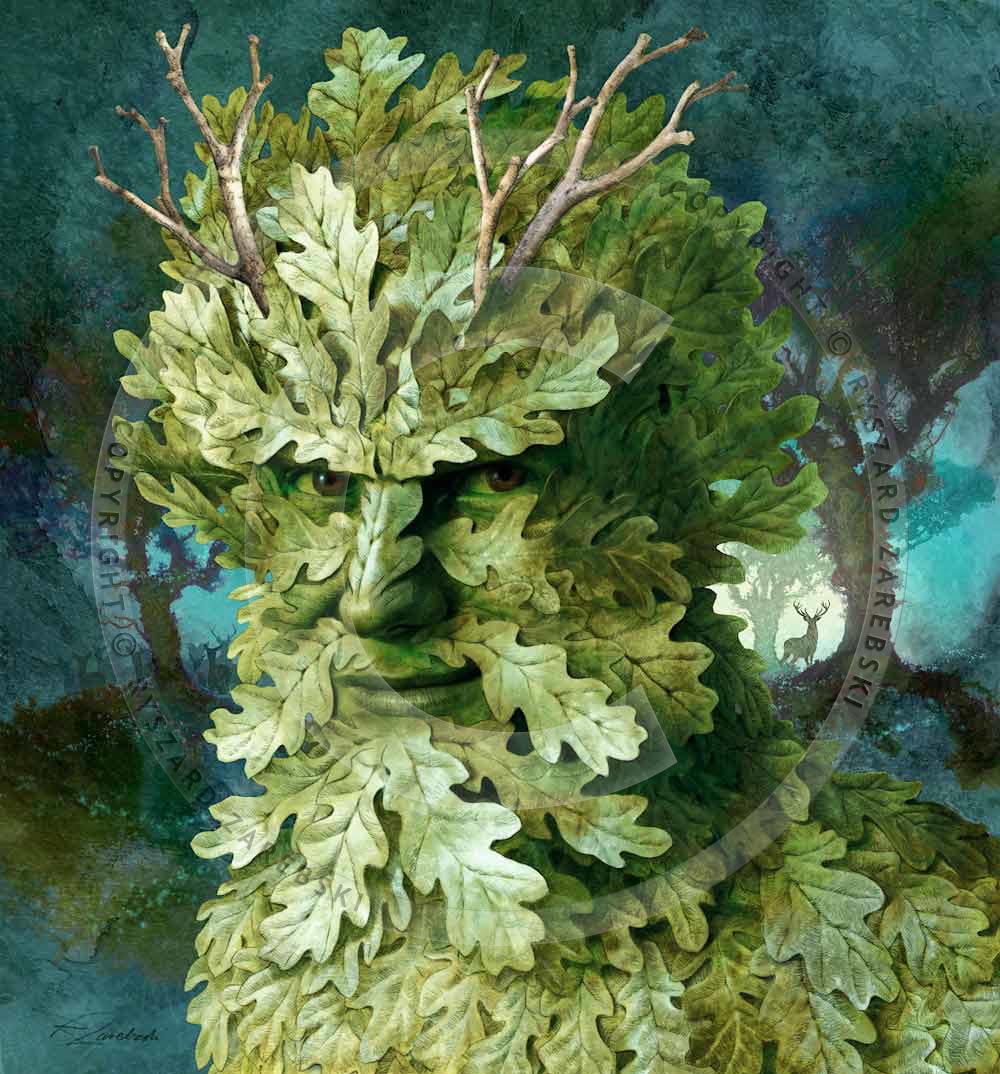
A connection has been made between Robin Goodfellow and the Green Man, a Pagan nature deity. In The Paganism Reader by Chas Clifton, the connection between links both Robin Goodfellow and the Green Man to Robin Hood. 'It should come as no surprise to find that the same Robin Goodfellow is none other than the Green Man or the spirit of the spring found in many old morris dances. The Green Man whose effigy was carved by masons on a boss in the cloisters of Norwich Cathedral, in the transept of Llantilio Crossenny church in Monmouthshire, among the decorations of Rosslyn Chapel near Edinburgh and in many other sacred edifices. The Green Man whose smiling face appears among the carvings on the front of one of the oldest inns in Sussex, at Alfriston. The same Robin whom the General Assembly of the Church of Scotland petitioned King James VI in 1577 and again in 1578 to ban, in connection with the performing of plays featuring Robin Hood, King of the Man, on the Sabbath day, mainly because of the unseemly ribaldry of the vulgar people on these occasions.' It is interesting that carvings of the Green Man can be found in many churches and cathedrals across the country. In most cases, the Church had a low view of the very idea of the Green Man due to his connection with not only Paganism but blasphemous gods. It is believed that many of these images were carved into the stone walls of churches and cathedrals secretly and without the permission of the Church authorities. The Green Man represents Nature, renewal, and reproduction, and is closely linked to the passing of the seasons as well as the waxing and waning of the sun. 

Robin Hood (Original)
 
The Church's opinion of Puck, Robin Goodfellow and the Green Man, and subsequently the public's opinion, was that they were associated with the Devil. This can be seen in William Langland's The Vision of Piers Plowman, with statements such as: 'Nor neither heat, nor hail nor none hell's pouke,' which refers to puck as a demon, and 'Out of the pouke's poundfold no mainprise may fetch us.' This last statement actually means that no bail will get you out of the demon's prison. Langland makes a pouke, later changed to puck, a great adversary to God and man. This is, undoubtedly, a view that was encouraged by the church. It is interesting to note that, during the witch trials, a favoured name for witches familiars was Robin – from Robin Goodfellow and, therefore, Puck. This could potentially have been an embellishment made by the Church and their authorities. In his translation of Ovid's Metamorphoses, Arthur Golding also gives the impression that he linked a pouke with the Devil: 
 
'The country where Chymeara that same 'pouke'
With goatish body, lion's head and breast, and dragon's tail.'

Some sources also believe that Robin Hood could have originated as Puck. This is much debated and many seem to disagree. Some sources tell us that Robin Hood is actually a corruption of Robin of the wood or Robin in the Wood. There are many things that could link Hood with Goodfellow. Robin Hood: From Darkwood to Hollywood states: 'In European lore we find that elves of the wood were seen with Hoods and that Robin Hood is linked with Robin Goodfellow, otherwise now known as Puck or Hob... As Puck he can be traced across the entire European continent and it is believed to be of Proto-Indo-European origin, revealing the ancient nature of this particular strand of folklore. As Hob he is the Hobgoblin and Hob is also interchangeable with Rob or indeed Hod.... Puck on the other hand as a Nature spirit doesn't care for our perceptions, he can manipulate nature to serve his own ends. In this respect Robin Hood has also been linked with the global phenomenon of the Green Man or Wildman of the Woods.' Some sources, however, argue that the similarities between Robin Hood and Puck are not definitive proof that the two are actually linked. In Imagining Robin Hood we are told,''Moreover Robin Goodfellow was a prankster, and... Robin Hood himself takes on the shape of a prankster in at least one story. One cannot therefore dismiss out of hand the links between Robin Hood, the green outlaw and the Maytime setting with hidden and deep-rooted folk memories. But this is a long was from arguing, as many folklorists have, that Robin Hood is essentially the personification of a pagan deity, the mythic Green Man who encapsulated the power of nature and man's oneness with the earth.' Robin Hood's connection to the Green Man and Robin Goodfellow, and, alternatively, the Green Man's/ Robin Goodfellow's connection with May Day is interesting. May Day was once a moveable feast day which was dependent on the first blossoming of the hawthorn and, according to Mike Harding, the author of A Little Book of the Green Man, 'was the signal for all and sundry to hie them away to the woods for a mass orgy.' The difficult winters and bad diets meant not only high fatalities but low fertility, so it was important to make sure there were plenty of babies by way of women having many sexual partners. Children born of these orgies went under the name of the Robin Hood games and later became known as Robson, Robinson or Hudson. It was only when Cromwell put an end to these festivals that the 'Robin Hood games' came to an end.

In conclusion, Puck is a mischievous, domestic fairy who is also known as Robin Goodfellow and Hobgoblin or Hob, which is a shortened version of Robin. He has the ability to shapeshift into a horse, calf, donkey and, in some cases, an eagle, and loves to play tricks on people and to make mischief, misleading travellers in the night and laughing at them. He has also been known to do house and farm work to earn the reward of cream or milk, much like the English Brownie. Puck can be traced back to the Greek God, Pan and to the Pagan Green Man. Puck has connections with the European 'Hoods', or elves of the woods, often connecting him with Robin Hood, which can, again, be traced back to the Pagan Green Man, along with Robin Goodfellow and Hobgoblin.. He has been called pouke, pooke and poake, which have been terms used for a demon or the Devil. His association with the Devil is due to his connection to, what the Church considered, blasphemous Gods. This, in turn, has given the household Hobgoblin a bad name, with further associations with the Devil. However, in modern times, Puck is seen as a good natured and somewhat troublesome fairy, more often connected with William Shakespeare's play, A Midsummer Night's Dream and, as a popular and much loved character in children's literature, with Rudyard Kipling's Puck of Pook's Hill

Next time:  We will look at the witch's familiar, which also has a little something to do with fairies. 

Friday, 15 February 2013

How Fairy Traditions Influence Modern Ireland

How Fairy Traditions Influence Modern Ireland

Fairy traditions and beliefs were once rife in Ireland and, while they do not continue in the modern age to the extent that they once did, fairies still hold influence over Ireland today.  Lets look at some cases in which people's beliefs have influenced modern Ireland.

In March 1997, an electricity substation was intended to be built on an old fairy fort in Kilkeel, Ireland. However, once work began on the project, a chain of accidents occurred, some of which included failures of machinery and injuries to those involved. While the Irish are not necessarily avid believers in fairies, they do respect that disturbing such places may invite bad luck and, consequently, blamed fairies for this run of bad luck. This belief had repercussions, with the substation being relocated. There are many other examples of this Irish belief of ill luck following those that disturb old fairy forts, causing problems in the construction of buildings and also roads.

The fairy bush which moved a motorway (Original)
 
This deep-rooted belief surfaced in 2000, in Latoon, Co. Clare, when workers refused to destroy a hawthorn bush which stood in the way of the £100m bypass of Newmarket-on-Fergus. Hawthorn bushes are said to be sacred to fairies and it is considered an invitation of bad luck to cut one, let alone to destroy it. Consequently, the road was constructed around the hawthorn bush as opposed to destroying it.

Fairies make the news in Ireland (Original)
In January, 2007, fairies were blamed for problems with electricity poles that had been erected in Sooey, Ireland. ESB contractors erected a number of electricity poles, two of which were placed within 20 yards of a fairy fort. However, within a short time, these two poles were bent over by the wind. The contractors returned and straightened the poles, only for them to fall over during the Christmas holiday period. While non-believers blamed strong winds, some locals insisted that the fairies were showing their disapproval. One local man was quoted as saying, 'Some of the others have bent over a bit but none have been knocked over completely like the two near the fort.' He added that those local to the area had 'great respect for the fairy fort' and that it had never before been interfered with for fear of what may have followed.

The Hill of Tara (Original)
Another example of the Irish apprehension of fairy forts occurred during the construction of the M3 motorway in Ireland. Apparently, during the planning of the M3's construction, Eddie Lennihan, a storyteller, warned the Irish Government against destroying the fairy forts of Tara Skryne Valley and that, if they did, they would be cursed. A spokesman for the National Roads Authority allegedly mocked the seanchai and said that they were unconcerned. In June 2007, Dick Roche, the Minister for the Environment, signed an order to destroy Lismullin Henge, a 4000 year old astronomical observatory and place of worship that has been called one of the most important archaeological finds of the century and has, by the Irish, been associated with fairies, and work on the M3 began. A series of accidents followed. Dick Roche was held up by an armed gang, was demoted and lost his job; the Minister of Transport, Martin Cullen was almost sucked out of a helicopter when the door fell off; the chief Health and Safety Officer was seriously injured by a falling tree when the felling of trees began at Rath Lugh; and a worker was killed when he became trapped in a fairy house. Then, in the summer of 2009, several large wasps nests, which, according to Celtic Lore, are associated with the anger of Mother Earth, were discovered throughout the Valley. The destruction of the many fairy forts along with the occurrence of accidents has led many of the Irish to believe that they have been cursed. Anti-highway activist, Carmel Divine told reporters that a 'modern day Curse of Tara' has been unleashed on Ireland due to the 'destruction and desecration of the M3 Motorway'. She claims that all of Ireland's troubles date back to 2007, when the work on the M3 began and that, as long as humans continue to meddle with sacred ground, the curse will remain.

In 2011, locals blamed the bankruptcy of Sean Quinn's multi-billion euro empire on fairies. They believe that Quinn incurred the fairy's wrath when he relocated a 400 year old megalithic tomb in order to expand his quarry near Ballyconnel. Eddie Leniham was quoted as saying, 'You don't interfere with a fort, a 'sceach', or fairy bush...' He added that while the belief in these traditions is not as strong as it once was, it is far from gone.

The Aughrim Wedge Tomb in the grounds of the Slieve Russell Hotel in Ballyconnell, Co Cavan (Original)

The occurrence at Kilkeel, as I have demonstrated above, is not an unusual event in Ireland. The fear of destroying forts and raths due to the repercussions that may follow has come up during many different construction projects over the years and, while a hindrance to the Irish Government and construction companies, this belief helps to preserve Ireland's many archaeological sites that would otherwise be destroyed.

Next time: We will learn about Puck, his origins and how he is portrayed today.

The Cottingley Fairies

 The Cottingley Fairies

The story of the Cottingley Fairies is one of the best known controversies concerning the argument of whether fairies actually exist. It all began in July of 1917, with Frances Griffiths getting into trouble with her mother for coming home with wet shoes and stockings. In frustration, Frances' mother said that she didn't understand what attracted the two girls to the beck as there was nothing there to see. In her book, Reflections on the Cottingley Fairies, Frances says, 'I did what I had never done before. I answered her back, yelling, 'There is! I go up to see the fairies!' Frances' mother, obviously, did not believe her daughter and sent her to the attic bedroom which she shared with her older cousin Elsie Wright. She also made sure to ask Elsie if she had seen these fairies, to which Elsie said she had.

After being teased mercilessly, Elsie concocted a plan to fool the adults. 'Elsie got tired of the joking and one night suggested to me that she would copy the dancing figures of fairies from one of my most precious possessions, my Princess Mary's Gift book... 'That will shake them!' she said. 'They'll have to stop making fun of us then.'' The next time that the two girls were teased by their parents, Elsie challenged her father, telling him that if he lent them his camera, a Midg quarter plate, the two girls would try to take a photograph of one of the fairies. While Arthur, Elsie's father, wasn't happy about it, after being pestered by his wife and daughter, he eventually gave in. After loading the camera with a glass plate and setting the camera's shutter speed of 1/50s, the girls took the camera down to the beck to photograph a fairy.
 
'Elsie had already prepared her fairy figures when no one was about,' says Frances in her book. The figures were painted onto a stiff paper and poked into the ground using flat-headed hatpins which was stuck onto the backs of the figures. 'On the lower bank she had found a small toadstool growing and a poor-looking little harebell, and she had arranged her fairies artistically on this bank... She then told me to stand behind the bank and she would take the photograph.' And so the first photograph was taken.

 The First Photograph – Frances and the Dancing Fairies (Original)
 
Once the photograph was taken, Frances and Elsie proceeded to destroy the evidence. 'Before leaving the beck we'd torn the cut-outs into tiny pieces and just stuck the hatpins into the earth...just getting rid of what, I supposed, would be called 'The Evidence!'' The girls then went home and Elsie's father took the plate out of the camera to expose it, with Elsie going with him. It was not long before Elsie could be heard shouting, 'Frances, they're coming up!'

To make sure that the adults did believe that the fairies existed, Elsie convinced Frances to help her take another photograph. '...she thought it would consolidate our position...if we took another photograph. She would like to paint a gnome and I was to have the job of taking the photo.' 
 
The girls, again, destroyed the evidence, with Frances later commenting, '...I had no feeling of guilt at all... to me, it was of no consequence.' Elsie's father then developed the second plate, and was somewhat irritated by the appearance of another strange figure as the plate developed. He believed that the girls were trying to play some kind of trick on him but, when he questioned them, they adamantly denied any kind of trickery, insisting that these were the fairies with which they had been playing. The girls' parents had apparently been searching for proof that the girls were trying to fool them but could find no evidence that might have suggested trickery.

While Polly, Elsie's mother, was sceptical about the photographs, she took an interest in the Theosophical Society, attending some of their meetings in 1919. Here the two photographs attracted great interest and later came to the attention of Mr Edward L. Gardner.

'It was early in this year, 1920, that I heard from a friend of photographs of fairies having been successfully taken in the North of England,' commented Gardner, in the first published account of the Cottingley Fairies, printed in the Christmas edition of The Strand, published in November 1920. Gardner requested prints of the photographs and, upon viewing them, requested the plates which he received a few days later. Upon seeing the negatives, Gardner was filled with hope that these photographs could be genuine.
The Second Photograph – Elsie and the Gnome (Original)
Consequently, Gardner had them examined by Mr Snelling, an expert photographer with, at the time, 30 years practical experience. He passed the photographs to Snelling with no explanation, only asking what he thought of them. Gardner writes, 'After examining the 'fairies' negative carefully, exclamations began: This is the most extraordinary thing I've ever seen! Single exposure! Figures have moved! Why, it's a genuine photograph!' As a leading expert in faked photographs, Snelling's opinion was believed to be unquestionable, so when he gave his approval of the photographs genuineness,Gardner was convinced. In the article printed in The Strand, Arthur Conan Doyle comments, '...let me add the exact words which Mr Snelling allows us to use... He laughs at the idea that any expert in England could deceive him with a faked photograph. 'These two negatives, he says, 'are entirely genuine, unfaked photographs of single exposure open-air work, show movement in the fairy figures, and there is no trace whatever of studio work involving card or paper models, dark backgrounds, painted figures, ect. In my opinion, they are both straight untouched pictures.''
 
Prints that were touched up and sharpened were taken from the negatives, apparently to avoid damaging the originals. In the summer of 1920, Gardner decided to visit the family and was greatly relieved to find that they seemed trustworthy and honest.

It was not long after this that Sir Arthur Conan Doyle received a letter from a Miss Scatcherd, Gardner.'s sister.
I wish you could see a photo he has... He [Gardner] has got in touch with the family in Bradford where the little girl... Elsie, and her cousin, Frances, constantly go into the woods and play with the fairies. The father and mother are sceptical and have no sympathy with their nonsense... Some little time ago, Elsie said she wanted to photograph them, and begged her father to lend his camera. For long he refused, but at last she managed to get the loan of it and one plate. Off she and Frances went... Frances 'ticed them, as they call it... Soon three fairies appeared, and one pixie dancing in Frances' aura. Elsie snapped and hoped for the best. It was a long time before the father would develop the photo, but at last he did, and to his utter amazement the four sweet little figures came out beautifully.
Edward got the negative and took it to a specialist in photography who would know a fake at once... He pronounced it absolutely genuine and a perfectly remarkable photograph.
I wish you could see that photo and another one of the girls playing with the quaintest goblin imaginable.
Conan Doyle wrote to Gardner soon after receiving the above letter to express his interest in Gardner's findings.

In the summer of 1920 Gardner revisited Cottingley and left two Cameo quarter-plate folding cameras, a tripod and 24 marked plates, asking Elsie to photograph the fairies again. Frances, at the time 13 years old, received a letter telling her about Gardner's visit and inviting her to Cottingley to photograph the fairies during her summer holidays, with Frances begrudgingly accepting. In her book, Frances writes, 'Then the letter came from Gardner saying he was sending us a good camera 
  Photograph 3: Frances and the leaping fairy (Original)
 
and plenty of plates so we could take photographs. He'd arranged with Aunt Polly that I should
spend a fortnight... with her and wanted Elsie and me to go up the beck and take more photographs of fairies and gnomes. This was not funny. I couldn't write to Elsie to ask what she intended to do and we weren't on the phone, so I just accepted the camera with thanks.' At this point Frances was feeling uncomfortable about the whole idea and no longer wanted to pretend. 'It wasn't a joke anymore. People were taking it too seriously and it had all got out of hand.'

Regardless, the two girls went to the beck, Elsie already having prepared her fairies cut-outs. 'She'd
made up her mind to have... the one of the fairy holding out a harebell... the hatpin was stuck at a right angle to the figure and the point neatly pushed into the branch of the tree.' This particular image was much criticised for the contemporary hairstyle of the fairy. It was this photograph that prompted Conan Doyle to point out the fairy's 'navel', actually the appearance of the hatpin to which the fairy was pinned. 
Photograph 4: Fairy offering a posy to Elsie (Original)
 
At this stage, Frances believed that they had nothing more to worry about, but her aunt Polly had other ideas. 'I do remember how my heart sank when Aunt Polly said very firmly... that we MUST take some more photographs seeing how much money had been spent on the cameras and plates Mr Gardner had sent us... the second week went by with Aunt Polly complaining that we were ungrateful.'

So the girls went out once more to the beck with no further cut-outs, calling it 'a hopeless task.' Impulsively, Frances pointed her camera at a bird's nest and took a photograph, with Elsie telling her that she had wasted a plate. It was this photograph that later sparked an argument between Elsie and Frances as to who had taken the photograph but, at the time, they all believed it to be a wasted plate.

'Uncle duly developed it and we weren't surprised it was a dud. It looked very queer. A face in a bird's nest and some faces in the background, one with what looked like dark bobbed hair and other unfocused faces in odd places. This was discovered long after I left Cottingley and we all thought it a waste of a plate.'
In September 1920, Conan Doyle received a letter from Gardner on the results:
I have received from Elsie three more negatives taken a few days back. I need not describe them, for enclosed are the three prints... the most amazing that any modern eye has ever seen surely!... I went over to Harrow at once, and Snelling without hesitation pronounced the three as bearing the
 The Fairy Bower (Original)

same proofs of genuineness as the first two, declaring further that at any rate the 'bower' one was utterly beyond any possibility of faking.

In November 1920, Conan Doyle wrote an article on the Cottingley Fairies which was published in the Christmas edition of The Strand. Opinions on Conan Doyle's article varied greatly, with considerable interest from Yorkshire reporters who made 'elaborate inquiries and... that photographers for a considerable radius from the house were cross-questioned to find if they were accomplices.' The magazine, Truth, published an article expressing their opinion that it was nothing more than a deception, ending it with a prayer to Elsie that she should own up as to how it had been done. The best attack, in Conan Doyle's opinion, came from the Westminster Gazette, published on January 12, 1921, which expressed the opinion that the whole episode was indeed faked, although no proof was found to prove this opinion.

Conan Doyle later wrote, '...Elsie could only have done it by cut-out images, which must have been of exquisite beauty, of many different models, fashioned and kept without the knowledge of her parents and capable of giving the impression of motion when carefully examined by an expert. Surely this is a large order.' He did not, for a second, realise how right he was.

In August 1921, Frances and Elsie were brought together again in one final attempt to photograph the fairies, only this time Mr Hodson, a so-called psychic and friend of Gardner's, went with them. He apparently witnessed the many fairies for himself, much to the girl's amusement. 'In the end our normal selves came to the surface and one of us, I think it was Elsie, said she saw... a fairy which she described as looking just like Cinderella's fairy godmother... Yes, yes, Hodson said eagerly, and added that it was materialising. So we played up to him and we 'saw' things we would never have imagined under other circumstances.' Conan Doyle later writes, 'I have before me the reports, which are in the form of notes made as he actually watched the phenomena... Seated with the girls, he saw all that they saw, and more, for his power proved considerably greater... The whole glen, according to his account, was swarming with many forms of elemental life, and he saw not only wood-elves, gnomes, and goblins, but the rarer urdines, floating over the stream.'

In 1982, the dispute between Frances and Elsie about who took the final photograph arose, probably due to the comments made by Illingworth, the photographic manufacturer that supplied the marked glass plates used to take the photographs. Gardener, in a letter to H. Watt (Messrs A. P. Watt and Son), wrote, 'You may be interested to learn that apart from Mr Snelling who has been positive as to the genuineness all through, I interviewed Illingworth's late yesterday, and they conceded that the Bower negative was utterly unfakeable. It was quite amusing to see their Manager give way for he consistently held the non-committal position concerning the others.' Frances claimed that she was the one that took the photograph. Elsie, however, gave two differing versions of her taking the photograph, first saying she had done so with a tripod in Frances' presence and then saying that it was taken whilst Frances was absent. 

Professor Joe Cooper, author of The Case of the Cottingley Fairies, apparently wrote to Frances in 1984 telling her that Elsie, at this point, now had four differing versions of events. However, a letter written by Polly to Gardner in 1920, gives confirmation that it was indeed Frances who took the fifth and final photograph. 'And the third one [the Bower photograph] Elsie can't quite make out the circular shape in the middle, the one at the left hand corner Elsie thinks has some slight draping on, as Frances was quite near only did not focus her camera.' That this final photograph has no sign of forgery adds a little mystery to the events that took place.

In 1983, it all came to a head, with Frances writing a confession article for The Times. 'I'm fed up with these stories... I hated those photographs and cringe everytime I seem them. I thought it was a joke, but everyone kept it going. It should have died a natural death 60 years ago.'

Despite this final confession, Frances maintains that she did see fairies during her stays at Cottingley. In her book, Frances writes of her sightings of the fairies, calling them her 'little men' and that 'This was my secret – mine alone – and I didn't want to share it.' By the time Mr Hodson came to them, Frances was fed up and felt that she was too old to sit and wait for nothing. '...for I'd made up my mind that if I saw my little men or the others [the 'conventional' fairies], I wouldn't tell them. Let them see for themselves! I thought. I didn't like this charade and would much have preferred spending my holiday in Scarborough.' In 1986, Frances passed away, still believing in fairies and, whilst admitting that the first four were, indeed, fake, she always maintained that the final photograph was genuine and that the fairies did exist.

Next time: I'll tell you about Tir na nOg and the Tuatha De Danann.