Showing posts with label Greek. Show all posts

Wednesday, 18 February 2015

Creation Mythology - Greece


Greek mythology is considered to be one of the most complex and in order to look at it in full one must look at its development over many stages, starting in the Bronze Age, through the Helladic period and up to the Archaic and Classical periods.  Many Greek creation myths contain elements of the early Pelasgian myth, which is named after Pelasgus and can be dated back to around 4000 BC.  The Pelasgians worshipped goddesses and their creation myth is dominated by a female creator.


Eurynome and Ophion by nathanspotts
In the beginning there was the Eurynome, the Goddess of All Things.  She emerged, naked, from chaos and, finding nothing on which to rest her feet, she split the water from the sky and danced across the waves.  As Eurynome danced she created the wind.  She captured the north wind and, rubbing it between her hands, transformed it into the serpent Ophion, who is also known as Boreas.  Ophion and Eurynome coupled and then, as a dove, Eurynome, laid the world egg.  Ophion, as instructed by Eurynome, encircled the world egg until it hatched, bringing the sun, moon, stars, and earth into being along with all of its plants and creatures.  Eurynome and Ophion lived peacefully on Olympus together, but Ophion became arrogant and tried to claim ownership of the universe. Eurynome was forced to banish him, head flattened and teeth broken, to the darkness beneath the earth.  Sometime later, Eurynome created the Titans and Titanesses who were given control of the planet and then she made the first man, Pelasgus.


Oceanus and Tethys Mosaic by Erkan Adıgüzel
Homer in the Iliad, which was written in during the 8th century BC, credits Oceanus and Tethys, a Titaness, with the creation of the first gods and the world.  Tethys was the ruler of the sea, while Oceanus surrounded the universe.  Homer’s version of events follows a similar theme to that found in the Pelasgian myth of creation


For lo!  I haste to those remote abodes,

Where the great parents (sacred source of gods!)

Ocean and Tethys their old empire keep,

On the last limits of the land and deep.

In their kind arms my tender years were past;

What time old Saturn, from Olympus cast,

Of upper heavens to Jove resign’d to reign,

Whelm’d under the huge mass of earth and main.

For strife, I hear, has made the union cease,

Which held so long that ancient pair in peace.

Then, in the late 8th century BC, we find Hesiod of Boetia and the first fully formed Greek myth of creation contained within his Theogony and Works and Days.  Theogony, meaning ‘birth of the gods’ is a thousand line poem which is presented to the reader as a hymn to Zeus and details the origin of the world and of the gods.  I will give you a summary of the poem, but if you want to read Theogony in full, you can do so here. 


The Goddess Gaia by thefantasim`
In the beginning there was Chaos and from Chaos comes Gaia, who was the earth; Tartarus, who was the Underworld; Eros, who was love, Erebus; who was darkness; and Night.  Gaia created Ouranos, or Uranus, who was the sky and from their coupling came the three Cyclopes, or Kyklopes; the three Hecatoncheires, who were strong and monstrous creatures known as the ‘hundred-handed’; and the twelve Titans: six brothers and six sisters. 


Hecatonchire by Orion35
The Titan Oceanus was the stream of Ocean which encircled the disc of the earth in early concepts of geography.  Oceanus fathered three thousand daughters and three thousand sons who were called the Oceanids. 


Oceanids by cirrusmin0r
The Titan Hyperion fathered Helius, or Helios, and both were gods of the sun.  The sun god lived in the East, and every day he crossed the dome of the sky in a four horse drawn chariot and descended in the West – into Oceanus, who encircled the earth – before sailing back to the East to begin a new day.


Hyperion by heartfullofhell
Phaethon, sometimes son of Hyperon or Helius or Apollo, wanted to find out if the Sun was truly his father, so he visited the palace of the Sun to find out.  Here the sun god reassured Phaethon that he was his father and that he could have anything he might desire.  Phaethon asked to drive the sun-chariot for one day and was granted his wish.  However, Phaethon was inexperienced and unable to control the horses.  He caused absolute havoc and met his death at the hands of Zeus or Jupiter.


Selene and Endymion by Umina
 

Another daughter of Hyperion was Selene, a goddess of the moon who drove a two-horse chariot.  The goddess of the moon later became Artemis or Diana.  Selene fell head over heels in love with the hunter Endymion and would abandon her duties to visit the cave where Endymion lived.  Endymion was eventually granted endless sleep and eternal youth.


Eos by Vildamir
The goddess of the dawn was Eos or Aurora.  She was the third child of Hyperion and, like Selene, drove a two-horse chariot.  Eos fell in love with the human Tithonus, or Tithonos, and stole him away.  Zeus granted her wish and made Tithonus immortal, but Eos forgot to ask that Tithonus be given eternal youth and he grew old.  While Eos remained devoted to him, her love cooled.  Eos and Tithonus had a son, Memnon, who was killed by Achilles during the Trojan saga.  Eos stole away other lovers, including Cephalus who later became the husband of Procris.


Ouranos

Ouranos hated his children and, as they were about to be born, he hid them inside Gaia.  Gaia was very angry with Ouranos and wished for revenge.  Her appeal was granted by Cronus, who accepted a sickle fashioned by his mother and castrated Ouranos, his father.  The severed genitals of Ouranos were cast into the ocean and from them grew Aphrodite, the goddess of beauty and love.


Cronus devours one of his offspring by Peter Paul Rubens
Cronus, or Kronos, or Saturn, and Rhea, had several children who were eaten by their father Cronus.  Cronus became afraid that he would meet his end at the hands of one of his children.  Rhea was aware of Cronus’ fear and, when Zeus was to be born, she hid the birth from Cronus.  Zeus was taken to Crete while Cronus was given a stone wrapped in baby’s clothes to eat.  Rhea hid Zeus in a cave and he eventually grew up to overthrow his father.  Zeus went on to marry his sister Hera, or Juno, and they became the king and queen of the gods.

Another Greek creation myth came from the religious system Orphism, named after the mythological poet and musician Orpheus.  The Orphic cult developed during the late 7th century BC.  In contrast to Homer’s Olympian religion, Orphism was mostly concerned with the destiny of the soul.  The following poem is an account of creation, where time makes the silver egg of the cosmos and from the egg come the Orphic.  He was the first god and was known as Protogonos.  Protogonos was bisexual and from him came the seeds of all gods and men.  The poem is a parallel of Iranian religion, who put much emphasis on Zurvan, the god of time.  Time creates the egg from which comes Phanes-Dionysus.  Phanes, the creator, makes Nyx (the night), his daughter and he is both her mother and father.  Nyx is the only one lucky enough to behold the creator and over much time she join with Phanes and brought Gaea (earth), Uranus (heaven), and Cronus (light) into being.


Greek Relief 'Phanes'

The Sixth Orphic Hymn

O mighty first-begotten, hear my orayer,
Twofold, egg born, and wandering through the air;
 
Bull-roarer, glorying in thy golden wings,
From whom the race of Gods and mortals springs.
 
Ericapius, celebrated power,
Ineffable, occult, all shining flower.
 
‘Tis thine from darksome mists to purge the sight,
All-spreading splendour, pure and holy light;

Hence Phanes called the glory of the sky,
On waving pinions through the world you fly.
 

It was said that Zeus swallowed Phanes-Dionysus and, in capturing the source of being in his belly, was able to make the world anew.  The Orphics also told of Dionysus being eaten by the Titans.  Once the Titans were destroyed, mankind was able to emerge from their ashes.  And so manking contained both the evil of the Titans and the goodness of Dionysus.  In some Orphic myths, Dionysus is brought back by Persephone and/or Demeter.

That’s all for today.  Next time we will continue on with creation mythology – this time from the East.


Useful Resources
Encyclopedia of Ancient Deities by Charles Russell Coulter& Patricia Turner
A Dictionary of Creation Myths by David Adams Leeming
Creation Myths of the World: An Encylopedia by David A. L.eeming
Iliad by Homer 
The Many Faces of Creation: A History of Man's Search for His Place and Purpose by Vern A. Westfall


Thursday, 6 November 2014

Mythology, Legend and Folklore of the Sky - Part Three - The Stars

Long ago there lived a man and his three sons.  The man was fond of smoking tobacco in his pikka pipe.  As his sons grew, the man found them wives.  One day, the eldest son was invited by his wi'fe's parents to a wedding.  As he was their first son-in-law, he was treated like royalty and a feast was laid before him.  His wife's sister prepared a pikka for him only, being mischievous as she was, she filled it with salt instead of tobacco.  When the man blew into the pikka the salt crackled and caught fire and sparks flew into the air.  The son and his wife's family were awed and surprised.  They had never seen anything so beautiful.  The man continued to blow into the pikka and blew so hard that the sparks flew into the sky.  And here they stuck forever, becoming the stars.
        How the Stars Came Into Being - An Indian Folktale

Lake Mocan Stars
Photograph by Lincoln Harrison

While the Sun and Moon have their leading roles in the myths and legengs of the cosmos, the stars have fascinated people for generations and have their place in the part of many folktales and stories.  Often appearing as deities, the stars appear as the heavens, the home of the gods, or as a path between the earth and another world.

The Milky Way

The Mayans beleved that the Milky Way was a path for the spirits to follow into the Underworld.  The Cherokee of Native America have the following legend which relates how the Milky Way was created.

     Long ago, there were not many stars.  It was a time when the people depended on corn for their food.  The people would place the corn inside a hollow stup and pount it with a long wooden pestle to make cornmeal, which they stored in large baskets.  Corn meal meant the people could still eat in the winter.
     One day an old man and his wife went to their basket for some cornmeal but the cornmeal was gone.  It had been stolen.  They noticed cornmeal scattered on the ground and, in the middle of the scattered cornmeal were giant dog prints, so large that the couple knew they couldn't possibly belong to an ordinary dog.  They alerted the other people of the village and it was decided that this must be a spirit dog, come from another world.  And the people decided they didn't want the spirit dog in their village.  So they gathered their drums and turtle shell rattles, and that night they hid to wait for the spirit dog to arrive.
     Late in the night the people heard a whirring sound, like the wings of many birds.  Looking up they saw a giant dog swooping down from the sky and watched as it landed amongst the baskets of cornmeal, which it proceeded to eat in great mouthfuls.  The people jumped up, beating their drums and shaking their rattles, making so much noise that it sounded like thunder.  The spirit dog turned and began to run, with the people close behind still making as much noise as they could.  The great dog ran to the top of a hill, where it leaped into the sky with cornmeal spilling from its mouth.  It ran across the night sky until it disappeared from sight.  However, the spilled cornmeal made a path across the sky, with each grain of cornmeal becoming a star.  The Cherokees call this pattern gi li; un sun stan un'yi, meaning 'the place where the dog ran'.
     And this is how the Milky Way came to be

The Origin of the MilkyWay
by Jacopo Tintoretto
Probably inspired by Greek mythology

Another myth about the creation of the Milky Way comes from the Navajo people of Southwest America.

     When the world was new, the Holy People gathered around Black God to place the stars in the sky.  But progress was slow and Coyote became annoyed.  In irritation, he placed the red star Ma'iio, meaning 'the one who roams', in the south, hoping it would speed up the progress of the Holy People.  This star only appears for a short time in the year and symbolises trouble to the Navajo.  However, progress remained slow and Coyote grew more and more displeased.  Eventually he threw a bag of stars over his head and this became the Milky Way.

The Milky Way above a fir forest


The Pleiades

The Pleiades is a name for a cluster of stars within the constellation of Taurus and has an extensive amount of mythology associated wth them.  Throughout the world they are known by many names.  In Japan the Pleiades are known as Subaru, in China they're called Kimah.  The Aztecs called them Tianquiztli, meaning market or gathering place.and the Navajo called the Pleiades the 'Sparkling Suns; or the 'Delyahey', the home of the 'Black God'.  However, probably their most well known name comes from Greece, who called these stars the Seven Sisters, who are as follows:

The Pleiades (1895) by Elihu Vedder

Maia was the eldest of the seven Pleiades and the mother of Hermes by Zeus.
Electra was the mother of Dardanus and Iasiaon by Zeus.
Taygete was the mother of Lacedaemon, again by Zeus.
Alcyone was the mother of Hyrieus by Poseidon.
Celaeno was the mother of Lycus and Eurypylus by Poseidon.
Sterope (or Asterope) was the mother of Oenomais by Ares.
Merope, the youngest of the seven Pleiades.  In some myths she was wooed by Orion and in others she married Sisyphus, becoming mortal and, after giving Sisyphus several sons, faded away.

(C) Copyright Anglo-Australian Observatory / Royal Observatory, Edinburgh.
Permission required for use. Photography by David Malin.

After Zeus condemned Atlas to carry the Heavens upon his shoulders, Pleione and her seven daughters were travelling when they met Orion.  Orion fell in love with Pleione and her daughters.  In an effort to win their affections, he spent a great deal of time chasing them.  Years passed and still Orion chased them, until Zeus finally intervened by transforming the seven sisters into doves to give them the chance to escape Orion's advances.  The seven doves flew into the sky and here they transformed in the the cluster of stars which we call the Pleiades.

The Australian Aborigines also have a myth about the Seven Sisters, although it is vastly different from its Greek couterpart.

The Story of the Seven Sisters 
by Reggie Sultan

The Story of the Seven Sisters and the Faithful Lovers

     'In the dream time, many ages ago, the cluster of stars which we now know as the Pleiades, or the Seven Sisters, were seven beautiful ice maidens. Their parents were a great rugged mountain whose dark head was hidden in the clouds, and an ice-cold stream that flowed from the snow-clad hills. The Seven Sisters wandered across the land, with their long hair flying behind them like storm clouds before the breeze. Their cheeks were flushed with the kiss of the sun, and in their eyes was hidden the soft, grey light of the dawn. So entrancing was their beauty, that all men loved them, but the maidens' affections were as cold as the stream which gave them birth, and they never turned aside in their wanderings to gladden the hearts of men.
     One day a man named Wurrunnah, by a cunning device, captured two of the maidens, and forced them to live with him, while their five sisters travelled to their home in the sky. When Wurrunnah discovered that the sisters whom he had captured were ice-maidens, whose beautiful tresses were like the icicles that drooped from the trees in winter time, he was disappointed. So he took them to a camp fire, and endeavored to melt the cold crystals from their beautiful limbs. But, as the ice melted, the water quenched the fire, and he succeeded only in dimming their icy brightness.
     The two sisters were very lonely and sad in their captivity, and longed for their home in the clear blue sky. When the shadow of night was over the land, they could see their five sisters beckoning to them as they twinkled afar off. One day Wurrunnah told them to gather pine-bark in the forest. After a short journey, they came to a great pine tree, and commenced to strip the bark from it. As they did so, the pine tree (which belonged to the same totem as the maidens) extended itself to the sky. The maidens took advantage of this friendly act, and climbed to the home of their sisters. But they never regained their original brightness, and that is the reason why there are five bright stars and two dim ones in the group of the Pleiades. The Seven Sisters have not forgotten the earth folk. When the snow falls softly they loose their wonderful tresses to the caress of the breeze, to remind us of their journey across our land.
     When the Seven Sisters were on earth, of all the men who loved them the Berai Berai, or two brothers, were the most faithful. When they hunted in the forest, or waited in the tall reeds for the wild ducks, they always brought the choicest morsels of the chase as an offering to the Sisters. When the maidens wandered far across the mountains, the Berai Berai followed them, but their love was not favored.
     When the maidens set out on their long journey to the sky, the Berai Berai were grieved, and said: "Long have we loved you and followed in your foot steps, O maidens of the dawn, and, when you have left us' we will hunt no more." And they laid aside their weapons and mourned for the maidens until the dark shadow of death fell upon them. When they died, the fairies pitied them, and placed them in the sky, where they could hear the Sisters singing. Thus were they happily rewarded for their constancy. On a starry night, you will see them listening to the song of the Seven Sisters. We call them Orion's Sword and Belt, but it is a happier thought to remember them as the faithful lovers who have listened to the song of the stars from the birth of time.'


The Big Dipper

The seven stars of the Ursa Major, also known as the Bug Dipper, are among the oldest recognized patterns in the sky.  To different cultures, they represent a variety of different things - a plow, wagon, camel, coffin, skunk and canoe amongst other things - and stories concerning this constellation are thought to date back to the Ice Age.  One of the most famous names for Ursa Major is the Great Bear; a name which may have originated 50,000 years ago during the existence of a Paleolithic bear cult.
The Great Bear is a well known term for Ursa Major and appears in many myths from around the world.

Ursa Major and Ursa Minor

One such tale, called The Eternal Hunt, is shared by the Nova Scotian Micmac Indians and the St. Lawrence Iroquois Indians.  According to this tale, the quadrangle represents the bear which is being chased by seven hunters, with the three closest hunters being the handle of the dipper.  As autumn nears, the four furthest hunters disappear below the horizon, abandoning the hunt while the three closest hunters continue their pursuit.  The closest hunter is Robin, the second is Chickadee, who is said to carry the pot in which to cook the bear, and the third is Moose Bird.  During the autumn, the bear attempts to stand on two legs and Robin manages to wound the bear with an arrow.  The blood of the bear makes the leaves of the forest red and stains Robin, who is called Robin Redbreast from then on.  The bear is eaten and its skeleton continues to move through the sky on its back throughout winter until spring arrives, when a new bear leaves its den to resume to eternal hunt once more.

In Ovid's Metamorphoses is the story of Callisto and Arcus which has been attributed the Ursa Major and Ursa Minor:

Plate 19

     Jupiter, god of the skies, once fell in love with a beautiful forest nymph called Callisto.  One day Jupiter's wife, Juno heard that Callisto had given Jupiter a son, Arcus, and she flew into a jealous rage.  The angry goddess came down from Mount Olympus and found Callisto as she played beneath the trees with a child.  When Callisto saw Juno, she cried out in fear for all knew of the rage of Juno.
'So you are the one to capitvate my husband.  Well, let us see how he likes you like this!' Juno shouted and, as Callisto begged for forgiveness, her skin grew a thick covering of fur and her hands and feet transformed into paws with sharp claws.  Her mouth was soon filled with huge, sharp teeth and her voice became a deep growl.  The beautiful Callisto had become a ferocious looking bear.
     But this transformation didn't change the love she had for her son.  Unfortunately, he was terrified of her and the nymphs of the forest took him away to keep him safe.  All feared the bear Callisto and she was hunted by man and his dogs.  She was forced to run and hide from man and beast for not only did she not know how to fight, she had no desire to learn how.  She tried to stay close to her son and, as Arcus walked in the woods, the great bear was never far behind.  But as time went on, she was hunted more and more and was forced deep into the forest, far away from her son.
     Many years into the future, Callisto came upon a hunter in the woods and, when he turned, she realized that this was her son, Arcus, grown into a man.  But Arcus still feared this great bear and he raised his bow intending to shoot the bear.  At that moment, Jupiter looked down from Mount Olympus and saw what was about to happen.  He swept down from the mountain, picked up Callisto and threw her into the sky.  Then he picked up Arcus and threw him into the sky where he transformed into a small bear beside his mother.
     And thereafter they became stars known as Great Bear and Little Bear.  But Juno was not pleased, and commanded Nepture, god of the sea, to forbid the bears from descending into the ocean as the other stars were want to do.  And this is why Great Bear and Little Bear are the only two constellations that never set below the horizon.

Orion

Orion

Perhaps one of the most famous constellations is that of Orion the hunter, known in Celtic mythology as Cernunnos.  Orion is probably best known in Greek mythology, which tells us of how and why he became stars.  Orion bragged that he was so skilled that he would hunt down all the beasts of earth.  But Mother Earth wasn't pleased and sent the giant scorpion to destroy him.  In death both Orion and the scorpion were placed as stars on opposite sides of the sky where they cannot bother one another.  Even today Orion and the scorpion are never seen together in the night sky.  But just in case the scorpion decides to roam, the archer Sagittarius has his arrow on Antare, the heart of the scorpion.

The Scorpion


The Zodiac and the Stars

“Pallas (Minerva) watches over the Woolbearer (Aries);
Cytherea (Venus) over Taurus;
Phoebus (Apollo) the shapely Gemini;
You, Cyllenius (Mercury), over Cancer;
and Jupiter, you yourself rule Leo with the Mother of the Gods;
Virgo who bears ears of grain belongs to Ceres;
and the forged scales to Vulcan;
quarrelsome Scorpio clings to Mars;
Diana cherishes the hunting man part horse (Sagittarius);
and Vesta the contracted stars of Capricorn;
opposite Jupiter is Aquarius, the star of Juno;
and Neptune acknowledges his own Pisces in the upper air.”
- Manilius

 The Constellations with Astrological Signs of the Zodiac, Atlas Coelestis, 1660. Andreas Cellarius. British Museum, Creative Commons.

The signs of the zodiac (derived from the Greek word meaning 'circle of animals') were developed between 3,200 and 500BC in Mesopotamia and were taken over by the Greeks in aournd 500BC.  As we know them today, the zodiac comprises of 12 signs: Aries the Ram, Taurus the Bull, Gemini the Twins, Cancer the Crab, Leo the Lion, Virgo the Maiden, Libra the Scales, Scorpio the Scorpion, Sagittarius the Centaur or Archer, Capricorn the 'Goat-horned' or the Sea Goat, Aquarius the Water Bearer and Pisces the Fish.  Early astrologers discovered that it took 12 lunar cycles or months for the sun to get back to its original position and identified 12 constellations which they linked with the progression of the seasons.  In Greece, each of these constellations has its own myth.  Here I'll give you the very basics of the myths which are linked to the zodiac signs but, if you want more information, this website is really helpful and perhaps I'll look at the Greek zodiac more closely in a future post.

  • The first sign of the Greek zodiac is Aries, the Ram (March 21 - April 20) which is linked with the story of the Golden Ram who rescued two children, brother and sister, from being sacrificed to the gods. 
  • Next comes Taurus, the Bull (April 21 - May 21), who is associated with the legend of Theseus and the Minotaur.
  • Taurus is followed by Germini, the Twins (May 22 - June 21), which has been linked to the story of Castor and Polydeuces.
  • Cancer, the Crab (June 22 - July 23) follows and is linked with the second labor of Hercules when he was tasked with killing Lerna Hydra, a water snake with 100 heads.
  • The fifth is Leo, the Lion (July 24 - August 23), who is attributed to the first labor of Hercules, who had to capture the Nemean Lion.
  • Virgo, the Maiden (August 24 - September 23) is associated with the tale of Demeter and her daughter Persephone.
  • The stars of Libra, the Scales (September 24 - October 23) signifies justice, equity and balance.
  • The eighth constellation of Scorpio, the Scorpion (October 24 - November 22) is linked with the story of Orion and the Scorpion which you can find above.
  • Sagittarius, the Centaur or Archer is linked with the myth of Centaur who is named after Cheiron, the famous king of the centaurs.
  • Capricorn, the 'goat-horned' or Sea Goat (December 22 - January 20) is linked with the birth of Zeus, father of the gods.
  • The constellation of Aquarius, the Water Bearer is believed to be associated with the story of Ganymede.
  • The final constellation of Pisces is thought to have been inspired by the story of Aphrodite.

While the Greek zodiac is the most well known, it is not the only zodiac.  The Chinese zodiac is believed to be a mixture of geomancy, horoscopes, astronomy and astrology.  Their lunar calendar dates from 2637BC and includes five cycles of twelve years, with a complete cycle lasting sixty years.  This website is an excellent source of information on the Chinese zodiac.  The Chinese also have a legend which tells us why the rat was the first animal of the years in the Chinese zodiac.

 Chinese Zodiac Cycle - InternChina

The Order of the Animals

     The Jade Emperor deemed that animals should be designated as calendar signs and the first twelve to arrive would be the chosen ones.  At the time, the cat and the rat were good friends. When news of the Emperor's decision reached them, cat told rat that they should arrive early to sign up but the cat was always late to rise.  The rat promised to wake his friend so they could go together.
     But on the morning of the choosing, the rat was too excited to remember his promise and went straight to the gathering place, forgetting to wake the cat.  On the way, the rat encountered many other animals which were much faster than him.  He didn't want to fall behind, so rat devised a cunning plan and made the ox carry him on the condition that he would sing to the ox.  So the ox carried the rat on his back and they were lucky enough to arrive first.  The ox was pleased, thinking he would be the first sign of the years.  But the sneaky rat slid in front of him and became the first animal of the Chinese zodiac.
     Unfortunately, the cat was so late that by the time he arrived, the selection was already over.  And that is why all animals appear behind the rat and also why the cat hates the rate so much that he will chase and try to kill it whenever their paths cross.

That's it for now.  Part four is about the mythology, folklore and legend of the weather.  Until next time.


Useful Resources
http://www.firstpeople.us/FP-Html-Legends/HowTheMilkyWayCameToBe-Cherokee.html
http://www.astro.sunysb.edu/fwalter/AST101/pdf/orion.pdf
http://www.theoi.com/Gigante/GiganteOrion.html
http://www.aavso.org/myths-uma
http://www.ancient-wisdom.co.uk/zodiac.htm
https://www.astrologers.com/about/history
http://www.igreekmythology.com/greek-zodiac.html
http://www.travelchinaguide.com/intro/social_customs/zodiac/story.htm
http://www.crystalinks.com/pleiades.html
http://www.windows2universe.org/mythology/stars.html
Favorite Greek Myths by Mary Pope Osborne
Dictionary of Nature Myths: Legends of Earth, Sea and Sky by Tamra Andrews
Some Myths and Legends of the Australian Aborigines by W. J. Thomas

Monday, 18 February 2013

Puck

Puck

Puck (Original)
 
Puck is possibly one of the most famous and popular figures in English fairy tradition. He is also known as Robin Goodfellow and some sources believe that his roots could go back as far as the Greek God Pan and to the Pagan deity, the Green Man. The name, Puck, derives from the Middle English 'pook' or 'pouke', another word for an elf or sprite. He is similar to the German spuk, a hobgoblin, and the Dutch spook, 'a ghost', although the last is denied by some linguists. There also seem to be similarities with the Welsh 'pwca', and the Icelandic 'púki', both being imps, and with the shapechanging Irish 'phooka'.

In early England, the name Puck seems to have been used in association with the Devil, probably through the encouragement of the Church. Examples of this particular use can be found in Langland's Piers Plowman. In Ben Jonson's play, The Sod Shepherd, the term 'Puck-hairy' is used, which may originally come from the German picklehäring, a jester. 
 
To be 'pooke-ledden' in Worcestershire once meant the same thing as to be 'pixy-led' in Devon. Another phrase likened to being pixy-led is Robin Goodfellow has been with you tonight; a phrase that can be found as early as 1531. In Robert Burton's Anatomy of Melancholie, we are told 'Necromancers take upon them to raise and lay them at their pleasures: and so likewise those which Mizaldus calls Ambulones, that walk about at midnight on great heaths and desert places, which (saith Lavater) 'draw men out of the way, and lead them all night a bye-way, or quite bar them of their way,' these have several names in several places; we commonly call them Pucks.' This statement identifies Puck with the 'Jack-o'-lanthorn', 'Will-o'-the-wisp', and 'Friar Rush'; different names for a misleading spirit which, with his shifting light, manipulated travellers into bogs and bad situations, much like the hero of Robin Goodfellow. Here we find Robin, misleading travellers with the sound of his voice and causing general mischief, linking him with Puck. According to this play, Robin apparently shape-changes into a horse and tempts travellers into riding him, when he would bear them into pools and ponds. This links him not just to Puck but to the Hampshire spirit once known as the 'colt-pixy'. The colt-pixy was believed to tempt other horses into bogs and quagmires. In Chester we find the 'picktree-brag' in the likeness of the Galloway Pony, which was believed to drop strangers and travellers into stagnant ponds before retreating with an outburst of laughter. Sometimes the picktree-brag would take the likeness of a calf sporting a white handkerchief around its neck and a bushy tail, or, at times, it would appear as an ass. The Irish phooka was also believed to take the form of a horse. As the 'lob', 'lob-lie-by-the-fire', or 'lubberfiend', Puck is equated with the Irish leprechaun or lubberkin. This association probably stems from the French lubin, with Puck assuming the role of heath-dwelling domestic spirit. In this role, according to John Milton in L'Allegro:

Tells how the drudging Gobin swet
To ern his Cream-bowle duly set,
When in one night, ere glimps of morn,
His shadowy Flale hath thresh'd the Corn
That ten day-labourers could not end,
Then lies him down the Lubbar Fend.
And stretch'd out all the Chimney's length,
Basks at the fire his hairy strength 
 
Milton's Puck is not small, as he might be perceived today, but nearer to a Green Man. Joseph Ritson tells of another unnamed source that is of some relation to Milton, giving us another description of Puck, although somewhat similar to Milton's: '...she, particularly, told of his thrashing the corn, churning the butter, drinking the milk, &c. and, when all was done, 'lying before the fire like some rough hurgin bear.'' 
 
Both Milton and Ritson give the impression that Puck is also a domestic spirit. Puck would thresh the corn to earn a bowl of cream before relaxing by the fire, much like the household Brownie, Hob or Hobgoblin. The Hobgoblin or Hob was despised by the 17th Puritans. A Hob is really just a shortened version of the name Robert or Robin, which was once a term used for the Devil. However, Puck the Hobgoblin later became a much loved character of children's literature with Rudyard Kipling's Puck of Pook's Hill (1906) and Rewards and Fairies (1910). 

Kipling's Puck is extremely critical of the common modern image of the fairy: 'Can you wonder that the People of the Hills don't care to be confused with that pointy-winged, wand-waving, sugar-and-shake-your-head set of imposters? Butterfly wings, indeed!' Kipling's Puck is the oldest thing in England and not only is he critical of modern fairies, he is immune to many of the things once believed to deter them. ''By Oak, Ash and Thorn!' Cried Puck, taking off his blue cap. 'I like you too. Sprinkle plenty of salt on the biscuit, Dan, and I'll eat it with you. That'll show you the sort of person I am.  Some of us,' - he went on, with his mouth full – 'couldn't abide Salt, of Horse-shoes over the door, or Mountain-ash berries, or Running water, or Cold Iron, or the sound of Church bells. But I am Puck!' 

A Midsummer Night's Dream (Original)
 
A Midsummer Night's Dream, by William Shakespeare, gives us a summary of Puck which was probably drawn from folklore sources. 
 
Fairy: Either I mistake your shape and making quite,
Or else you are that shrewd and knavish sprite
Called Robin Goodfellow. Are you not he
That frights the maidens of the villagery
Skim milk and sometime labour in the quern,
And bootless make the breathless housewife churn,
And sometimes make the drink to bear no harm,
Mislead night-wanderers, laughing at their harm?
Those that Hobgoblins, call you and sweet puck,
You do their work, and they shall have good luck,
Are you not he?
Puck: Thou speakest aright;
I am that merry wanderer of the night.
I jest to Oberon and make him smile.
When I a fat and bean fed horse beguile,
Neighing in the likeness of a filly foal,
And sometimes lurk I in a gossip bowl
In very likeness of a roasted crab,
And when she drinks against her lips I bob
And on her withered lips dewlap pour the ale,
The wisest aunt, telling the saddest tale,
Sometimes for three foot stool mistaketh me;
Then slip I from her bum, down topple she.
And tailor cries, and falls into a cough;
And then the whole quire hold their hips and laugh,
And waxen in their mirth, and sneeze and swear
A merrier hour was never wasted there.

This verse gives us a good overview of who Puck is as a character. Shakespeare tells us that Puck is a crafty and deceitful spirit who is often called Robin Goodfellow. He also tells us that Puck scares the village maids, steals cream and frustrates housewives by stopping their milk from turning into butter. He stops beer from foaming and misleads travellers in the night. Shakespeare also tells us that Puck is sometimes called Hobgoblin and that he will help some, giving them good luck. In the same passage, Puck himself tells us that he tricks horses into thinking he is a female horse and that, disguised as an apple, he hides in the bottom of an old woman's drink before bobbing against their lips, scaring them into spilling their drink all over themselves. He also disguises himself as a three-legged stool and waits for someone to sit on him before dropping them on the ground to make people laugh. 
 
There is some difference in opinion as to whether Puck and Robin Goodfellow are one and the same. However, from the comparisons made above, in my opinion, it is easy to see that they are, at the very least, very similar and, more likely, identical. The Hobgoblin can also be grouped in with Puck. The Mad Merry Pranks of Robin Goodfellow, possibly written by Shakespeare's friend Ben Jonson, agrees with this conclusion, telling us in the introduction: Robin Goodfellow, alias Pucke, alias Hobgoblin, in the creed of ancient superstition," says Bishop Percy, "was a kind of merry sprite... Shakespeare's statement in A Midsummer Night's Dream seems to verify the matter, showing that it's appropriate to suggest that Puck can also be called Robin Goodfellow and Hobgoblin. 

The Greek God Pan (Original)
 
When we look further back, Puck or Robin Goodfellow have been linked to the Greek God, Pan. In Midsummer: Magical Celebrations of the Summer Solstice we are told, 'Robin Goodfellow is sometimes described as having the head of a youth and the body of a goat. Like the god Pan, he has a lusty nature, small horns on his head, and carries musical pipes. It may be that he is the fairy remnant of the ancient horned god or nature spirits, since there originally seem to have been a race of pucks.' 

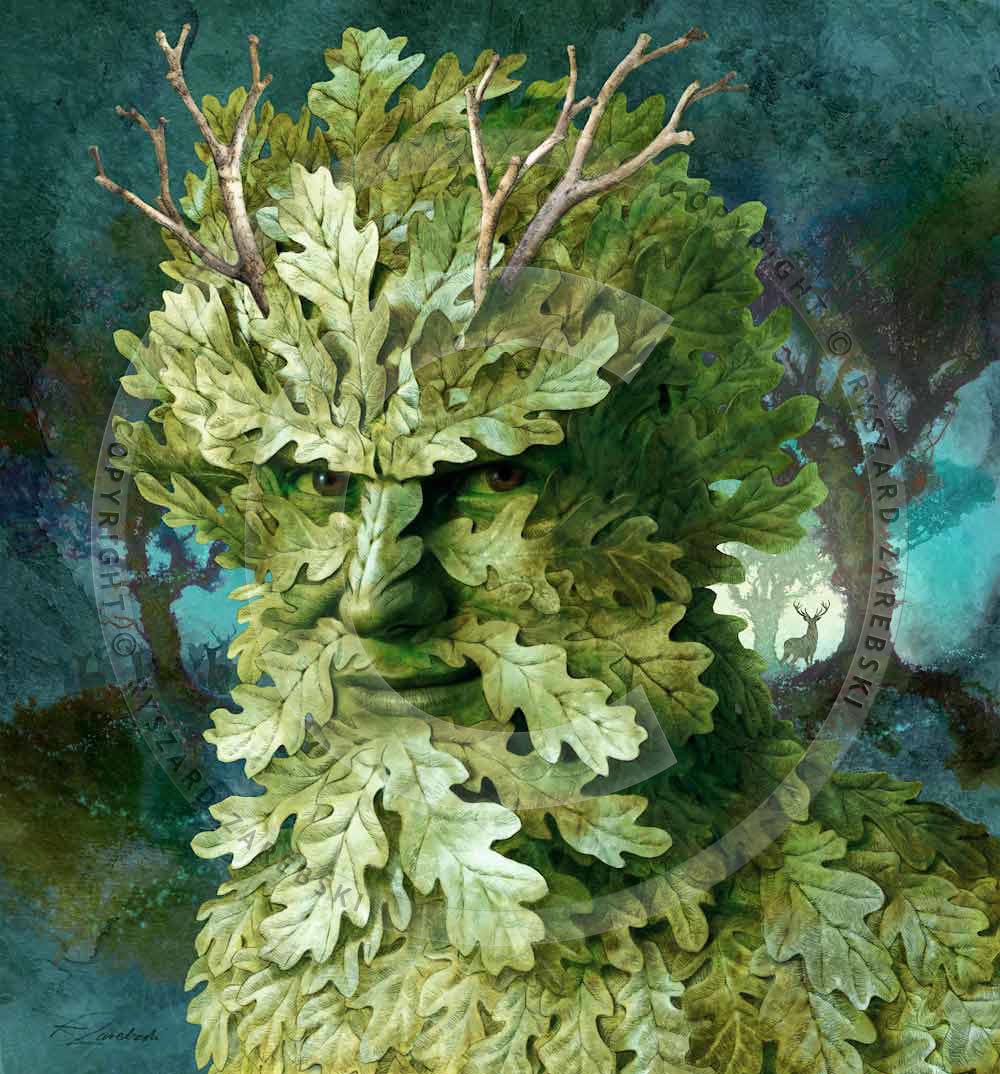
The Green Man (Original)
 
A connection has been made between Robin Goodfellow and the Green Man, a Pagan nature deity. In The Paganism Reader by Chas Clifton, the connection between links both Robin Goodfellow and the Green Man to Robin Hood. 'It should come as no surprise to find that the same Robin Goodfellow is none other than the Green Man or the spirit of the spring found in many old morris dances. The Green Man whose effigy was carved by masons on a boss in the cloisters of Norwich Cathedral, in the transept of Llantilio Crossenny church in Monmouthshire, among the decorations of Rosslyn Chapel near Edinburgh and in many other sacred edifices. The Green Man whose smiling face appears among the carvings on the front of one of the oldest inns in Sussex, at Alfriston. The same Robin whom the General Assembly of the Church of Scotland petitioned King James VI in 1577 and again in 1578 to ban, in connection with the performing of plays featuring Robin Hood, King of the Man, on the Sabbath day, mainly because of the unseemly ribaldry of the vulgar people on these occasions.' It is interesting that carvings of the Green Man can be found in many churches and cathedrals across the country. In most cases, the Church had a low view of the very idea of the Green Man due to his connection with not only Paganism but blasphemous gods. It is believed that many of these images were carved into the stone walls of churches and cathedrals secretly and without the permission of the Church authorities. The Green Man represents Nature, renewal, and reproduction, and is closely linked to the passing of the seasons as well as the waxing and waning of the sun. 

Robin Hood (Original)
 
The Church's opinion of Puck, Robin Goodfellow and the Green Man, and subsequently the public's opinion, was that they were associated with the Devil. This can be seen in William Langland's The Vision of Piers Plowman, with statements such as: 'Nor neither heat, nor hail nor none hell's pouke,' which refers to puck as a demon, and 'Out of the pouke's poundfold no mainprise may fetch us.' This last statement actually means that no bail will get you out of the demon's prison. Langland makes a pouke, later changed to puck, a great adversary to God and man. This is, undoubtedly, a view that was encouraged by the church. It is interesting to note that, during the witch trials, a favoured name for witches familiars was Robin – from Robin Goodfellow and, therefore, Puck. This could potentially have been an embellishment made by the Church and their authorities. In his translation of Ovid's Metamorphoses, Arthur Golding also gives the impression that he linked a pouke with the Devil: 
 
'The country where Chymeara that same 'pouke'
With goatish body, lion's head and breast, and dragon's tail.'

Some sources also believe that Robin Hood could have originated as Puck. This is much debated and many seem to disagree. Some sources tell us that Robin Hood is actually a corruption of Robin of the wood or Robin in the Wood. There are many things that could link Hood with Goodfellow. Robin Hood: From Darkwood to Hollywood states: 'In European lore we find that elves of the wood were seen with Hoods and that Robin Hood is linked with Robin Goodfellow, otherwise now known as Puck or Hob... As Puck he can be traced across the entire European continent and it is believed to be of Proto-Indo-European origin, revealing the ancient nature of this particular strand of folklore. As Hob he is the Hobgoblin and Hob is also interchangeable with Rob or indeed Hod.... Puck on the other hand as a Nature spirit doesn't care for our perceptions, he can manipulate nature to serve his own ends. In this respect Robin Hood has also been linked with the global phenomenon of the Green Man or Wildman of the Woods.' Some sources, however, argue that the similarities between Robin Hood and Puck are not definitive proof that the two are actually linked. In Imagining Robin Hood we are told,''Moreover Robin Goodfellow was a prankster, and... Robin Hood himself takes on the shape of a prankster in at least one story. One cannot therefore dismiss out of hand the links between Robin Hood, the green outlaw and the Maytime setting with hidden and deep-rooted folk memories. But this is a long was from arguing, as many folklorists have, that Robin Hood is essentially the personification of a pagan deity, the mythic Green Man who encapsulated the power of nature and man's oneness with the earth.' Robin Hood's connection to the Green Man and Robin Goodfellow, and, alternatively, the Green Man's/ Robin Goodfellow's connection with May Day is interesting. May Day was once a moveable feast day which was dependent on the first blossoming of the hawthorn and, according to Mike Harding, the author of A Little Book of the Green Man, 'was the signal for all and sundry to hie them away to the woods for a mass orgy.' The difficult winters and bad diets meant not only high fatalities but low fertility, so it was important to make sure there were plenty of babies by way of women having many sexual partners. Children born of these orgies went under the name of the Robin Hood games and later became known as Robson, Robinson or Hudson. It was only when Cromwell put an end to these festivals that the 'Robin Hood games' came to an end.

In conclusion, Puck is a mischievous, domestic fairy who is also known as Robin Goodfellow and Hobgoblin or Hob, which is a shortened version of Robin. He has the ability to shapeshift into a horse, calf, donkey and, in some cases, an eagle, and loves to play tricks on people and to make mischief, misleading travellers in the night and laughing at them. He has also been known to do house and farm work to earn the reward of cream or milk, much like the English Brownie. Puck can be traced back to the Greek God, Pan and to the Pagan Green Man. Puck has connections with the European 'Hoods', or elves of the woods, often connecting him with Robin Hood, which can, again, be traced back to the Pagan Green Man, along with Robin Goodfellow and Hobgoblin.. He has been called pouke, pooke and poake, which have been terms used for a demon or the Devil. His association with the Devil is due to his connection to, what the Church considered, blasphemous Gods. This, in turn, has given the household Hobgoblin a bad name, with further associations with the Devil. However, in modern times, Puck is seen as a good natured and somewhat troublesome fairy, more often connected with William Shakespeare's play, A Midsummer Night's Dream and, as a popular and much loved character in children's literature, with Rudyard Kipling's Puck of Pook's Hill. 

Next time:  We will look at the witch's familiar, which also has a little something to do with fairies.