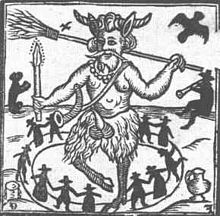
Puck

Puck is possibly one of the most famous and popular figures in English fairy tradition. He is also known as Robin Goodfellow and some sources believe that his roots could go back as far as the Greek God Pan and to the Pagan deity, the Green Man. The name, Puck, derives from the Middle English 'pook' or 'pouke', another word for an elf or sprite. He is similar to the German spuk, a hobgoblin, and the Dutch spook, 'a ghost', although the last is denied by some linguists. There also seem to be similarities with the Welsh 'pwca', and the Icelandic 'púki', both being imps, and with the shapechanging Irish 'phooka'.

Puck (Original)
Puck is possibly one of the most famous and popular figures in English fairy tradition. He is also known as Robin Goodfellow and some sources believe that his roots could go back as far as the Greek God Pan and to the Pagan deity, the Green Man. The name, Puck, derives from the Middle English 'pook' or 'pouke', another word for an elf or sprite. He is similar to the German spuk, a hobgoblin, and the Dutch spook, 'a ghost', although the last is denied by some linguists. There also seem to be similarities with the Welsh 'pwca', and the Icelandic 'púki', both being imps, and with the shapechanging Irish 'phooka'.
In
early England, the name Puck seems to have been used in association
with the Devil, probably through the encouragement of the Church.
Examples of this particular use can be found in Langland's Piers
Plowman. In Ben Jonson's play,
The Sod Shepherd, the
term 'Puck-hairy' is used, which may originally come from the German
picklehäring, a
jester.
To
be 'pooke-ledden' in Worcestershire once meant the same thing as to
be 'pixy-led' in Devon. Another phrase likened to being pixy-led is
Robin Goodfellow has been with you tonight;
a phrase that can be found as early as 1531. In Robert Burton's
Anatomy of Melancholie,
we are told 'Necromancers take upon them to raise and lay them at
their pleasures: and so likewise those which Mizaldus calls
Ambulones, that walk about at midnight on great heaths and desert
places, which (saith Lavater) 'draw men out of the way, and lead them
all night a bye-way, or quite bar them of their way,' these have
several names in several places; we commonly call them Pucks.' This
statement identifies Puck with the 'Jack-o'-lanthorn',
'Will-o'-the-wisp', and 'Friar Rush'; different names for a
misleading spirit which, with his shifting light, manipulated
travellers into bogs and bad situations, much like the hero of Robin
Goodfellow. Here we find
Robin, misleading travellers with the sound of his voice and causing
general mischief, linking him with Puck. According to this play,
Robin apparently shape-changes into a horse and tempts travellers
into riding him, when he would bear them into pools and ponds. This
links him not just to Puck but to the Hampshire spirit once known as
the 'colt-pixy'. The colt-pixy was believed to tempt other horses
into bogs and quagmires. In Chester we find the 'picktree-brag' in
the likeness of the Galloway Pony, which was believed to drop
strangers and travellers into stagnant ponds before retreating with
an outburst of laughter. Sometimes the picktree-brag would take the
likeness of a calf sporting a white handkerchief around its neck and
a bushy tail, or, at times, it would appear as an ass. The Irish
phooka was also believed to take the form of a horse. As the 'lob',
'lob-lie-by-the-fire', or 'lubberfiend', Puck is equated with the
Irish leprechaun or lubberkin. This association probably stems from
the French lubin, with Puck assuming the role of heath-dwelling
domestic spirit. In this role, according to John Milton in
L'Allegro:
Tells how the
drudging Gobin swet
To ern his Cream-bowle duly set,
When in one night, ere glimps of morn,
His shadowy Flale hath thresh'd the Corn
That ten day-labourers could not end,
Then lies him down the Lubbar Fend.
And stretch'd out all the Chimney's length,
Basks at the fire his hairy strength
To ern his Cream-bowle duly set,
When in one night, ere glimps of morn,
His shadowy Flale hath thresh'd the Corn
That ten day-labourers could not end,
Then lies him down the Lubbar Fend.
And stretch'd out all the Chimney's length,
Basks at the fire his hairy strength
Milton's
Puck is not small, as he might be perceived today, but nearer to a
Green Man. Joseph Ritson tells of another unnamed source that is of
some relation to Milton, giving us another description of Puck,
although somewhat similar to Milton's: '...she, particularly, told of
his thrashing the corn, churning
the butter, drinking the milk, &c. and, when all was done, 'lying
before the fire like some rough hurgin bear.''
Both
Milton and Ritson give the impression that Puck is also a domestic
spirit. Puck would thresh the corn to earn a bowl of cream before
relaxing by the fire, much like the household Brownie, Hob or
Hobgoblin. The Hobgoblin or Hob was despised by the 17th
Puritans. A Hob is really just a shortened version of the name
Robert or Robin, which was once a term used for the Devil. However,
Puck the Hobgoblin later became a much loved character of children's
literature with Rudyard Kipling's Puck of Pook's Hill (1906)
and Rewards and Fairies (1910).
Kipling's Puck is extremely critical of the common modern image of the fairy: 'Can you wonder that the People of the Hills don't care to be confused with that pointy-winged, wand-waving, sugar-and-shake-your-head set of imposters? Butterfly wings, indeed!' Kipling's Puck is the oldest thing in England and not only is he critical of modern fairies, he is immune to many of the things once believed to deter them. ''By Oak, Ash and Thorn!' Cried Puck, taking off his blue cap. 'I like you too. Sprinkle plenty of salt on the biscuit, Dan, and I'll eat it with you. That'll show you the sort of person I am. Some of us,' - he went on, with his mouth full – 'couldn't abide Salt, of Horse-shoes over the door, or Mountain-ash berries, or Running water, or Cold Iron, or the sound of Church bells. But I am Puck!'

Kipling's Puck is extremely critical of the common modern image of the fairy: 'Can you wonder that the People of the Hills don't care to be confused with that pointy-winged, wand-waving, sugar-and-shake-your-head set of imposters? Butterfly wings, indeed!' Kipling's Puck is the oldest thing in England and not only is he critical of modern fairies, he is immune to many of the things once believed to deter them. ''By Oak, Ash and Thorn!' Cried Puck, taking off his blue cap. 'I like you too. Sprinkle plenty of salt on the biscuit, Dan, and I'll eat it with you. That'll show you the sort of person I am. Some of us,' - he went on, with his mouth full – 'couldn't abide Salt, of Horse-shoes over the door, or Mountain-ash berries, or Running water, or Cold Iron, or the sound of Church bells. But I am Puck!'

A Midsummer Night's Dream (Original)
A
Midsummer Night's Dream, by William Shakespeare, gives us a
summary of Puck which was probably drawn from folklore sources.
Fairy:
Either I mistake your shape and making quite,
Or
else you are that shrewd and knavish sprite
Called
Robin Goodfellow. Are you not he
That
frights the maidens of the villagery
Skim
milk and sometime labour in the quern,
And
bootless make the breathless housewife churn,
And
sometimes make the drink to bear no harm,
Mislead
night-wanderers, laughing at their harm?
Those
that Hobgoblins, call you and sweet puck,
You
do their work, and they shall have good luck,
Are
you not he?
Puck:
Thou speakest aright;
I am that merry
wanderer of the night.
I jest to Oberon
and make him smile.
When I a fat and
bean fed horse beguile,
Neighing in the
likeness of a filly foal,
And sometimes
lurk I in a gossip bowl
In very likeness
of a roasted crab,
And when she
drinks against her lips I bob
And on her
withered lips dewlap pour the ale,
The wisest aunt,
telling the saddest tale,
Sometimes for
three foot stool mistaketh me;
Then slip I from
her bum, down topple she.
And tailor cries,
and falls into a cough;
And then the
whole quire hold their hips and laugh,
And waxen in
their mirth, and sneeze and swear
A merrier hour
was never wasted there.
This verse gives us
a good overview of who Puck is as a character. Shakespeare tells us
that Puck is a crafty and deceitful spirit who is often called Robin
Goodfellow. He also tells us that Puck scares the village maids,
steals cream and frustrates housewives by stopping their milk from
turning into butter. He stops beer from foaming and misleads
travellers in the night. Shakespeare also tells us that Puck is
sometimes called Hobgoblin and that he will help some, giving them
good luck. In the same passage, Puck himself tells us that he tricks
horses into thinking he is a female horse and that, disguised as an
apple, he hides in the bottom of an old woman's drink before bobbing
against their lips, scaring them into spilling their drink all over
themselves. He also disguises himself as a three-legged stool and
waits for someone to sit on him before dropping them on the ground to
make people laugh.
There
is some difference in opinion as to whether Puck and Robin Goodfellow
are one and the same. However, from the comparisons made above, in
my opinion, it is easy to see that they are, at the very least, very
similar and, more likely, identical. The Hobgoblin can also be
grouped in with Puck. The
Mad Merry Pranks of Robin Goodfellow,
possibly written by Shakespeare's friend Ben Jonson, agrees with this
conclusion, telling us in the introduction: Robin
Goodfellow, alias Pucke, alias Hobgoblin, in the creed of ancient
superstition," says Bishop Percy, "was a kind of merry sprite...
Shakespeare's statement in A
Midsummer Night's Dream seems
to verify the matter, showing that it's appropriate to suggest that
Puck can also be called Robin Goodfellow and Hobgoblin.


The Greek God Pan (Original)
When
we look further back, Puck or Robin Goodfellow have been linked to
the Greek God, Pan. In Midsummer:
Magical Celebrations of the Summer Solstice
we are told, 'Robin Goodfellow is sometimes described as having the
head of a youth and the body of a goat. Like the god Pan, he has a
lusty nature, small horns on his head, and carries musical pipes. It
may be that he is the fairy remnant of the ancient horned god or
nature spirits, since there originally seem to have been a race of
pucks.'

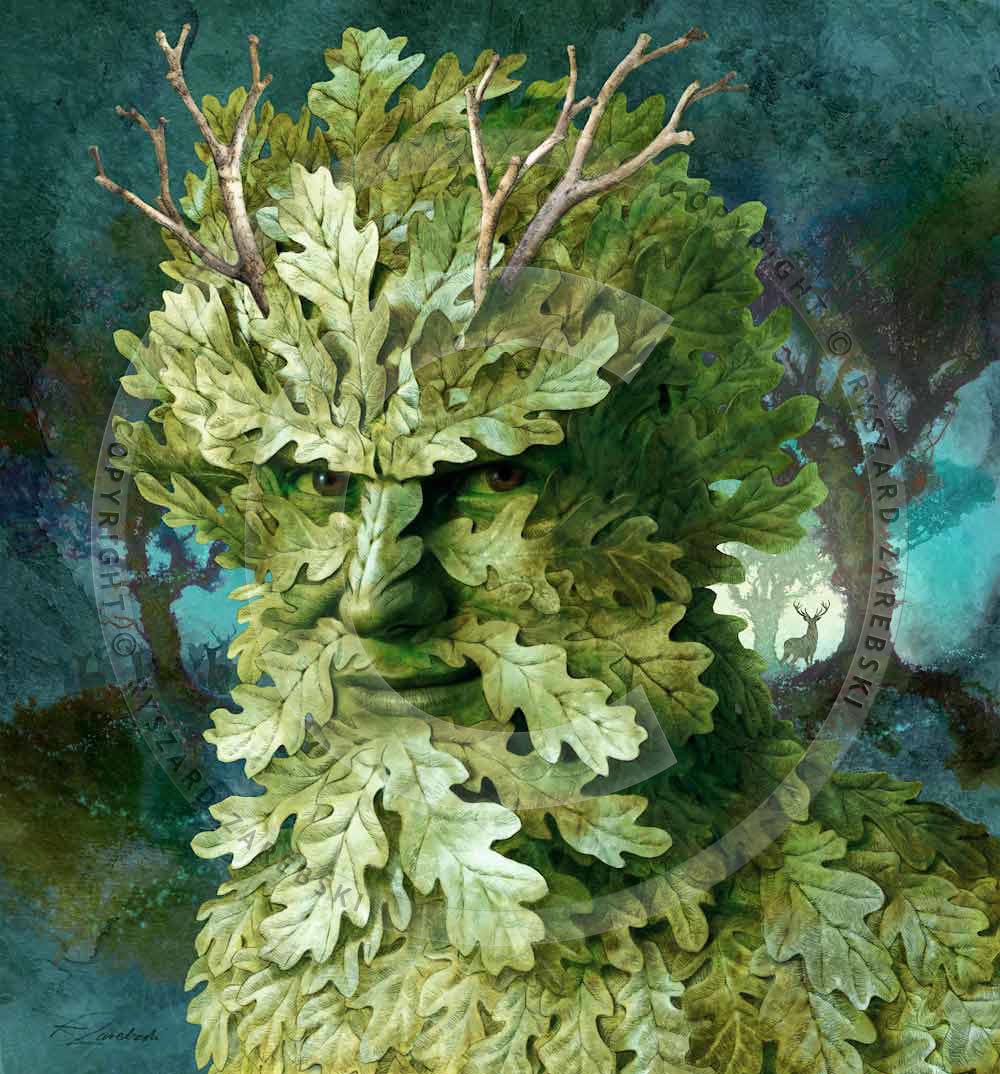
The Green Man (Original)
A
connection has been made between Robin Goodfellow and the Green Man,
a Pagan nature deity. In The
Paganism Reader by Chas
Clifton, the connection between links both Robin Goodfellow and the
Green Man to Robin Hood. 'It should come as no surprise to find that
the same Robin Goodfellow is none other than the Green Man or the
spirit of the spring found in many old morris dances. The Green Man
whose effigy was carved by masons on a boss in the cloisters of
Norwich Cathedral, in the
transept of Llantilio Crossenny church in Monmouthshire, among the
decorations of Rosslyn Chapel near Edinburgh and in many other sacred
edifices. The Green Man whose smiling face appears among the
carvings on the front of one of the oldest inns in Sussex, at
Alfriston. The same Robin whom the General Assembly of the Church of
Scotland petitioned King James VI in 1577 and again in 1578 to ban,
in connection with the performing of plays featuring Robin Hood, King
of the Man, on the Sabbath day, mainly because of the unseemly ribaldry of the
vulgar people on these occasions.' It is interesting that carvings
of the Green Man can be found in many
churches and cathedrals across the country. In most cases, the
Church had a low view of the very idea of the Green Man due to his
connection with not only Paganism but blasphemous gods. It is
believed that many of these images were carved into the stone walls
of churches and
cathedrals secretly and without the permission of the Church
authorities. The Green Man represents Nature, renewal, and
reproduction, and is closely linked to the passing of the seasons as
well as the waxing and waning of the sun.


Robin Hood (Original)
The
Church's opinion of Puck, Robin Goodfellow and the Green Man, and
subsequently the public's opinion, was that they were associated with
the Devil. This can be seen in William Langland's The
Vision of Piers Plowman,
with statements such as: 'Nor neither heat, nor hail nor none hell's
pouke,' which refers to puck as a demon, and 'Out of the pouke's
poundfold no mainprise may fetch us.' This last statement actually
means that no bail will get you out of the demon's prison. Langland
makes a pouke, later changed to puck, a great adversary to God and
man. This is, undoubtedly, a view that was encouraged by the church.
It is interesting to note that, during the witch trials, a favoured
name for witches familiars was Robin – from Robin Goodfellow and,
therefore, Puck. This could potentially have been an embellishment
made by the Church and their authorities. In his translation of
Ovid's Metamorphoses,
Arthur Golding also gives the impression that he linked a pouke with
the Devil:
'The country where
Chymeara that same 'pouke'
With goatish body,
lion's head and breast, and dragon's tail.'
Some
sources also believe that Robin Hood could have originated as Puck.
This is much debated and many seem to disagree. Some sources tell us
that Robin Hood is actually a corruption of Robin of the wood or
Robin in the Wood. There are many things that could link Hood with
Goodfellow. Robin
Hood: From Darkwood to Hollywood states:
'In European lore we find that elves of the wood were seen with Hoods
and that Robin Hood is linked with Robin Goodfellow, otherwise now
known as Puck or Hob... As Puck he can be traced across the entire
European continent and it is believed to be of Proto-Indo-European
origin, revealing the ancient nature of this particular strand of
folklore. As Hob he is the Hobgoblin and Hob is also interchangeable
with Rob or indeed Hod.... Puck on the other hand as a Nature spirit
doesn't care for our perceptions, he can manipulate nature to serve
his own ends. In this respect Robin Hood has also been linked with
the global phenomenon of the Green Man or Wildman of the Woods.'
Some sources, however, argue that the similarities between Robin Hood
and Puck are not definitive proof that the two are actually linked.
In Imagining
Robin Hood we
are told,''Moreover
Robin Goodfellow was a prankster, and... Robin Hood himself takes on
the shape of a prankster in at least one story. One cannot therefore
dismiss out of hand the links between Robin Hood, the green outlaw
and the Maytime setting with hidden and deep-rooted folk memories.
But this is a long was from arguing, as many folklorists have, that
Robin Hood is essentially the personification of a pagan deity, the
mythic Green Man who encapsulated the power of nature and man's
oneness with the earth.' Robin Hood's connection to the Green Man
and Robin Goodfellow, and, alternatively, the Green Man's/ Robin
Goodfellow's connection with May Day is interesting. May Day was
once a moveable feast day which was dependent on the first blossoming
of the hawthorn and, according to Mike Harding, the author of A
Little Book of the Green Man,
'was the signal for all and sundry to hie them away to the woods for
a mass orgy.' The difficult winters and bad diets meant not only
high fatalities but low fertility, so it was important to make sure
there were plenty of babies by way of women having many sexual
partners. Children born of these orgies went under the name of the
Robin Hood games and later became known as Robson, Robinson or
Hudson. It was only when Cromwell put an end to these festivals that
the 'Robin Hood games' came to an end.
In
conclusion, Puck is a mischievous, domestic fairy who is also known
as Robin Goodfellow and Hobgoblin or Hob, which is a shortened
version of Robin. He has the ability to shapeshift into a horse,
calf, donkey and, in some cases, an eagle, and loves to play tricks
on people and to make mischief, misleading travellers in the night
and laughing at them. He has also been known to do house and farm
work to earn the reward of cream or milk, much like the English
Brownie. Puck can be traced back to the Greek God, Pan and to the
Pagan Green Man. Puck has connections with the European 'Hoods', or
elves of the woods, often connecting him with Robin Hood, which can,
again, be traced back to the Pagan Green Man, along with Robin
Goodfellow and Hobgoblin.. He has been called pouke, pooke and
poake, which have been terms used for a demon or the Devil. His
association with the Devil is due to his connection to, what the
Church considered, blasphemous Gods. This, in turn, has given the
household Hobgoblin a bad name, with further associations with the
Devil. However, in modern times, Puck is seen as a good natured and
somewhat troublesome fairy, more often connected with William
Shakespeare's play, A
Midsummer Night's Dream
and, as a popular and much loved character in children's literature,
with Rudyard Kipling's Puck
of Pook's Hill.
Next time: We will look at the witch's familiar, which also has a little something to do with fairies.
Next time: We will look at the witch's familiar, which also has a little something to do with fairies.