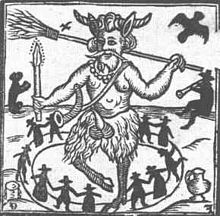
The Origins of Witchcraft
Everyone
has heard about the witch-hunts and persecution of witches which
occurred mostly between the 14th
and 17th
centuries, a period known as the
The Early Modern period, but where does our modern perception of
witchcraft come from? In fact, where did our 14th
century predecessors get their
concept of witchcraft? In other words, where did witchcraft originate
and how has it evolved?
The
word 'witch' originates from the Anglo-Saxon word 'wicca', which was
derived from the word 'wicce' meaning wise. The word 'witch' also
means to 'twist' or 'bend', and relates to psychogenesis or
telekinesis. The word 'witch' dates back thousands of years, to when
people worshipped Mother Earth or Nature as goddesses. Women were
revered as creatures of new life. Witchcraft means 'the craft of the
wise' and is the oldest religion in the world, remaining in existence
through the oral transfer of knowledge from one generation to the
next. It was primarily practiced by women as they stayed at home
while the men worked. Witchcraft incompassed not ony magic - home
medicines and remedies including potions, herbs, stones, oils, and
massages were important factors.

Earth Mother by Shere Crossman (Original)
Essentially,
witchcraft was created along with human civilization due to fear of
the unknown, and because of the role magic was believed to play in
making day-to-day life easier. Witches were the mediators between
humans and mysterious super powers, such as spirits and angels. When
a witch succeeded in solving someone's apparently mysterious problem,
it was labelled magic: a process which couldn't be easily explained
using logical analysis. Witchcraft was practiced in almost every
society and culture across the world, although beliefs and traditions
differed from place to place. According to scholars, it predates the
majority of well-known religions and goes back to the Paleolithic
period.
Archaeological
discoveries have shown us how people worshipped the hunter god and
fertility goddess during this period. The presence of cave
paintings, estimated to be 30,000 years old, which protray a man with
the head of a stag, along with another showing a pregnant woman
standing in a circle made up of eleven other people, proves that
witchcraft is one of the oldest religions in the world. These relics
are evidence that witchcraft predates Christianity by thousands of
years.


Dancing Witch Doctor Cave Painting Copy by Abbe' Breuil (Original)
While
it was more often practiced by women, men were also witches, although
this was less common. Witches were considered highly valuable,
providing vital services for the health of the family. They healed
the sick and suffering and were respected for how wise they were.
Witches had a range of different uses, being capable of inducing
hypnosis, making childbirth and other health problems pain free; they
could use telepathy, clairvoyance, intuition, dowsing, crystals, and
trance as means of communicating with the dead. At this point,
religion and magic were inseparable. However, as people flocked to
witches with the health problems, the Christian Church began to feel
threatened.
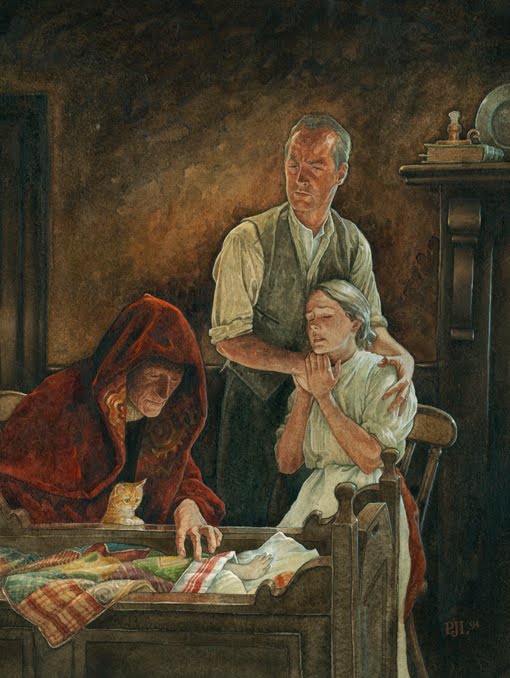
The Wise Woman from Catkin (Original)
While witches and their
craft were once respected, it has evolved massively since its
creation. As we come to the growth of Christianity, witchcraft
changed to suit this new religion, which portrayed the practice of
magic as evil and those practicing it as heathens and heretics. Many
of the ideas incorporated into the practise of witchcraft were taken
from popular folklore, with the development of these beliefs being
the responsibility of the Christian intellects of the time, before
being filtered back to the common people through indirect means.
When looking at the old beliefs in witchcraft, one
of the common elements is involvement with the Devil and demons.
During the Middle Ages, the Devil was usually known as Satan, meaning
'the adversary'. Satan did not play a particularly big
role in the Old Testament, but he was far more apparent in the New
Testament, where he tempted those with a belief in God, trying to get
them to turn their backs on their religion. In the New Testament, the
war between the Kingdom of God and the Kingdom of Satan began, each
trying to gain control of the souls of mortal men.
You may wonder what this has to do with the
evolution of witchcraft and that Christianity has little to do with
witchcraft. However, the growth of Christianity had a great
deal to do with the later views on witchcraft. As Christianity
spread, it encontered other beliefs and other religions, all of which
those following Christianity would try to convert to the 'one true
faith.' Those seen to be denying the word of God and to be leading
souls away from God were seen to be a part of the Kingdom of Satan.
Before long, Christianity began to demonize the
gods belonging to other religions, especially those which had
converted to Christianity. Pagan deities were some of the most often
used to describe the Devil, along with Roman and Celtic deities.
People were taught to fear and hate these deities, with fertility
gods most often being recognised as demonic. The Greek deity Pan and
the Celtic Cernunnos gave the Christian Devil his goat-like
appearance, with the Roman Diana adding the sometimes described
woman''s breasts to his description. In the confessions of accused
witches, these details were often described, although they were
probably prompted by the inquisitor.

The Persecution of Witches (Original)
In the 12th and 13th
centuries, demons were creatures of spirit – much like angels,
these were the fallen angels. If a demon were to be visible, its body
was said to be made from the vapours of the earth, with this control
of the air later becoming an imporant theory for the flight of
witches.
The Christian religion maintained that only God
could cause a miracle. Any claim that the Devil could control
creation or free will was considered heretical, and any 'miraculous
transformations' were considered to be an illusion, with illusion
being one of the Devil's supposed powers over the material world.
Where the Devil was considered to have power over the material world,
God was believed to provide humans with free will. So, if you were
seen as being possessed by demons, it was believed that it was
through your own choice. According to Malleus Maleficarum,
the Devil could influence a person's choices through bibery and
tricks. This meant that accused witches maintained their moral
responsibility, especially is a pact with the Devil had been made.
This brings us to another important element in
accepted witch traditions. A pact with the Devil meant that not only
did you practise harmful magic, you were also considered to be a
Devil worshipper. This idea was developed over many centuries, with
the earliest documentation of such pacts being by St. Augustine,
although the belief didn't become widespread until the descriptions
were translated into Latin during the 9th century. It was,
by this point in time, believed that all magic practisioners received
their powers from pacts with the Devil, although not all Devil
worshippers were granted magical powers. A pact with the Devil was
seen as some kind of legal contract with the Devil promising a reward
in exchange for the witch's immortal soul. This reward may be a
promise of wealth, power, sexual indulgence, or happiness in the
afterlife. In some instances the witch would be bestowed with magical
powers.

A portrayal of Devil worship and cannibalism committed by witches (Original)
The practice of magic increased in the 12th
and 13th centuries with the transaltions of Greek and
Islamic texts. One popular magical practice was necromancy, or
communication with the dead, where demons would be apparently
summoned so they could be trapped, meaning the witch could learn from
their hidden knowledge. As the practice of magic became more common,
so did condemnation of these practices, with demonologists stating
that while necromancers may not mean to worship the Devil, their
communications with demons must come with a price. They concluded
that the witch must need to offer some form of bait for the demon, or
do some service for the Devil in exchange for the demons knowledge.
This meant that even if the practisioner didn't intend to worship the
Devil, anything considered the practice of magic was condemned as
evil.
This was not the first condemnation of magic, but
a pact with the Devil was an imporant addition to witchcraft
traditions, making the label of witch applicable to peasants who
practiced magic with little or no understanding of the implications
of their actions – a pact with the Devil, whether it was was
intentional or not. This connection between magic and heresy was then
used to condemn other so called heretics, including those found to be
involved in secret, group worship and abnormal, inhumane behaviour.
Witchcraft became a sort of religious mockery of Christianity, which
was best expressed during the witches' sabbath, the next element in
the concept of witchcraft.
At this point there was a shift of focus from the
upper-class, educated, male magician to the poor, unknowledgable,
female witch. There was a corresponding change in the attributes of
the pact, from equal partnership where the magicial could fight for
the advantage, to a role of subservience, where the witch submitted
voluntarily. This was pointed out by King James VI of Scotland, when
he said, ''Witches are servants only, and slaves to the Devil; but
the Necromancers are his masters and commanders.''
A gathering of witches was known as the sabbath
and was a place for those Devil worshippers to debase themselves,
taking part in sexual activities with demons, cannibalism and the
murder of innocent infants. In some parts of Europe, including
France, Spain and Italy, witches were believed to take part in
parodies of the Catholic Mass. When all of these activities were
connected they provided fulfilled Christians worst fears. This
society of so-called witch lore may have been invented by monks
during the 12th and 13th centuries as
propaganda in the war against other beliefs, such as those held by
the Waldensians and Cathars, before being applied to other heretics.
These intense accusations became a huge burden for accused witches as
knowledge of heretical practices grew.
Belief in the sabbath was not universal, although
it was widespread and an important addition to those who hunted
witches. The assumption that witches gathered to worship the Devil
led to many endless hunts for those connected to the accused witches,
and was probably a contributing factor in the scale of the exhaustive
searches.

Coven in Flight (Original)
Another belief that was often included in witch
lore was the claim that witches were capable of flight. One way of
doing this was through the Devil's material control over the air,
which could propel a witch for great distances through the air.
Another theory was that the Devil used his power of illusion, making
the witch believe that they had flown. This second idea was also used
in claims that the sabbath itself was an illusion. Regardless, flight
was used to explain how witches were able to attend sabbaths which
were believed to be held in remote areas. Origins of this concept may
go back to pagan beliefs which were still followed by many peasants.
One of these beliefs held that women could transform into strigae,
or abhorrent screeching owls. Another belief was of the Dianic 'wild
hunt, when a witch was said to ride through the countryside on the
backs of various beasts.
Metamorphosis was
another element in Early Modern witch lore. It was said that a witch
was capable of transforming themselves or others into animals, with a
particular favourite being the wolf. While this too was supposedly
another of the Devil's illusion, it was a common assumption. To us,
these beliefs may seem far-fetched but, at the time, they seemed like
rational explanations. These beliefs were often challenged, although
no one dared to deny the central theme of the Devil, which held the
entire movement in one piece.
So, when looking at the origins of witchcraft, one
has to understand that it had been present in society since the dawn
of time, with witches being considered wise and important. However,
with the growth of Christianity, fear of witches and the practice of
magic was instilled into the public, pushing them to convert from
their life-long religion to the 'one true faith', Christianity. What
followed was the accusation and murder of many innocents who had
often committed no crime or wrong doing.
Fortunately, with modern witchcraft, respect for
this practice has once again grown and is now followed by many people
in the modern age, without the fear of persecution. It attracts
people from all walks of life, bringing them together in an
understanding of the life, nature, evolution and mysteries of the
universe through witchcraft. Unlike other religions, witchcraft
allows a huge amount of freedom, with the only real rules being that
you should harm none unless you wish it to be returned to you three
times three, nor should nature be misused the generosity of nature by
distrupting its balance.
Next time: We will take a closer look at the persecution of witches during the Salem Witch Trials.