Showing posts with label origin. Show all posts

Friday, 19 December 2014

The Origin of Santa Claus and the Customs of Christmas: Part One

Santa Claus with Little Girl by MeeranUhm
 Everyone loves Santa Claus - the jolly bearded man dressed in red and white who comes down the chimney to deliver presents on Christmas Eve.  He has many names,  Saint Nicholas, Father Christmas and Kris Kringle to name a few.  But where did Santa Claus come from and how did the tradition of Christmas begin?  Lets look back through time and trace the origins of Santa Claus and the customs of Christmas.

Popular opinion states that Santa Claus was inspired by Saint Nicholas - a kind hearted and generous bishop.  So this is where we will start our search for the origin of Santa. 

The Legend of Saint Nicholas

     'Long ago, in a far off land known today as Turkey, there was a boy named Nicholas.  Nicholas was a person who created numerous miracles and accomplished many good deeds.  As a teenager, Nicholas inherited a vast fortune, but he had no idea what to do with it.  Wanting to help those less fortunate than himself, Nicholas set out to make the wishes of others come true.  While Nicholas knew the townspeople needed his held, he was also aware that they were a very proud people, so Nicholas decided to help his friends secretly.
    Each night, Nicholas would disguise himself and deliver such items as food, clothing, and money to the people of his village.  Of all the townspeople, Nicholas felt the closest bond with one specific family.  In this family, there were three daughters.  Sadly, the family was very poor and the father felt much pain over the fact that he couldn't afford the weddings of each daughter.  In his desire to help the family, Nicholas left a bag of gold on the father's doorstep as the wedding of the eldest daughter approached.
Saint Nicholas of Myra by Vicki Shuck
    When it was time for the second daughter to marry, Nicholas again visited the family.  He threw another bag of gold into the family's chimney.  The family greatly appreciated the individual who was providing them with such a fortune, but they had no idea who this person could be.  As the third daughter's wedding neared, the father decided to stand guard so he could identify this generous stranger who had given his family such happiness.  Nicholas arrived and tossed a bag of gold through an open window and, upon hearing the bag of gold land on the floor, the father chased Nicholas until he caught him
    Nicholas didn't want the father to make his identity known and had the man promise to keep it a secret.  However, the father's gratitude was so great that he was unable to keep his promise and soon the whole town knew that Nicholas was responsible for the acts of generosity which had been happening throughout the entire town.
    Every year, in December, Nicholas took it upon himself to reward all the girls and boys who had been good during the year by giving them gifts.  And he is still remembered today for his kindness, generosity and love for the children.  In honour of this great saint, countries across the world give gifts to children on the day of Saint Nicholas, December 6th.

Who was Saint Nicholas?
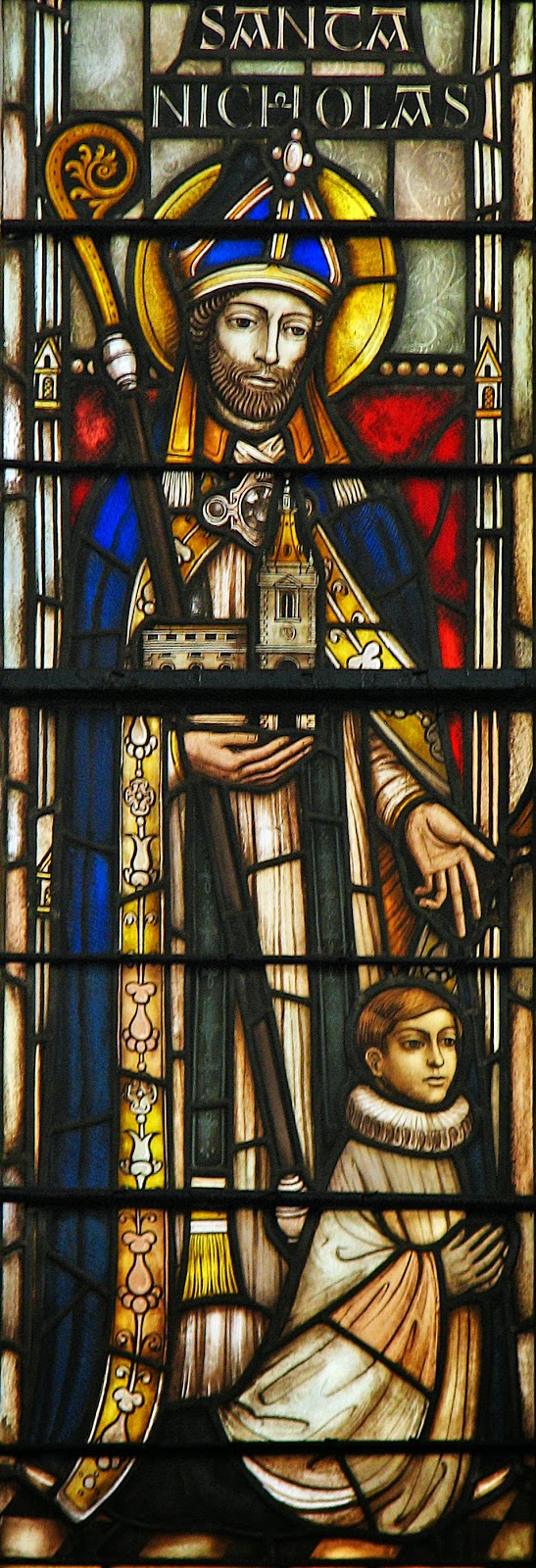
Stained Glass Window of St. Nicholas & a Chorister
While the legend of Saint Nicholas is prevalent throughout the world, there are very few surviving documents of Saint Nicholas.  Much of what we think we know is little more than legend, passed down through the generations and growing with every telling.  But what do we really know about Saint Nicholas?

The first known reference of Saint Nicholas dates back to between 510 and 515, with the writer Theodor, lector of Byzantinum, in the book 'Tripartite History.  This literature is entirely dependant on three 5th century historians: Socrates, Sozomen, and Theodor.  His name appears within Theodor's list of participants of the Council of Nicaea, where it says, 'Nicholas of Myra of Lycia.'

Several churches were built in his name - Emperor Theodosius II (401-550) had a church constructed in Myra which became known as the Church of St. Nicholas, while the Roman Emperor Justinian (527-565) restored a St. Nicholas church just outside of the summer palace of Blachernes.  The most significant documentation of Saint Nicholas appears in the biography of bishop Nicholas of Sion, where we are told, 'And going down to the metropolis of Myra, he went off to the martyrium of the glorious Saint Nicholas.'  This is considered to be 'confirmation that the man who would become Santa once existed.' 

While we know that he existed, Saint Nicholas remains elusive, even to the scholars who dedicate much of their life to studying him.  It is believed that Saint Nicholas served as a bishop in the 4th century in the town of Myra.  The first known 'biography' of this saint dates to the 8th or 9th century, long after his death, when a collection of tales about him was compiled by a Greek monk known as Michael the Archimadrite.

Those that have attempted to piece his life together have little to go on and rely on traditions and the few clues which remain from the times in which he lived.  Most of what we think we know is legend with no historical record. 

Other Legends of the Good Saint Nicholas

Santa Claus
Now that we at least know that Saint Nicholas was a real man, lets take a look at the other legends detailing the generosity of this saint.  The most well-known legend of Nicholas's generosity is the one I have detailed in the legend of Saint Nicholas above: that of the gifts of gold he left for a father who could not afford to give his daughters a dowry.  Some say that the daughter's father was preparing to sell his children into slavery and that Nicholas wished to save them from this fate.  In some accounts one of the bags of gold rolled into a stocking, while another was thrown down the chimney, and this is said to be the origin for Santa Claus coming down the chimney and filling a stocking or shoes with gifts.  The image of Santa Claus carrying a sack of presents is also said to originate with this legend.

Another legend explains how Nicholas became a bishop.  It is said that Nicholas believed that God would want him to live amongst the people, so he travelled to Myra, where the Archbishop had recently died.  Here the bishops were trying to choose a successor.  According to the legend the oldest bishop dreamed that he had been commanded to watch the doors of the cathedral the following morning and the first person to enter with the name Nicholas should be made bishop.  On the following morning Nicholas entered the cathedral and was immediately consecrated as Archbishop of Myra.

Throughout much of Europe Nicholas is known as the patron saint of schoolboys.  According to one legend, the devil came to the gates of a school in the middle of Saint Nicholas's feast day disguised as a beggar and a father, who honoured Saint Nicholas, sent his son to give this beggar money.  However, the boy was strangled by the demon.  Heartbroken, the father took his dead son into the house, crying, 'Saint Nicholas, is this my reward for the honours I have given you?'  Saint Nicholas heard the man and resurrected his son.

Nicholas of Myra
Another tale tells of how Nicholas brought three dismembered students back to life.  An Asian father sent his sons to a school in Athens, telling them to stop in Myra to receive blessings from Nicholas.  However, during a night's stay at an inn in Myra, the innkeeper and his wife killed the boys, cut up their bodies, and his the pieces inside barrels intended for salting meat.  They meant to sell them as pickled pork.  But Nicholas somehow sensed what had happened and accused the couple of murder.  The innkeeper and his wife were overwhelmed by this great saint and immediately felt remorse for what they had done.  Nicholas forgave the couple and the boys rose from the brine, whole and alive.

Other legends of Saint Nicholas are set during a trip by sea to Egypt and Palestine.  During a storm, Nicholas is said to have calmed to ocean.  When a sailor fell from a ship's mast and died, he was brought back to life by Nicholas.  Another tale tells of how an immoral sea captain tried to kidnap Nicholas but failed when a storm pushed the ship towards Myra, where Nicholas simply stepped off the ship and walked across the water back to land.

And the legends of his kindness don't end with his death.  The Crusaders from over seven hundred years after the death of Saint Nicholas credited him with freeing them from prison, restoring their health, and form blessing them with visions when they prayed to him.
St. Nicholas Saving Those in Danger at Sea

So Nicholas became the patron saint of children and, in addition, he is also said to have watched over seafarers, with 'several stories about him... [sounding] remarkably like activities previously attributed to Poseidon or Neptune.'  As seafarers were most often both travellers and merchants, Nicholas 'also became the patron saint of travellers in general, and merchants, and bankers, and even pawnbrokers.'

Throughout his life, Nicholas gained a reputation for his acts of kindness.  He is said to have saved the people of the city from famine and, when he died on December 6th 343, the people believed him to be a worker of miracles.  During the years following his death, Nicholas gained in popularity.  In around 1000 AD the legends of Saint Nicholas were taken to Russia, Lapps and Samoyeds.  He became the patron saint of Russia, amongst other countries and the custom of giving gifts on Nicholas' saint day, December 6th and the day of his death, came into being.

Judgement and Punishment

While Saint Nicholas is most often portrayed as generous and kind, some of the legends tell us that he was also a stern disciplinarian.  In 14th century French monastic schools, a monk dressed as Saint Nicholas would question and reprimand children, rewarding good children with sweets and cane the bad children with traditional birch twigs.  Over the next century this tradition of judgement, reward, and punishment spread to common households. 

Naughty children were often left a birch rod, with the people of Holland giving the following explanation: 'The monks of a certain church wanted the responses of Saint Nicholas sung in church.  The abbot refused, saying, 'I consider this music worldly and profane, and shall never give permission for it to be used in my church.'  The good saint, long dead and living in heaven, heard these words.  Nicholas... was so angered by the abbot's words that he descended from heaven in a rage, dragged the abbot out of bed by the hair, and beat him with a birch rod until he was nearly dead.  The point was well taken: from that day, the responses were included in the service.'

Sinterklaas and Black Pete
The Dutch people called Saint Nicholas Sinterklaas, who would arrive on December 5th, the eve of Saint Nicholas's Day.  The children probably viewed this time with both trepidation and fear.  Their Christmas-season ritual would begin with the preparation for a visit from Saint Nicholas.  The children would be drilled on their church lessons with a hope that they would be able to answer any questions the saint had for them.  The reward would be sweets or gifts, while the punishment for wrong answers was sticks and pieces of coal.  The children in Holland would sing a song to give thanks for his goodness and to welcome him, then sweets were thrown through the doorway to signal his arrival.  Saint Nicholas would enter, followed by his servant, Black Peter, who the Dutch called Zwarte Piet.

The Saint's Companion by Nashoba-Hostina
This was the source of the children's fear, for Black Peter was terrifying to behold.  He was a 'hairy, chained, horned, blackened, devilish monster' and he  had a very simple job.  While the children were drilled on their knowledge of the Bible, Black Pete would glare at the children, holding a gaping sack in his hairy claws and, every now and again, he would flash his enormous, razor-sharp canines at the children.  Then he would leap towards the children, growling and threatening to beat them with his rod.  If a child was particularly naughty, Nicholas would warn them that Black Pete might stuff him in his sack and carry them off to some hell until the following Christmas.  While Saint Nicholas always rescued the naughty children, giving them sticks or ashes as a punishment, this did not make for a lighthearted festival.

So far Saint Nicholas seems to have little connection with Christmas.  Legend states that he was generous but was also judgemental of naughty children, and would punish them, whether it was with a birch stick or a piece of coal.  We also have something of an origin for sitting on Santa's knee while he asks you if you've been good or bad.  However, he is connected with the eve and day of December 6th, not December 25th, with the only connection being the month of December.  And what of the red suit, the beard, the reindeer, the elves, and Santa's sleigh?  And what of Black Peter? 

It is commonly believed that the Dutch brought Saint Nicholas with them to America.  However, Saint Nicholas did not appear in America until after Santa Claus became established and the legend that the Dutch brought this figure with them to America was 'invented by Washington Irving in an 1809 satire, the fictional 'Knickerbocker History', and has no basis in fact.'  Evidently there are aspects of the legends of Saint Nicholas within modern Christmas customs, but we are still missing many of the details. 

Next time we will further explore the origins of Santa and our modern Christmas customs and traditions, including a closer look at Zwarte Piet and some of the other figures who may factor into our modern perception of Santa Claus.

Useful Resources

Saint Nicholas by Joe Wheeler
The True Saint Nicholas: Why He Matters to Christmas by William J. Bennett
Bad Santas: and other creepy Christmas characters by Paul Hawkins
Christmas: A Candid History by Bruce David Forbes
Explorers, Fortunes and Love Letters by New Netherland Institute
Christmas: Its Carols, Customs and Legends by Ruth Heller
Santa Claus, Last of the Wild Men by Phylis Siefker

Friday, 22 February 2013

Pre-Classical, Classical and Biblical Origins of Witchcraft

Enuma Elish

Aspu, the First Begetter, and Tiamat, the First Mother, made a generation of dragons from Chaos.  Some time later, another generation rose, one of which was Ea, the god of wisdom.  Ea soon killed Aspu, and Tiamat, wishing to avenge his death, with the help of one of her sons, Kingu, made another race - scorpion-tailed monsters.  Tiamat, with eleven of these monsters, went to do battle with Ea's son, Marduk.  However, Marduk was armed with seven winds, a storm chariot, and a strong coat of mail.  He wore upon his lips a red paste and, on his wrist, a herb protecting him from poison, and his head was crowned with flames.

When the two met, Marduk captured Tiamat in a net, sending the wind into her belly which tore her open.  Then Marduk shot her full of arrows and beat her about the head until she was dead.  Following this, he bound Tiamat's body and stood on it, before shackling the eleven monsters which he imprisoned beneath the ground.  These monsters became the gods of the underworld.

The battle between Tiamat and Marduk (Original)

Marduk then split Tiamat's corpse in two, using one half to hold back the waters from above, and using the other half as a foundation for the earth and the sea.  He made the sun, moon, constellations and planets, going on to kill Kingu, whose blood he used to create the human race.

The Sumerian-Babylonian hero Gilgamesh  was one of the first of the humans to encounter the underworld gods.  He sought a magical herb which would make him immortal, only to find his way blocked by two fearsome monsters, one male, one female.  These monsters, which were part human, part dragon and bore scorpion-like tails, recognized that Gilgamesh was part divine and allowed him to pass.  Gilgamesh soon found himself in a heavenly garden, where he met a woman who was making wine.  However, he didn't find the herb of immortality.

So, Gilgamesh spoke with Utnapishtim, the Sumerian Noah, who himself had already attained immortality.  At last, he learned that the herb could be found beneath the sea and went to retrieve it.  Now that he had the herb in his possession, Gilgamesh believed that he no longer needed to fear death.  Unfortunately, a serpent stole the herb and Gilgamesh was forced to accept the inevitability of death. 
 Gilgamesh, 8th century (Original)

Enuma Elish is one of the earliest creation myths, dating from around 2000 BC and being Babylonia-Assyrian in origin.  Many of the themes found in this myth - scorpion-tailed dragon monsters, the underworld, a heavenly garden, magical plants, and women bringing mischief into the world - are seen consistently through 4000 years of occult belief.  For example, Aztec mythology echoes Sumerian themes when describing a heavenly garden which is guarded by a serpent, and the Norse beliefs tell of a great snake which coils around the world tree, Ygdrasil.  The role of the serpent in Eden is another well known similarity to these ancient beliefs, as well as the weakness of Eve, who brought suffering to the world.

Less well known is the Jewish teaching where Eve is created from Adam's barbed tail, rather than Adam's rib, showing us how the demonic element of Adam is converted into the female form.  This is probably the first evidence of misogyny, which presents itself in late medieval portrayals of the serpent in Eden, which was given the face of a woman.

Adam and Eve (Original)

While Eve brought suffering, she was considered an improvement on the Jewish Lilith, Adam's first wife.  Lilith was the original loose woman.  First she objected to her supine role in intercourse, asking Adam, ''Why must I lie beneath you?''  Adam tried to force her, so she left him to live beside the Red Sea with the more compatible wanton demons.  Before leaving Adam, Lilith bore Asmodeus and other demons, with some saying that she went on to be the queen of Zmargad and Sheba.  Apparently King Solomon believed that the Queen of Sheba was a night-demon as she had hairy legs.  Lilith can also be found as the Babylonian-Assyrian wind-demoness Lilitu, and in Sumerian writings as Lillake.  She was believed to strangle children and was also a succubus which preyed on sleeping men.

Famous relief from the Old Babylonian period, believed to be Lilitu or Lilith (Original)

In Isaiah 24:11-15 Lilith, who is referred to as ''screech-owl'' in the King James Bible, was believed to suck the blood of children, and was related to striga, a word meaning witch.  She was simply a ''night-demon'' in the Hebrew Bible, and lived in the ruined desert of Edom.  Lilith was believed to keep company with pelicans, hedgehogs, owls, ravens, jackals, ostriches, kites, wildcats, hyenas, vipers, and satyrs, many of which were attributed to ''Devil worshippers'' in later times.  Lilith can also be found in the book of Job 18:13-15, where she is seen as domestic, but she also kept company with what sounds like the Devil.
He [the wicked man] is torn from the shelter of his tent, and dragged before the King of Terrors.
Then Lilith makes her home under his roof, while people scatter brimstone on his holding.

Satan identifying with the serpent of Eden and with Lucifer was not established until the end of the first century AD, with the Book of Revelations telling us:
The great dragon, the primeval serpent, known as the devil or Satan, who had deceived all the world, was hurled down to the earth and his angels were hurled down with him.
From this point on, the scaly-tailed, claw footed, bat or dragon-winged representation of Satan becomes an important point of Christianity and develops as a fundamental  preoccupation of those hunting witches. 

Yahweh made sorcery and divination something which should by punishable by death, with Exodus 22:18 telling us, ''You shall not allow a sorceress to live.''  The Greek Septuagint translates ''sorceress'' to ''pharmakos,'' meaning ''poisoner.''  Leviticus 20:27 tells us, ''Any man or woman who is a necromancer or magician must be put to death by stoning; their blood shall be on their own heads.''  And Deuteronomy 18:10-11 tells us, ''There must never be anyone among you... who practices divination, who is a soothsayer, augur or sorcerer, who uses charms, consults ghosts or spirits, or calls up the dead.''

However, the Egyptian Exodus could not have been achieved if not for numerous acts of authorised magic.  The most famous of these acts involved a contest with Egyptian magicians, and can be found in Exodus 7:9-13:
Yahweh said to Moses and Aaron, ''If Pharaoh says to you, 'Produce some marvel,' you must say to Aaron, 'Take your staff and throw it down in front of Pharaoh, and let it turn into a serpent.'
To Pharaoh then Moses and Aaron duly went, and they did as Yahweh commanded.  Aaron threw down his staff in front of Pharaoh, and it turned into a serpent.
Then Pharaoh in his turn called for the sages and the sorcerers, and with their witchcraft the magicians of Egypt did the same.
Each threw his staff down and these turned into serpents.  But Aaron's staff swallowed up the staffs of the magicians.
Yet Pharaoh's heart was stubborn and, as Yahweh had foretold, he would not listen to Moses and Aaron.
Moses and Aaron follow further instructions given by Yahweh, using the staffs to impose plague upon Egypt.  Pharaoh's magicians match this, turning the rivers into blood and creating a plague of frogs.  But they find themselves outdone when Moses and Aaron bring plagues of mosquitoes and gadflies, the death of livestock, an affliction of boils, locusts, darkness and the death of Egypt first-born children.  Moses later uses his staff to make water flow from a desert rock and during the Israelites battle with the Amalekites they would prevail as long as Moses held his staff aloft.

In critical situations it was extremely important that freelance diviners and magicians not be allowed to obstruct legitimate policies.  When King Saul were pushed by the Philistines, he enforced the ban on necromancy and expelled the sorcerers.  He then asked Yahweh for advice but, when Yahweh didn't answer, he was forced to find himself a witch, who raised the ghost of Samuel.  Samuell then correctly predicted Saul's approaching death. 

Apart from necromancy and wand-power, other magical practices were well known in the ancient middle east, including the interpretation of dreams, the casting of lots (urim and thummin), and forms of sympathetic magic involving magical models, the ''poppets'' that are traditionally part of the witch's armoury.

One of the most influential and successful magicians found in the ancient world was the pharaoh Nekhtanebt II, who was said to have protected his kingdom with witchcraft from 359 to 342 BC.  He did this in the following way.  News of an attack comes : an invading fleet is standing off the Nile delta.  The King is unconcerned, soon going to his secret room where he practices magic.  He pours water into a huge bowl.  On its surface floats small wax ships of his own and the enemy fleet.  He says the magical words to summon demons of the wind and other elements.  The waxen fleets begin to move, meeting one another on the surface of the wave roughened water.  Soon the enemy's wax fleet begin to founder and, as they do, their counterparts also founder and sink in the Mediterranean, and Egypt is once again saved.
However, a day comes when a Persian army gather against Egypt.  The pharaoh again goes to his secret room and tries the magical words, but finds that his power is insufficient.  He foresees his army's defeat, sees Egypt taken by Artaxerxes Ochus, the butcher.  Nekhtanebt has no further choices, so he puts on a disguise, packs up his gold and books of magic and runs away.  In time he crosses the Mediterranean, settling in Macedonia.  Here his reputation as a seer and a doctor spreads.  He has brought the Egyptian art of magic and divination to Greece.

God Horus Protecting King Nekhtanebt II (Original)

This story includes three elements which are seen throughout the subject's history- political crisis, the use of supernatural powers, and an exploitation of a mystical connection between things which are similar yet different - in this case , the wax models and the real ships they represent.

The basic political element of ancient witchcraft was divination, with state oracles being well established throughout the classical world.  Among the Mesopotamians, haruspication, or the study of the internal organs of sacrificed animals, seems to have been the most common method of prophecy.  However, abnormal births of both a human and animal nature, were also closely examined by entrail specialists known as baruas.  Dreams were also studied for their predictive power.  And so the earliest method of divination required either ritual sacrifice or the invocation of supernatural beings.

In China, amongst other places, similar techniques were used to predict future events.  They would do this by reading the lines on tortoise shells, the flight of birds, the cracks appearing in burned bones or the way in which a handful of sticks and stones fell.  We can see this technique used today when we have our tea-leaves or playing cards read.  In all methods of divination, either a connection with the cosmological or with some superior being is assumed.

All major oracles of Ancient Greece had enduring political or social weight behind them.  The Oracle of Apollo at Delphi is probably the most famous today, but there were others which were equally notable.  What is now Libya was once known as the temple of Ammon, in the territory known as Nubia.  This was one of the most famed.  The oak grove at Dodona was sacred to Zeus and was just as acclaimed.  Every oracle had their own priests and, while these were open to the public for a fee, they were also subsidised to some degree by the state.  Their methods of divination varied.  At Dodona, the most popular form was kleromancy, in which a question would be asked and a stripe of lead would be chosen, on which a yes or no answer would be written.  An Ammon, the movements of the god's statues would be interpreted by a priest for an answer.

At Delphi, where the god of light, Apollo, is said to have defeated a great serpent, oracular statements were given by the Pythia, a priestess.  In some accounts, the Pythia sat on a tripod above a crack in the ground, where she would inhale the volcanic fumes and the smoke from a burning mixture of barley, marijuana and chopped bay leaves.  She would speak in verse and her words would be interpreted by a priest.  During the fourth and fifth centuries BC, private citizens would pay a fee equal to two days' wages for the average Athenian for a consultation. The state could pay anywhere up to ten times as much.  An emergency consultation could be arranged for a premium amount.

Odysseus and Circe (Original)

Non-institutional advice on hidden things was available, although the psychic risk was believed to be higher, with the witch or necromancer's procedures being dangerous.  When the hero Odysseus needed prophetic advice, he was forced to go to the enchantress Circe who had turned several of his soldiers into pigs because the great seer Teriesias had died.  Circe tells him that, if he wished to find Teiresias he first had to visit Persephone's groves of willow and black poplar which skirted the House of Hades.  Odysseus followed Circe's advice, digging a pit one cubit square, before pouring a concoction of honey, milk, wine and water into it.  Next he sprinkled white barley meal on top before filling the pit with the blood of a ram and ewe which had been sacrificed to Hades and Persephone.

The oracles of Apollo and Zeus were relatively typical of established Greek religion.  However, another impulse, this one being personal, chaotic and elated, was expressed in the worship of Dionysus, the horned god of wine and fertility.  Dionysus was as important to Greek religion as Hecate, the patron of necromancers.  During this religious worship, rather than the careful removal of animal entrails, devotees tore living creatures, including humans, to pieces with their teeth and hands.

Dionysus (Original)

Dionysus was god of the earth, specifically of the vine.  His name means ''sprout (or shoot) of god, with his main festivals taking place at the end of a harvest.  Dionysus was half human, half divine, having a mortal mother, Semele, and a divine father, Zeus.  In all of the myths about Dionysus, we again find recurrent themes - this time of a god with strong connections to humans, who experiences violent outbursts and who goes through great suffering (he is dismembered and resurrected, like the crops whose fertility he oversees).  He is usually horned and is followed by horned familiars, with his main follows being wild women, worshipping the fields, woods and ravines instead of the temple.

In the Eleusinian mysteries, which were dedicated to Dionysus and Demeter, a mystifying religion was established which gave its followers faith and confidence in the afterlife.  As late as 80 BC, Plutarch the historian wrote soothing words to his wife when their daughter passed away:
About that which you have heard, dear heart, that the soul once departed from the body vanishes and feels nothing, I know that you give no belief to such assertions because of those sacred and faithful promises given in the mysteries of Bacchus (the Roman name for Dionysus) which we who are of that religious brotherhood know.  We hold it firmly for an undoubted truth that our soul is incorruptible and immortal.  We are to think that they pass into a better place and a happier condition.  Let us behave ourselves accordingly, outwardly ordering our lives, while within all shall be purer, wiser, incorruptible.

Dionysus, unlike many other ancient gods, was powerful and popular enough to survive until modern times, although only in rural and unfamiliar fragments, as a type of horned, anarchic god, much like Satan.

As you can see, many of the factors found in ancient myths have found their way into modern religion, although perhaps not in the form they were once known as.  The themes that we have seen here have been twisted and changed throughout history to fit in with newer religions, such as Christianity.

Next time: I will tell you about the Burning Times.

Wednesday, 20 February 2013

The Origins of Witchcraft

The Origins of Witchcraft

Everyone has heard about the witch-hunts and persecution of witches which occurred mostly between the 14th and 17th centuries, a period known as the The Early Modern period, but where does our modern perception of witchcraft come from? In fact, where did our 14th century predecessors get their concept of witchcraft? In other words, where did witchcraft originate and how has it evolved?

The word 'witch' originates from the Anglo-Saxon word 'wicca', which was derived from the word 'wicce' meaning wise. The word 'witch' also means to 'twist' or 'bend', and relates to psychogenesis or telekinesis. The word 'witch' dates back thousands of years, to when people worshipped Mother Earth or Nature as goddesses. Women were revered as creatures of new life. Witchcraft means 'the craft of the wise' and is the oldest religion in the world, remaining in existence through the oral transfer of knowledge from one generation to the next. It was primarily practiced by women as they stayed at home while the men worked. Witchcraft incompassed not ony magic - home medicines and remedies including potions, herbs, stones, oils, and massages were important factors.

Earth Mother by Shere Crossman (Original)

Essentially, witchcraft was created along with human civilization due to fear of the unknown, and because of the role magic was believed to play in making day-to-day life easier. Witches were the mediators between humans and mysterious super powers, such as spirits and angels. When a witch succeeded in solving someone's apparently mysterious problem, it was labelled magic: a process which couldn't be easily explained using logical analysis. Witchcraft was practiced in almost every society and culture across the world, although beliefs and traditions differed from place to place. According to scholars, it predates the majority of well-known religions and goes back to the Paleolithic period.

Archaeological discoveries have shown us how people worshipped the hunter god and fertility goddess during this period. The presence of cave paintings, estimated to be 30,000 years old, which protray a man with the head of a stag, along with another showing a pregnant woman standing in a circle made up of eleven other people, proves that witchcraft is one of the oldest religions in the world. These relics are evidence that witchcraft predates Christianity by thousands of years.

 Dancing Witch Doctor Cave Painting Copy by Abbe' Breuil (Original)

While it was more often practiced by women, men were also witches, although this was less common. Witches were considered highly valuable, providing vital services for the health of the family. They healed the sick and suffering and were respected for how wise they were.  Witches had a range of different uses, being capable of inducing hypnosis, making childbirth and other health problems pain free; they could use telepathy, clairvoyance, intuition, dowsing, crystals, and trance as means of communicating with the dead. At this point, religion and magic were inseparable. However, as people flocked to witches with the health problems, the Christian Church began to feel threatened. 

 
The Wise Woman from Catkin (Original)

While witches and their craft were once respected, it has evolved massively since its creation. As we come to the growth of Christianity, witchcraft changed to suit this new religion, which portrayed the practice of magic as evil and those practicing it as heathens and heretics. Many of the ideas incorporated into the practise of witchcraft were taken from popular folklore, with the development of these beliefs being the responsibility of the Christian intellects of the time, before being filtered back to the common people through indirect means.

When looking at the old beliefs in witchcraft, one of the common elements is involvement with the Devil and demons. During the Middle Ages, the Devil was usually known as Satan, meaning 'the adversary'. Satan did not play a particularly big role in the Old Testament, but he was far more apparent in the New Testament, where he tempted those with a belief in God, trying to get them to turn their backs on their religion. In the New Testament, the war between the Kingdom of God and the Kingdom of Satan began, each trying to gain control of the souls of mortal men.

You may wonder what this has to do with the evolution of witchcraft and that Christianity has little to do with witchcraft.  However, the growth of Christianity had a great deal to do with the later views on witchcraft. As Christianity spread, it encontered other beliefs and other religions, all of which those following Christianity would try to convert to the 'one true faith.' Those seen to be denying the word of God and to be leading souls away from God were seen to be a part of the Kingdom of Satan.

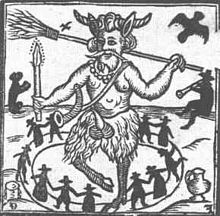
Before long, Christianity began to demonize the gods belonging to other religions, especially those which had converted to Christianity. Pagan deities were some of the most often used to describe the Devil, along with Roman and Celtic deities. People were taught to fear and hate these deities, with fertility gods most often being recognised as demonic. The Greek deity Pan and the Celtic Cernunnos gave the Christian Devil his goat-like appearance, with the Roman Diana adding the sometimes described woman''s breasts to his description. In the confessions of accused witches, these details were often described, although they were probably prompted by the inquisitor.


 The Persecution of Witches (Original)

In the 12th and 13th centuries, demons were creatures of spirit – much like angels, these were the fallen angels. If a demon were to be visible, its body was said to be made from the vapours of the earth, with this control of the air later becoming an imporant theory for the flight of witches.

The Christian religion maintained that only God could cause a miracle. Any claim that the Devil could control creation or free will was considered heretical, and any 'miraculous transformations' were considered to be an illusion, with illusion being one of the Devil's supposed powers over the material world. Where the Devil was considered to have power over the material world, God was believed to provide humans with free will. So, if you were seen as being possessed by demons, it was believed that it was through your own choice. According to Malleus Maleficarum, the Devil could influence a person's choices through bibery and tricks. This meant that accused witches maintained their moral responsibility, especially is a pact with the Devil had been made.

This brings us to another important element in accepted witch traditions. A pact with the Devil meant that not only did you practise harmful magic, you were also considered to be a Devil worshipper. This idea was developed over many centuries, with the earliest documentation of such pacts being by St. Augustine, although the belief didn't become widespread until the descriptions were translated into Latin during the 9th century. It was, by this point in time, believed that all magic practisioners received their powers from pacts with the Devil, although not all Devil worshippers were granted magical powers. A pact with the Devil was seen as some kind of legal contract with the Devil promising a reward in exchange for the witch's immortal soul. This reward may be a promise of wealth, power, sexual indulgence, or happiness in the afterlife. In some instances the witch would be bestowed with magical powers.

A portrayal of Devil worship and cannibalism committed by witches (Original)

The practice of magic increased in the 12th and 13th centuries with the transaltions of Greek and Islamic texts. One popular magical practice was necromancy, or communication with the dead, where demons would be apparently summoned so they could be trapped, meaning the witch could learn from their hidden knowledge. As the practice of magic became more common, so did condemnation of these practices, with demonologists stating that while necromancers may not mean to worship the Devil, their communications with demons must come with a price. They concluded that the witch must need to offer some form of bait for the demon, or do some service for the Devil in exchange for the demons knowledge. This meant that even if the practisioner didn't intend to worship the Devil, anything considered the practice of magic was condemned as evil.

This was not the first condemnation of magic, but a pact with the Devil was an imporant addition to witchcraft traditions, making the label of witch applicable to peasants who practiced magic with little or no understanding of the implications of their actions – a pact with the Devil, whether it was was intentional or not. This connection between magic and heresy was then used to condemn other so called heretics, including those found to be involved in secret, group worship and abnormal, inhumane behaviour. Witchcraft became a sort of religious mockery of Christianity, which was best expressed during the witches' sabbath, the next element in the concept of witchcraft.

At this point there was a shift of focus from the upper-class, educated, male magician to the poor, unknowledgable, female witch. There was a corresponding change in the attributes of the pact, from equal partnership where the magicial could fight for the advantage, to a role of subservience, where the witch submitted voluntarily. This was pointed out by King James VI of Scotland, when he said, ''Witches are servants only, and slaves to the Devil; but the Necromancers are his masters and commanders.''

A gathering of witches was known as the sabbath and was a place for those Devil worshippers to debase themselves, taking part in sexual activities with demons, cannibalism and the murder of innocent infants. In some parts of Europe, including France, Spain and Italy, witches were believed to take part in parodies of the Catholic Mass. When all of these activities were connected they provided fulfilled Christians worst fears. This society of so-called witch lore may have been invented by monks during the 12th and 13th centuries as propaganda in the war against other beliefs, such as those held by the Waldensians and Cathars, before being applied to other heretics. These intense accusations became a huge burden for accused witches as knowledge of heretical practices grew.

Belief in the sabbath was not universal, although it was widespread and an important addition to those who hunted witches. The assumption that witches gathered to worship the Devil led to many endless hunts for those connected to the accused witches, and was probably a contributing factor in the scale of the exhaustive searches.

Coven in Flight (Original)

Another belief that was often included in witch lore was the claim that witches were capable of flight. One way of doing this was through the Devil's material control over the air, which could propel a witch for great distances through the air. Another theory was that the Devil used his power of illusion, making the witch believe that they had flown. This second idea was also used in claims that the sabbath itself was an illusion. Regardless, flight was used to explain how witches were able to attend sabbaths which were believed to be held in remote areas. Origins of this concept may go back to pagan beliefs which were still followed by many peasants. One of these beliefs held that women could transform into strigae, or abhorrent screeching owls. Another belief was of the Dianic 'wild hunt, when a witch was said to ride through the countryside on the backs of various beasts.

Metamorphosis was another element in Early Modern witch lore. It was said that a witch was capable of transforming themselves or others into animals, with a particular favourite being the wolf. While this too was supposedly another of the Devil's illusion, it was a common assumption. To us, these beliefs may seem far-fetched but, at the time, they seemed like rational explanations. These beliefs were often challenged, although no one dared to deny the central theme of the Devil, which held the entire movement in one piece.
So, when looking at the origins of witchcraft, one has to understand that it had been present in society since the dawn of time, with witches being considered wise and important. However, with the growth of Christianity, fear of witches and the practice of magic was instilled into the public, pushing them to convert from their life-long religion to the 'one true faith', Christianity. What followed was the accusation and murder of many innocents who had often committed no crime or wrong doing.

Fortunately, with modern witchcraft, respect for this practice has once again grown and is now followed by many people in the modern age, without the fear of persecution. It attracts people from all walks of life, bringing them together in an understanding of the life, nature, evolution and mysteries of the universe through witchcraft. Unlike other religions, witchcraft allows a huge amount of freedom, with the only real rules being that you should harm none unless you wish it to be returned to you three times three, nor should nature be misused the generosity of nature by distrupting its balance. 

Next time: We will take a closer look at the persecution of witches during the Salem Witch Trials.

Sunday, 10 February 2013

The Origins of Fairies


Now in the olden days of King Arthur,
Of whom the Britons speak with great honour,
All this wide land was land of faery.
The elf-queen, with her jolly company,
Danced oftentimes on many a green mead;
This was the old opinion, as I read.
I speak of many hundred years ago;
But now no man can see the elves, you know
.
(From The Wife of Bath's Tale by Geoffrey Chaucer)

The origin of fairies is one of the most debated questions in regards to folklore with their roots being traced back in time to nature spirits, Pagan gods and goddesses, elementals and the dead, amongst other things.  The Welsh, who worshipped the Mother Goddess, referred to fairies as The Mothers and fairyland was known as The Land of Women, with fairies often depicted as women.  These 'little people' can be perceived as both good and bad, malevolent and giving, capable of assisting us and warring against us.  Symbologist, J. E. Cirlot noted that they fulfill humble tasks, yet possess extraordinary powers.  Throughout their history they have been connected with the devil and have been believed to serve witches as familiars.  They have been said to steal children, leaving changelings in their place.  They can cause illness but can also prevent it.  As Richard Kieckhefer wrote, Fairies have good and evil sides, and while they can represent primal paganism they can be said to hold the Christian faith.  But how did these beings come into existence as we perceive them today - as the tooth fairy, Tinkerbell and the fairy godmother?
The belief in fairies actually goes back to the dawn of time and is evident across the world.  Parallels in traditions can be seen in cultures as far apart as Africa, Australia and Britain and can be traced to both written and oral traditions.  From the Sanskrit gandhana - semidivine celestial musicians - to the nymphs of the Greeks, the jinni of Arabian myth to other characters of the Samoans, Arctic and other indigenous Americans.  The word fairy is derived from the Latin fata, or fate, which refers to the three women who spin and control the threads of life.  We also have the English term fays, meaning enchanted or bewitched.  The Old French word faerie has also been linked to the modern word fairy.

Those researching fairies often turn to Medieval texts, occasionally using place names as evidence of the history of fairies.  However, it is questionable that these texts and place names are describing fairies at all.
Fairy traditions within literature really began with Chaucer and Gower in the 1380s.  They are described here as a combination of the frightening and the amusing, as an already vanishing race.  Before this, the fairy didn't really exist - at least not as we know them today.  So called 'earlier accounts' tell us of supernatural beings that vary from text to text, with their characteristics or dwelling place found within their name, for example, the Barrow Revellers and the Green Children of Woolpit.  There is nothing within these texts to suggest that these beings are of the same 'species'.  The fairy tradition grew to encompass sprites, boggarts, pixies, banshees, brownies, hobgoblins, elementals, trolls, elves and many other creatures.


A 1639 depiction of Puck
In fact, there are many different concepts which were once unrelated that have, in modern times, come together to define what we now call the fairy.  Take, for example, the word elf, which Chaucer made into the equivalent of the word fairy.  The word elf can be linked to the Old English aelf, the Anglo-Saxon dryades and the Scandinavian Vanir.  In later literature, elf has been used to translate the Romance fadas.  Robert of Gloucester took a different approach, relating elves to the spiritual beings of the sky.
Elves are often found within literature but are absent from the land and, along with the fairy, you will not find them in English place names until the 18th century.  You do, however, find the puca, an occupant of barrows, wells and pits.  The puca was later linked to Puck, or Robin Goodfellow and could also be associated with the Will o'-the-Wisp and Friar Rush.  These were usually night-walking spirits which mislead men into unfortunate circumstances, playing tricks and causing mischief on the unwary.  However, in the earliest instances, a puck, pouke or pook was another name for the devil.
When looking at northern England, we find that aelf is commonly used, but puca is absent.  In this area elf is kept as the normal word for these beings in modern times, but the Romance fairy has been almost completely rejected.  This is believed to be through the influence of Scandinavian beliefs, with the aelf referring to a dwarf, or dweorg.  When looking at Scandinavian tradition in connection with the fairy, we find the words nanus and pygmaeus, which refers to a short human being.

There are many theories which have been proposed for the origin of faires:
  • Unbaptized souls which are caught in limbo because they are not good enough to go to heaven, nor bad enough to go to hell.
  • The Book of Enoch makes fairies fallen angels - the angels which were loyal to Satan.  The legend tells us that they were cast out of heaven with Satan but, on the journey to hell, God stopped them mid-flight, condemning them to remain where they were.  Some stopped in the air, some on the earth and some in the rivers and seas.  This belief can be found in Scotland, Ireland and Scandinavia.  A similar account to this is that when God stopped these angels, those still in heaven remained angels, those in hell became devils and those in between became fairies.
  • The Irish tales of the Tuatha De Danaan refer to these beings as fairies, but they were once worshipped as gods and goddesses.
  • Certain traditions tell us that fairies were demons.  This belief became popular with the start of Puritanism, with the once friendly hobgoblin becoming a wicked goblin.  Any dealings with fairies was considered a form of witchcraft in this era and was punished as such.
  • Some say they are native spirits which live in all things and in all places on Earth.  These can be described as elementals, such as gnomes and sylphs, as described by Paracelsus  Some popular folklore accounts describe fairies as 'spirits of the air'.
  • Others believe that fairies are simply tiny human beings.  There is evidence in parts of Europe and the British Isles that, in the Neolithic and Bronze Ages, there were populations of small-structured races.  The Irish know these races as the Tuatha De Danaan and believe them to dwell in barrows, hills and mounds.  These people are believed to have been hard-working but shy and, as the lands were invaded by bigger, stronger people, they hid in the woodland to live with nature.
  • The dead have sometimes been linked with fairies, with the Irish banshee at times being described as a ghost.  The northern English Cauld Lad of Hylton tells us of a murdered boy who is described as a household sprite, like a brownie.  Another tale describes a man who was caught by the fairies and, everytime he looked at one, he saw one of his dead neighbours.
  • J. M. Barrie's 1902 book The Little White Bird tells us: When the first baby laughed for the first time, his laugh broke into a million pieces, and they all went skipping about.  That was the beginning of fairies.
 There are many sources for these beliefs, with common themes being found in the Celtic nations describing a race of small people who were driven into hiding by humans.  They were seen as another race or as spirits which were believed to live in the Otherworld, or Tir na nOg.  With the coming of Christianity fairies lived on and were reputed by the Church to be 'evil beings'.

So, when looking at the origins of modern fairies, one needs to look to the time of Richard II, where a combination of poets from both England and France took their old traditions and formed the tricksters like Robin Goodfellow, the familiar spirits of cunning men and the domestic spirits like the Brownie and Hobgoblin.  This, in turn, changed the native traditions of the sidhe of Ireland and the Highlands, adding new characteristics such as small size into people's beliefs of fairies.

By the 1800s, fairy traditions had changed so much that it became difficult to discern what some beings - the Anglo-Saxon grims, scucca, thyrs and the rural Church Grims, Black Shucks and Holothrusts - were like to start with.  The modern fairy was born, masking a full understanding of the older supernatural encounters which have been included in the modern perception of these little people.

Next time I plan to tell you about some of the things which were said to please the fairies and about what was said to happen if the fairies were displeased.  I also was to include some of things believed to be sacred to the fairies how these things effect modern man in places like Ireland.
Hyper Smash


Blogarama - The Blog Directory