Showing posts with label Zwarte. Show all posts

Friday, 19 December 2014

The Origin of Santa Claus and the Customs of Christmas: Part One

Santa Claus with Little Girl by MeeranUhm
 Everyone loves Santa Claus - the jolly bearded man dressed in red and white who comes down the chimney to deliver presents on Christmas Eve.  He has many names,  Saint Nicholas, Father Christmas and Kris Kringle to name a few.  But where did Santa Claus come from and how did the tradition of Christmas begin?  Lets look back through time and trace the origins of Santa Claus and the customs of Christmas.

Popular opinion states that Santa Claus was inspired by Saint Nicholas - a kind hearted and generous bishop.  So this is where we will start our search for the origin of Santa. 

The Legend of Saint Nicholas

     'Long ago, in a far off land known today as Turkey, there was a boy named Nicholas.  Nicholas was a person who created numerous miracles and accomplished many good deeds.  As a teenager, Nicholas inherited a vast fortune, but he had no idea what to do with it.  Wanting to help those less fortunate than himself, Nicholas set out to make the wishes of others come true.  While Nicholas knew the townspeople needed his held, he was also aware that they were a very proud people, so Nicholas decided to help his friends secretly.
    Each night, Nicholas would disguise himself and deliver such items as food, clothing, and money to the people of his village.  Of all the townspeople, Nicholas felt the closest bond with one specific family.  In this family, there were three daughters.  Sadly, the family was very poor and the father felt much pain over the fact that he couldn't afford the weddings of each daughter.  In his desire to help the family, Nicholas left a bag of gold on the father's doorstep as the wedding of the eldest daughter approached.
Saint Nicholas of Myra by Vicki Shuck
    When it was time for the second daughter to marry, Nicholas again visited the family.  He threw another bag of gold into the family's chimney.  The family greatly appreciated the individual who was providing them with such a fortune, but they had no idea who this person could be.  As the third daughter's wedding neared, the father decided to stand guard so he could identify this generous stranger who had given his family such happiness.  Nicholas arrived and tossed a bag of gold through an open window and, upon hearing the bag of gold land on the floor, the father chased Nicholas until he caught him
    Nicholas didn't want the father to make his identity known and had the man promise to keep it a secret.  However, the father's gratitude was so great that he was unable to keep his promise and soon the whole town knew that Nicholas was responsible for the acts of generosity which had been happening throughout the entire town.
    Every year, in December, Nicholas took it upon himself to reward all the girls and boys who had been good during the year by giving them gifts.  And he is still remembered today for his kindness, generosity and love for the children.  In honour of this great saint, countries across the world give gifts to children on the day of Saint Nicholas, December 6th.

Who was Saint Nicholas?
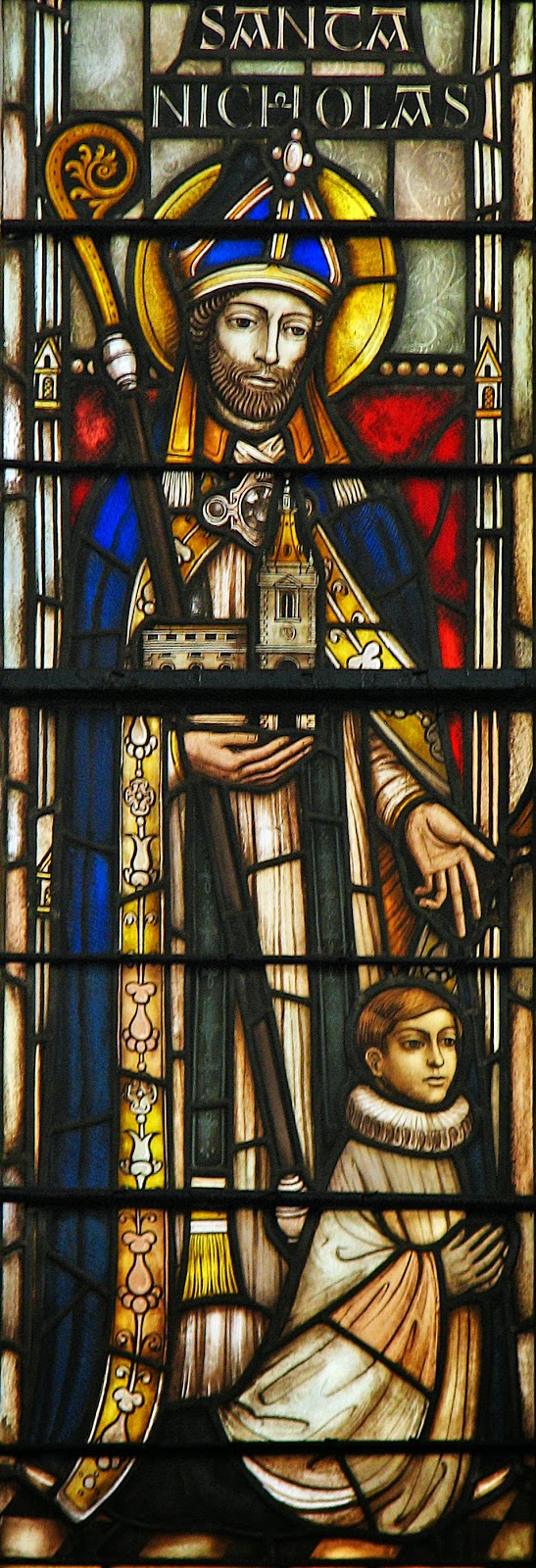
Stained Glass Window of St. Nicholas & a Chorister
While the legend of Saint Nicholas is prevalent throughout the world, there are very few surviving documents of Saint Nicholas.  Much of what we think we know is little more than legend, passed down through the generations and growing with every telling.  But what do we really know about Saint Nicholas?

The first known reference of Saint Nicholas dates back to between 510 and 515, with the writer Theodor, lector of Byzantinum, in the book 'Tripartite History.  This literature is entirely dependant on three 5th century historians: Socrates, Sozomen, and Theodor.  His name appears within Theodor's list of participants of the Council of Nicaea, where it says, 'Nicholas of Myra of Lycia.'

Several churches were built in his name - Emperor Theodosius II (401-550) had a church constructed in Myra which became known as the Church of St. Nicholas, while the Roman Emperor Justinian (527-565) restored a St. Nicholas church just outside of the summer palace of Blachernes.  The most significant documentation of Saint Nicholas appears in the biography of bishop Nicholas of Sion, where we are told, 'And going down to the metropolis of Myra, he went off to the martyrium of the glorious Saint Nicholas.'  This is considered to be 'confirmation that the man who would become Santa once existed.' 

While we know that he existed, Saint Nicholas remains elusive, even to the scholars who dedicate much of their life to studying him.  It is believed that Saint Nicholas served as a bishop in the 4th century in the town of Myra.  The first known 'biography' of this saint dates to the 8th or 9th century, long after his death, when a collection of tales about him was compiled by a Greek monk known as Michael the Archimadrite.

Those that have attempted to piece his life together have little to go on and rely on traditions and the few clues which remain from the times in which he lived.  Most of what we think we know is legend with no historical record. 

Other Legends of the Good Saint Nicholas

Santa Claus
Now that we at least know that Saint Nicholas was a real man, lets take a look at the other legends detailing the generosity of this saint.  The most well-known legend of Nicholas's generosity is the one I have detailed in the legend of Saint Nicholas above: that of the gifts of gold he left for a father who could not afford to give his daughters a dowry.  Some say that the daughter's father was preparing to sell his children into slavery and that Nicholas wished to save them from this fate.  In some accounts one of the bags of gold rolled into a stocking, while another was thrown down the chimney, and this is said to be the origin for Santa Claus coming down the chimney and filling a stocking or shoes with gifts.  The image of Santa Claus carrying a sack of presents is also said to originate with this legend.

Another legend explains how Nicholas became a bishop.  It is said that Nicholas believed that God would want him to live amongst the people, so he travelled to Myra, where the Archbishop had recently died.  Here the bishops were trying to choose a successor.  According to the legend the oldest bishop dreamed that he had been commanded to watch the doors of the cathedral the following morning and the first person to enter with the name Nicholas should be made bishop.  On the following morning Nicholas entered the cathedral and was immediately consecrated as Archbishop of Myra.

Throughout much of Europe Nicholas is known as the patron saint of schoolboys.  According to one legend, the devil came to the gates of a school in the middle of Saint Nicholas's feast day disguised as a beggar and a father, who honoured Saint Nicholas, sent his son to give this beggar money.  However, the boy was strangled by the demon.  Heartbroken, the father took his dead son into the house, crying, 'Saint Nicholas, is this my reward for the honours I have given you?'  Saint Nicholas heard the man and resurrected his son.

Nicholas of Myra
Another tale tells of how Nicholas brought three dismembered students back to life.  An Asian father sent his sons to a school in Athens, telling them to stop in Myra to receive blessings from Nicholas.  However, during a night's stay at an inn in Myra, the innkeeper and his wife killed the boys, cut up their bodies, and his the pieces inside barrels intended for salting meat.  They meant to sell them as pickled pork.  But Nicholas somehow sensed what had happened and accused the couple of murder.  The innkeeper and his wife were overwhelmed by this great saint and immediately felt remorse for what they had done.  Nicholas forgave the couple and the boys rose from the brine, whole and alive.

Other legends of Saint Nicholas are set during a trip by sea to Egypt and Palestine.  During a storm, Nicholas is said to have calmed to ocean.  When a sailor fell from a ship's mast and died, he was brought back to life by Nicholas.  Another tale tells of how an immoral sea captain tried to kidnap Nicholas but failed when a storm pushed the ship towards Myra, where Nicholas simply stepped off the ship and walked across the water back to land.

And the legends of his kindness don't end with his death.  The Crusaders from over seven hundred years after the death of Saint Nicholas credited him with freeing them from prison, restoring their health, and form blessing them with visions when they prayed to him.
St. Nicholas Saving Those in Danger at Sea

So Nicholas became the patron saint of children and, in addition, he is also said to have watched over seafarers, with 'several stories about him... [sounding] remarkably like activities previously attributed to Poseidon or Neptune.'  As seafarers were most often both travellers and merchants, Nicholas 'also became the patron saint of travellers in general, and merchants, and bankers, and even pawnbrokers.'

Throughout his life, Nicholas gained a reputation for his acts of kindness.  He is said to have saved the people of the city from famine and, when he died on December 6th 343, the people believed him to be a worker of miracles.  During the years following his death, Nicholas gained in popularity.  In around 1000 AD the legends of Saint Nicholas were taken to Russia, Lapps and Samoyeds.  He became the patron saint of Russia, amongst other countries and the custom of giving gifts on Nicholas' saint day, December 6th and the day of his death, came into being.

Judgement and Punishment

While Saint Nicholas is most often portrayed as generous and kind, some of the legends tell us that he was also a stern disciplinarian.  In 14th century French monastic schools, a monk dressed as Saint Nicholas would question and reprimand children, rewarding good children with sweets and cane the bad children with traditional birch twigs.  Over the next century this tradition of judgement, reward, and punishment spread to common households. 

Naughty children were often left a birch rod, with the people of Holland giving the following explanation: 'The monks of a certain church wanted the responses of Saint Nicholas sung in church.  The abbot refused, saying, 'I consider this music worldly and profane, and shall never give permission for it to be used in my church.'  The good saint, long dead and living in heaven, heard these words.  Nicholas... was so angered by the abbot's words that he descended from heaven in a rage, dragged the abbot out of bed by the hair, and beat him with a birch rod until he was nearly dead.  The point was well taken: from that day, the responses were included in the service.'

Sinterklaas and Black Pete
The Dutch people called Saint Nicholas Sinterklaas, who would arrive on December 5th, the eve of Saint Nicholas's Day.  The children probably viewed this time with both trepidation and fear.  Their Christmas-season ritual would begin with the preparation for a visit from Saint Nicholas.  The children would be drilled on their church lessons with a hope that they would be able to answer any questions the saint had for them.  The reward would be sweets or gifts, while the punishment for wrong answers was sticks and pieces of coal.  The children in Holland would sing a song to give thanks for his goodness and to welcome him, then sweets were thrown through the doorway to signal his arrival.  Saint Nicholas would enter, followed by his servant, Black Peter, who the Dutch called Zwarte Piet.

The Saint's Companion by Nashoba-Hostina
This was the source of the children's fear, for Black Peter was terrifying to behold.  He was a 'hairy, chained, horned, blackened, devilish monster' and he  had a very simple job.  While the children were drilled on their knowledge of the Bible, Black Pete would glare at the children, holding a gaping sack in his hairy claws and, every now and again, he would flash his enormous, razor-sharp canines at the children.  Then he would leap towards the children, growling and threatening to beat them with his rod.  If a child was particularly naughty, Nicholas would warn them that Black Pete might stuff him in his sack and carry them off to some hell until the following Christmas.  While Saint Nicholas always rescued the naughty children, giving them sticks or ashes as a punishment, this did not make for a lighthearted festival.

So far Saint Nicholas seems to have little connection with Christmas.  Legend states that he was generous but was also judgemental of naughty children, and would punish them, whether it was with a birch stick or a piece of coal.  We also have something of an origin for sitting on Santa's knee while he asks you if you've been good or bad.  However, he is connected with the eve and day of December 6th, not December 25th, with the only connection being the month of December.  And what of the red suit, the beard, the reindeer, the elves, and Santa's sleigh?  And what of Black Peter? 

It is commonly believed that the Dutch brought Saint Nicholas with them to America.  However, Saint Nicholas did not appear in America until after Santa Claus became established and the legend that the Dutch brought this figure with them to America was 'invented by Washington Irving in an 1809 satire, the fictional 'Knickerbocker History', and has no basis in fact.'  Evidently there are aspects of the legends of Saint Nicholas within modern Christmas customs, but we are still missing many of the details. 

Next time we will further explore the origins of Santa and our modern Christmas customs and traditions, including a closer look at Zwarte Piet and some of the other figures who may factor into our modern perception of Santa Claus.

Useful Resources

Saint Nicholas by Joe Wheeler
The True Saint Nicholas: Why He Matters to Christmas by William J. Bennett
Bad Santas: and other creepy Christmas characters by Paul Hawkins
Christmas: A Candid History by Bruce David Forbes
Explorers, Fortunes and Love Letters by New Netherland Institute
Christmas: Its Carols, Customs and Legends by Ruth Heller
Santa Claus, Last of the Wild Men by Phylis Siefker

Wednesday, 17 December 2014

The Origin of Santa Claus and the Customs of Christmas: Part Two


The Companions of Saint Nicholas by Spearhafoc
Last time we learned about Saint Nicholas: the legends of his generosity, of the punishments that might be doled out to naughty children, and of his connection with the modern Santa Claus.  We also learned a little bit about Zwarte Piet, or Black Peter.  Today we will further examine the companions of Santa Claus, as well as looking at some of the other forefathers of Santa Claus within Norse mythology.

Black Peter

Black Peter, like Santa Claus, is known by many names: Knecht Ruprecht, Pere Fouttard and Pelzabock der Hans Muff.

A modern postcard of Zwarte Piet
 According to Dutch tradition, Zwarte Piet was a Moorish slave who was freed by Sinterklaas.  In return for his freedome, Zwarte Piet devoted his life to serving Sinterklaas.  In Holland, Sinterklaas rides into Centennial Park on a white horse, led by Zwarte Piet during the town's Parade of Lights.  Sometimes Zwarte Piet rides a mule or walks behind Saint Nicholas.  He was the one to carry the presents for the good little children and the birch rods for the bad little children.  He was sometimes portrayed wearing clothes of a 16th century Spanish official.  He is said to have entered the house through the chimney to deliver presents.  His face has been blackened by the soot from the chimney.

The source of these legends are believed to be connected with both German and Dutch mythology, where the people were blessed by ghostly creatures capable of going up andx down chimneys like smoke.  Some traditions make Black Peter the devil who was defeated by Saint Nicholas, who then shackles him before the feast of Nicholas to do his bidding. 

Pere Fouttard
 Amongst the Germanic people Knecht Ruprecht was thought of as a 'grungy, sooty faced... farmhand or servant.'  He, like Black Peter, carries a sack and a rod.  The children would be asked to sing a religious song or to recite a religious poem.  If they were unable to do so, or if they had been naughty, Knecht Ruprecht would beat them, stuff them inside his sack and take them off to his cave in the Black Forest.

In France, Pere Fouttard would lead a donkey whose saddlebags were full of gifts.  He was dressed in black and was also known as the 'Evil Butcher' who was condemned to follow Saint Nicholas to make up for his past crimes: he would lure children into his butcher shop, where the children would meet their unfortunate end.  Children who had been naughty would be whipped.


A similar character can be found in Germany: the Krampus.  The Krampus was considered to be a 7 ft tall monster who possessed an extraordinary long tongue.  He carried a wicker basket, in which he would carry naughty children to his lair, and a whip, to punish the naughty children.  Today, in Austria, people still dress up as Krampuses and run down the streets, beating the 'bad' out of those they deem naughty.  Most families, however, use the story of the Krampus as a way to frighten their children into behaving.

The Krampus
As you can see, the unpleasant character of Black Peter and his aliases were, and in some countries still are, used as a means to make children behave themselves.  This tradition lives on in the 'better be good' attitude which accompanies Santa Claus and Christmas.  However, the punishment for misbehaviour has been lessened to a piece of coal rather than a beating with birch sticks and a trip to Hell is Black Peter's sack.

Some have argued that there are many problems with Saint Nicholas being the inspiration for the modern Santa Claus.  Santa has been portrayed as wearing a scruffy hair coat, with an unkept beard.  He is often covered in soot from sliding down the chimney and promises earthly rewards which he carries in a sack. 

Saint Nicholas, on the flip side, was meant be be just that - a saint.  So he was dressed in church attire and would have had heavenly aspirations.  Surely Saint Nicholas couldn't be considered materialistic.  However, when we look at Black Peter, we find 'a coat of hair, a disheveled beard, a bag, and ashes on his face.'  It seems that Black Peter has his own role to play within our modern perception of Santa Claus.

While Saint Nicholas and Black Peter both play a role in our modern perception of Santa Claus, there are others who help to form the modern basis for our Christmas gift-giver.  Many other ancient traditions have also been mixed into the legend.  One other influence Pagan gods of the Norse people..

The Pagan Gods of the Norse People


Midwinter by Skarbog
 Odin is usually portrayed as a long-bearded, one-eyed, old man and often appeared dressed in old robes and a hood.  In this guise he would grant gifts and boons as well as curses and catastophe.  He watched over the nine worlds, including the worlds of the elves.  Sometimes he was said to ride a flying, white horse with eight legs called Slepnir through the sky during Yule, when he would throw sweets to children.  The children would place their boots near the chimney and fill them with carrots, straw, or sugar for Odin's horse to eat and Odin would reward these children by replacing the food with gifts or sweets.  This practice, having survived Christianity, became associated with Saint Nicholas, with children still putting straw-filled shoes beside the chimney on every winter night in the hope that Saint Nicholas will reward them.

Before the Christmas tradition reached the lands of the Norse, the people celebrated Yule.  This winter holiday is associated with Odin and included feasting, drinking, and gift-giving, much like the Christmas traditions of today.  The terms Christmas and Yule have become interchangable.
While our modern Santa Claus cannot be said with certainty to have originated with Odin, there are definately similarities between this god and the holiday associated with him, and our modern Christmas.  Here we have the long beard of Santa Claus, the cloak and hood, a potential origin for Santa's elves and maybe even the reindeer.

Thor by derekulstad
 Another Norse god who is believed to be related to Santa Claus is Thor.  He was the god of peasants and the common people and was portrayed as an friendly and jolly elderly man, of heavy build, with a long white beard.  His element was fire and he was said to come down the chimney into his element, the fire.  Also, because of his element, his colour is red.  Thor was said to ride a chariot through the sky.  It was drawn by two white goats, whose names were Cracker and Gnasher.  Having fought against the ice and snow giants, Thor became the a god of Yule.  He was said to live in a palace among the icebergs in the Northland and was believed to help and protect people.  His symbol is that of a hammer, which is also the tool of a carpenter.  Thor himself was a skilled carpenter and his hammer was made by elves, who were also his helpers.

Today in Sweden Thor still represents Santa Claus, where children wait with great excitement for Jultomten; a gnome whose sleigh is drawn by the Julbocker, the goats of the god Thor.  He wears a red suit and cap and carries a bulging sack, much like our modern Santa.

The similarities between Thor and Santa Claus are very difficult to ignore.  Here we have the jovial old man, the long white beard, the trips up and down the chimney, the potential origin of Santa's red suit, a possible start for Santa's flying sleigh drawn by animals with similar names to our reindeer, and Santa's home at the North Pole.  We also have a skilled carpenter, whose symbol was a hammer, and the elves who are said to help him, much like Santa's elves.

Father winter by alexson1
Old Man Winter, also known as Father Winter, is another Norse character who has found a place within our modern Christmas.  Some believe that Old Man Winter is another personification of Odin on account of the giant white horse he was said to ride.  Depicted as wearing a hooded fur coat, this characted also had a long white beard and was welcomed into homes to enjoy the festivities.  During the 8th and 9th centuries, when the Vikings conquered Britain, Old Man Winter was introduced and became the English Father Christmas.

That's all for today.  Next time we will further examine Yule, the Winter Solstice, which may provide us with further clues of how the holiday of Christmas began.


Useful Resources

Oddball Michigan: A Guide to 450 Really Strange Places by Jerome Pohlen
Santa's Book of Knowledge by Santa Al Horton
Santa Claus: Is He for Your Child? by John L. Hoh
The Curious Tales of Santa Claus by Gregory Conte and Therese Conte
Santa Claus: Last of the Wild Men by Rhylis Siefker
About Christmas by Nicolae Sfetcu
The Story of Santa Claus by Joseph McCullough