Showing posts with label Black. Show all posts

Monday, 8 June 2015

Mythical Creatures: Giants of Wales - Part Two

Today we are going to finish learning about the Giants of Wales, their stories and defeats, starting with the giant, Benlli Gawr, who appears in Bernard Bolingbroke Woodward’s History of Wales.  He is said to have been defeated by heavenly intervention when Saint Germain was denied entry to his stronghold.

Saint Germain l'Auxerrois statue
Saint Germain and Benlli Gawr

At the time of this mission, there lived in Powys a wicked and tyrannical king, named Benlli; - Benlli Gawr, the giant, he was more frequently called.  The saint found himself one evening at the gate of this giant’s city, and sent a mild and respectful message to him, hoping to carry on his good work where it was so greatly needed.  But the churl sent word back, that if he stayed at the gate a twelvemonth, he should not enter the city.  The saint was distressed at this, for it was becoming dark, and he knew not where to get a night’s lodging; when the keeper of the gate, who had been the unwilling bearer of his lord’s reply, courteously invited him to his own humble abode; and thither St. Germain joyfully went.  Next day he took his place at the gate again, hoping for admission.  Whilst occupied in prayer, a man covered with sweat hastily came out, and prostrated himself before the saint.  ‘Dost thou believe in the Holy Trinity?’ asks St. Germain.  ‘I do,’ replied the man.  Whereupon the saint baptized him, and told him that within an hour he should die; and so it happened; for Benlli above all things abominated want of punctuality in the men he employed, and this man coming to his work after sun-rising, was straightway beheaded.
No entrance could the saint gain; so at night he bade his host call all his friends out of the wicked city; and when he had so done, he told them to watch and pray, and whatever might happen to the tyrant’s stronghold, by no means even to look towards it.  Thus they did, and early in the night fire
Gold Cape, found 1833, Bryn yr Ellyllon, around 1900-1600BC
fell from heaven, and burned up both tyrant and stronghold, and city and people, so that not one escaped.  It was thus that, in the eighth century, our Lord’s command to the apostles to shake off the dust of their feet as a testimony against a city that refused to receive them, had become perverted.  We have mentioned this legend, however, for the purpose of calling our readers’ attention to a curious ornament of gold, somewhat resembling a corslet, which was discovered near Mold in Flintshire, under a carnedd, long known as the Bryn yr Ellyllon, or Elfin’s hill, and is now in the British Museum.  The bones of a large-sized skeleton were found with it; and it seems to have been ornamented with amber beads, as well as with chasing.  Dr. Owen Pughe conjectured that this was the burial-place of Benlli Gawr, whose stronghold was on Moel Benlli near it; the mode of sepulture being such as would prevail in the fifth century.


Our next tale comes from the folklore of Shropshire and concerns the Giant of Wales, who bore a grudge against the Mayor and people of Shrewsbury and sought to drown them all.

The Wrekin Giant - artist unknown
The Origin of the Wrekin

Once upon a time there was a wicked old giant in Wales who, for some reason or other, had a very great spite against the Mayor of Shrewsbury and all his people, and he made up his mind to dam up the Severn, and by that means cause such a flood that the town would be drowned.
So off he set, carrying a spadeful of earth, and tramped along mile after mile trying to find the way to Shrewsbury.  And how he missed it I cannot tell, but he must have gone wrong somewhere, for at last he got close to Wellington, and by that time he was puffing and blowing under his heavy load, and wishing he was at the end of his journey.  By-and-by there came a cobbler along the road with a sack of old boots and shoes on his back, for he lived at Wellington, and went once a fortnight to Shrewsbury to collect his customers old boots and shoes, and take them home with him to mend.  And the giant called out to him.  ‘I say,’ he said, ‘how far is it to Shrewsbury?’  ‘Shrewsbury,’ said the cobbler, ‘what do you want at Shrewsbury?’  ‘Why,’ said the giant, ‘to fill up the Severn with this lump of earth I’ve got here.  I’ve an old grudge against the Mayor and the folks at Shrewsbury, and now I mean to drown
The Wrekin, Telford
them out, and get rid of them all at once.’  ‘My Word!’ thought the cobbler, ‘this’ll never do!  I can’t afford to lose my customers!’ and he spoke up again, ‘Eh!’ he said, ‘you’ll never get to Shrewsbury – not today, nor tomorrow.  Why, look at me!  I’m just come from Shrewsbury, and I’ve had time to wear out all these old boots and shoes on the road since I started.’  And he showed him his sack.  ‘Oh!’ said the giant, with a great groan, ‘then it’s no use!  I’m fairly tired out already, and I can’t carry this load of mine any farther.  I shall just drop it here and go back home.’  So he dropped the earth on the ground just where he stood, and scraped his boots on the spade, and off he went home again to Wales, and nobody ever heard anything of him in Shropshire after.  But where he put down his load there stands the Wrekin to this day: and even the earth he scraped off his boots was such a pile that it made the little Ercall by the Wrekin’s side.


The Slender Man - artist unknown
Finally, before we finish looking at Welsh giants, we have the black giants of Wales.  These range from the giant black ghosts of Welsh folklore to the black giants of the Mabinogion.  The following tale tells of Edward Frank who one night saw a giant ghost on his journey home.

Of gigantic ghosts there are many examples which are very grotesque indeed.  Such an apparition which met Edward Frank, a young man who lived in the parish of Llantarnam.  As he was coming home one night he heard something walking towards him, but at first could see nothing.  Suddenly his way was barred by a tall dismal object which stood in the path before him.  It was the ghost of a marvellous thin man, whose head was so high above the observer’s line of vision that he nearly fell over backward in his efforts to gaze at it.  His knees knocked together and his heart sank.  With great difficulty he gasped forth, ‘In the name of God what is here?  Turn out of my way or I will strike thee!’  The giant ghost then disappeared, and the frightened Edward, seeing a cow not far off, went towards her to lean on her, which the cow stood still and permitted him to do.  The naiveté of this conclusion is convincing.

Another folktale tells of a giant black man who terrified Anne Jenkins, the daughter of the Reverend Mr. Herbert Jenkins.

Anne, the daughter of Mr. Herbert Jenkins, a young woman, well disposed to what is good, gave me the following relation:-
That as she was going one evening to milk the Cows by Rhiw-neweth to seek them, she saw something like a black man, standing by a holly-tree.  She had a Bitch with her which saw it also, and ran towards him to bark at him, upon which it stretched out its black tongue, and the Bitch was frightened and ran back to the young woman turning about her feet for fear; upon which the young woman was so terrified that she could scarcely speak: she found the Cows and brought them back to their own field, from whence they had strayed.  And passing by the holly-tree back again, feared to look at it, lest she should see the same sight again; but being past it, saw it again, very big in the middle and narrow at both ends, going before, treading very heavily, so that the ground seemed to tremble under it.  It went towards a spring in that field which is under it.  It went towards a spring in that field which is under Rhiw-newith, called Ffynnon yr Yspryd – (the Fountain of the Spirit); because of an Apparition formerly seen by it.  About which it fetched a turn, and went over the stile from that field into the Rhiw-newith, the common way so called, and there he whistled so exceedingly strong, that the narrow Valley echoed it back, and then departed; she then felt herself well.

The Mabinogion is ‘full of black men, usually giants, always terrible to encounter.’  One of these appears in ‘Peredur the Son of Evrawc’.
 
Peredur Illustration by Alan Lee
Excerpt from Peredur the Son of Evrawc

Arthur was in Caerllion upon Usk; and he went to hunt, and Peredur went with him.  And Peredur let loose his dog upon a hart, and the dog killed the hart in a desert place.  And a short space from him he saw signs of a dwelling, and towards the dwelling he went, and he beheld a hall, and at the door of the hall he found bald swarthy youths playing at chess.  And when he entered, he beheld three maidens sitting on a bench, and they were all clothed alike, as became persons of high rank.  And he came, and sat by them upon the bench; and one of the maidens looked steadfastly upon Peredur, and wept.  And Peredur asked her wherefore she was weeping.  ‘Through grief, that I should see so fair a youth as thou art, slain.’  ‘Who will slay me?’ inquired Peredur.  ‘If thou art so daring as to remain here tonight, I will tell thee.’  ‘How great soever my danger may be from remaining here, I will listen unto thee.’  ‘This Palace is owned by him who is my father,’ said the maiden, ‘and he slays everyone who comes hither without his leave.’  ‘What sort of man is thy father, that he is able to slay everyone thus?’  ‘A man who does violence and wrong unto his neighbours, and who renders justice unto none.’  And hereupon he saw the youths arise and clear the chessmen from the board.  And he heard a great tumult; and after the tumult there came in a huge black one-eyed man, and the maidens arose to meet him.  And they disarrayed him, and he went and sat down; and after he had rested and pondered awhile, he looked
Peredur Illustration by Alan Lee
at Peredur, and asked who the knight was.  ‘Lord,’ said one of the maidens, ‘he is the fairest and gentlest youth that ever thou didst see.  And for the sake of Heaven, and of thine own dignity, have patience with him.’  ‘For thy sake I will have patience, and I will grant him his life this night.’  Then Peredur came towards them to the fire, and partook of food and liquor, and entered into discourse with the ladies.  And being elated with the liquor, he said to the black man, ‘It is a marvel to me, so mighty as thou sayest thou art, who could have put out thine eye.’  ‘It is one of my habits,’ said the black man, ‘that whosoever puts me to question which thou hast asked, shall not escape with his life, either as a free gift or for a price.’  ‘Lord,’ said the maiden, ‘whatsoever he may say to thee in jest, and through the excitement of liquor, make good that which thou saidst and didst promise me just now.’  ‘I will do so, gladly, for thy sake,’ said he.  ‘Willingly will I grant him his life this night.’  And that night thus they remained.
And the next day the black man got up, and put on his armour, and said to Peredur, "Arise, man, and suffer death." And Peredur said unto him, "Do one of two things, black man; if thou wilt fight with me, either throw off thy own armour, or give arms to me, that I may encounter thee." "Ha, man," said he, "couldst thou fight, if thou hadst arms? Take, then, what arms thou dost choose." And thereupon the maiden came to Peredur with such arms as pleased him; and he fought with the black man, and forced him to crave his mercy. "Black man, thou shalt have mercy, provided thou tell me who thou
Peredur Illustration by Alan Lee
art, and who put out thine eye." "Lord, I will tell thee; I lost it in fighting with the Black Serpent of the Carn. There is a mound, which is called the Mound of Mourning; and on the mound there is a carn, and in the carn there is a serpent, and on the tail of the serpent there is a stone, and the virtues of the stone are such, that whosoever should hold it in one hand, in the other he will have as much gold as he may desire. And in fighting with this
serpent was it that I lost my eye. And the Black Oppressor am I called. And for this reason I am called the Black Oppressor, that there is not a single man around me whom I have not oppressed, and justice have I done unto none." "Tell me," said Peredur, "how far is it hence?" "The same day that thou settest forth, thou wilt come to the Palace of the Sons of the King of the Tortures." "Wherefore are they called thus?" "The Addanc of the Lake slays them once every day. When thou goest thence, thou wilt come to the Court of the Countess of the Achievements." "What achievements are there?" asked Peredur. "Three hundred men there are in her household, and unto every stranger that comes to the Court, the achievements of her household are related. And this is the manner of it,--the three hundred men of the household sit next unto the Lady; and that not through disrespect unto the guests, but that they may relate the achievements of the household. And the day that thou goest thence, thou wilt reach the Mound of Mourning, and round about the mound there are the owners of three hundred tents guarding the serpent." "Since thou hast, indeed, been an oppressor so long," said Peredur, "I will cause that thou continue so no longer." So he slew him.

The last giant black man of the Mabinogion I want to cover here appears in ‘The Lady of the Fountain’ in a tale related by Kai to some of the Knights of the Round Table.

Excerpt from The Lady of the Fountain

Then Arthur spoke, "If I thought you would not disparage me," said he, "I would sleep while I wait for my repast; and you can entertain one another with relating tales, and can obtain a flagon of mead and some meat from Kai." And the King went to sleep. And Kynon the son of Clydno asked Kai for that which Arthur had promised them. "I, too, will have the good tale which he promised to me," said Kai. "Nay," answered Kynon, "fairer will it be for thee to fulfill Arthur's behest, in the first place, and then we will tell thee the best tale that we know." So Kai went to the kitchen and to the mead-cellar, and returned bearing a flagon of mead and a golden goblet, and a handful of skewers, upon which were broiled collops of meat. Then they ate the collops and began to drink the mead. "Now," said Kai, "it is time for you to give me my story." "Kynon," said Owain, "do thou pay to Kai the tale that is his due." "Truly," said Kynon, "thou are older, and art a better teller of tales, and hast seen more marvellous things than I; do thou therefore pay Kai his tale." "Begin thyself," quoth Owain, "with the best that thou knowest." "I will do so," answered Kynon.

The Lady of the Fountain Illustration by Alan Lee
"I was the only son of my mother and father, and I was exceedingly aspiring, and my daring was very great. I thought there was no enterprise in the world too mighty for me, and after I had achieved all the adventures that were in my own country, I equipped myself, and set forth to journey through deserts and distant regions. And at length it chanced that I came to the fairest valley in the world, wherein were trees of equal growth; and a river ran through the valley, and a path was by the side of the river. And I followed the path until mid-day, and continued my journey along the remainder of the valley until the evening; and at the extremity of a plain I came to a large and lustrous Castle, at the foot of which was a torrent. And I approached the Castle, and there I beheld two youths with yellow curling hair, each with a frontlet of gold upon his head, and clad in a garment of yellow satin, and they had gold clasps upon their insteps. In the hand of each of them was an ivory bow, strung with the sinews of the stag; and their arrows had shafts of the bone of the whale, and were winged with peacock's feathers; the shafts also had golden heads. And they had daggers with blades of gold, and with hilts of the bone of the whale. And they were shooting their daggers.

"And a little way from them I saw a man in the prime of life, with his beard newly shorn, clad in a robe and a mantle of yellow satin; and round the top of his mantle was a band of gold lace. On his feet were shoes of variegated leather, fastened by two bosses of gold. When I saw him, I went towards him and saluted him, and such was his courtesy that he no sooner received my greeting than he returned it. And he went with me towards the Castle. Now there were no dwellers in the Castle except those who were in one hall. And there I saw four-and-twenty damsels, embroidering satin at a window. And this I tell thee, Kai, that the least fair of them was fairer than the fairest maid thou hast ever beheld in the Island of Britain, and the least lovely of them was more lovely than Gwenhwyvar, the wife of Arthur, when she has appeared loveliest at the Offering, on the day of the Nativity, or at the feast of Easter. They rose up at my coming, and six of them took my horse, and divested me of my armour; and six others took my arms, and washed them in a vessel until they were perfectly bright. And the third six spread cloths upon the tables and prepared meat. And the fourth six took off my soiled garments, and placed others upon me; namely, an under-vest and a doublet of fine linen, and a robe, and a surcoat, and a mantle of yellow satin with a broad gold band upon the mantle. And they placed cushions both beneath and around me, with coverings of red linen; and I sat down. Now the six maidens who had taken my horse, unharnessed him, as well as if they had been the best squires in the Island of Britain. Then, behold, they brought bowls of silver wherein was water to wash, and towels of linen, some green and some white; and I washed. And in a little while the man sat down to the table. And I sat next to him, and below me sat all the maidens, except those who waited on us. And the table was of silver, and the cloths upon the table were of linen; and no vessel was served upon the table that was not either of gold or of silver, or of buffalo-horn. And our meat was brought to us. And verily, Kai, I saw there every sort of meat and every sort of liquor that I have ever seen elsewhere; but the meat and the liquor were better served there than I have ever seen them in any other place.
"Until the repast was half over, neither the man nor any one of the damsels spoke a single word to me; but when the man perceived that it would be more agreeable to me to converse than to eat any more, he began to inquire of me who I was. I said I was glad to find that there was some one who would discourse with me, and that it was not considered so great a crime at that Court for people to hold converse together. 'Chieftain,' said the man, 'we would have talked to thee sooner, but we feared to disturb thee during thy repast; now, however, we will discourse.' Then I told the man who I was, and what was the cause of my journey; and said that I was seeking whether any one was superior to me, or whether I could gain the mastery over all. The man looked upon me, and he smiled and said, 'If I did not fear to distress thee too much, I would show thee that which thou seekest.' Upon this I became anxious and sorrowful, and when the man perceived it, he said, 'If thou wouldest rather that I should show thee thy disadvantage than thine advantage, I will do so. Sleep here to-night, and in the morning arise early, and take the road upwards through the valley until thou reachest the wood through which thou camest hither. A little way within the wood thou wilt meet with a road branching off to the right, by which thou must proceed, until thou comest to a large sheltered glade with a mound in the centre. And thou wilt see a black man of great stature on the top of the mound. He is not smaller in size than two of the men of this world. He has but one foot; and one eye in the middle of his forehead.  And he has a club of iron, and it is certain that there are no two men in the world who would not find their burden in that club. And he is not a comely man, but on the contrary he is exceedingly ill-favoured; and he is the woodward of that wood. And thou wilt see a thousand wild animals grazing around him. Inquire of him the way out of the glade, and he will reply to thee briefly, and will point out the road by which thou shalt find that which thou art in quest of.'
"And long seemed that night to me. And the next morning I arose and equipped myself, and mounted my horse, and proceeded straight through the valley to the wood; and I followed the cross-road which the man had pointed out to me, till at length I arrived at the glade. And there was I three times more astonished at the number of wild animals that I beheld, than the man had said I should be. And the black man was there, sitting upon the top of the mound. Huge of stature as the man had told me that he was, I found him to exceed by far the description he had given me of him. As for the iron club which the man had told me was a burden for two men, I am certain, Kai, that it would be a heavy weight for four warriors to lift; and this was in the black man's hand. And he only spoke to me in answer to my questions. Then I asked him what power he held over those animals. 'I will show thee, little man,' said he. And he took his club in his hand, and with it he struck a stag a great blow so that he brayed vehemently, and at his braying the animals came together, as numerous as the stars in the sky, so that it was difficult for me to find room in the glade to stand among them. There were serpents, and dragons, and divers sorts of animals. And he looked at them, and bade them go and feed; and they bowed their heads, and did him homage as vassals to their lord.


The Lady of the Fountain Illustration by Alan Lee
"Then the black man said to me, 'Seest thou now, little man, what power I hold over these animals?' Then I inquired of him the way, and he became very rough in his manner to me; however, he asked me whither I would go? And when I told him who I was and what I sought, he directed me. 'Take,' said he, 'that path that leads towards the head of the glade, and ascend the wooded steep until thou comest to its summit; and there thou wilt find an open space like to a large valley, and in the midst of it a tall tree, whose branches are greener than the greenest pine-trees. Under this tree is a fountain, and by the side of the fountain a marble slab, and on the marble slab a silver bowl, attached by a chain of silver, so that it may not be carried away. Take the bowl and throw a bowlful of water upon the slab, and thou wilt hear a mighty peal of thunder, so that thou wilt think that heaven and earth are trembling with its fury. With the thunder there will come a shower so severe that it will be scarce possible for thee to endure it and live. And the shower will be of hailstones; and after the shower, the weather will become fair, but every leaf that was upon the tree will have been carried away by the shower. Then a flight of birds will come and alight upon the tree; and in thine own country thou didst never hear a strain so sweet as that which they will sing. And at the moment thou art most delighted with the song of the birds, thou wilt hear a murmuring and complaining coming towards thee along the valley. And thou wilt see a knight upon a coal-black horse, clothed in black velvet, and with a pennon of black linen upon his lance; and he will ride unto thee to encounter thee with the utmost speed. If thou fleest from him he will overtake thee, and if thou abidest there, as sure as thou art a mounted knight, he will leave thee on foot. And if thou dost not find trouble in that adventure, thou needest not seek it during the rest of thy life.'
"So I journeyed on, until I reached the summit of the steep, and there I found everything as the black man had described it to me. And I went up to the tree, and beneath it I saw the fountain, and by its side the marble slab, and the silver bowl fastened by the chain. Then I took the bowl, and cast a bowlful of water upon the slab; and thereupon, behold, the thunder came, much more violent than the black man had led me to expect; and after the thunder came the shower; and of a truth I tell thee, Kai, that there is neither man nor beast that can endure that shower and live. For not one of those hailstones would be stopped, either by the flesh or by the skin, until it had reached the bone. I turned my horse's flank towards the shower, and placed the beak of my shield over his head and neck, while I held the upper part of it over my own head. And thus I withstood the shower. When I looked on the tree there was not a single leaf upon it, and then the sky became clear, and with that, behold the birds lighted upon the tree, and sang. And truly, Kai, I never heard any melody equal to that, either before or since. And when I was most charmed with listening to the birds, lo, a murmuring voice was heard through the valley, approaching me and saying, 'Oh, Knight, what has brought thee hither? What evil have I done to thee, that thou shouldst act towards me and my possessions as thou hast this day? Dost thou not know that the shower to-day has left in my dominions neither man nor beast alive that was exposed to it?' And thereupon, behold, a Knight on a black horse appeared, clothed in jet-black velvet, and with a tabard of black linen about him. And we charged each other, and, as the onset was furious, it was not long before I was overthrown. Then the Knight passed the shaft of his lance through the bridle rein of my horse, and rode off with the two horses, leaving me where I was. And he did not even bestow so much notice upon me as to imprison me, nor did he despoil me of my arms. So I returned along the road by which I had come. And when I reached the glade where the black man was, I confess to thee, Kai, it is a marvel that I did not melt down into a liquid pool, through the shame that I felt at the black man's derision. And that night I came to the same castle where I had spent the night preceding. And I was more agreeably entertained that night than I had been the night before; and I was better feasted, and I conversed freely with the inmates of the castle, and none of them alluded to my expedition to the fountain, neither did I mention it to any; and I remained there that night. When I arose on the morrow, I found, ready saddled, a dark bay palfrey, with nostrils as red as scarlet; and after putting on my armour, and leaving there my blessing, I returned to my own Court. And that horse I still possess, and he is in the stable yonder. And I declare that I would not part with him for the best palfrey in the Island of Britain.

And that concludes the Giants of Wales.  Next time we will look at the giants of Scandinavia.

Useful Resources

English Fairy and Folktales by Edwin Sidney Hartland
A Relation of Apparitions of Spirits in the County of Monmouth and the Principality ofWales by Edmund Jones
The Mabinogion by Lady Charlotte Guest

Friday, 19 December 2014

The Origin of Santa Claus and the Customs of Christmas: Part One

Santa Claus with Little Girl by MeeranUhm
 Everyone loves Santa Claus - the jolly bearded man dressed in red and white who comes down the chimney to deliver presents on Christmas Eve.  He has many names,  Saint Nicholas, Father Christmas and Kris Kringle to name a few.  But where did Santa Claus come from and how did the tradition of Christmas begin?  Lets look back through time and trace the origins of Santa Claus and the customs of Christmas.

Popular opinion states that Santa Claus was inspired by Saint Nicholas - a kind hearted and generous bishop.  So this is where we will start our search for the origin of Santa. 

The Legend of Saint Nicholas

     'Long ago, in a far off land known today as Turkey, there was a boy named Nicholas.  Nicholas was a person who created numerous miracles and accomplished many good deeds.  As a teenager, Nicholas inherited a vast fortune, but he had no idea what to do with it.  Wanting to help those less fortunate than himself, Nicholas set out to make the wishes of others come true.  While Nicholas knew the townspeople needed his held, he was also aware that they were a very proud people, so Nicholas decided to help his friends secretly.
    Each night, Nicholas would disguise himself and deliver such items as food, clothing, and money to the people of his village.  Of all the townspeople, Nicholas felt the closest bond with one specific family.  In this family, there were three daughters.  Sadly, the family was very poor and the father felt much pain over the fact that he couldn't afford the weddings of each daughter.  In his desire to help the family, Nicholas left a bag of gold on the father's doorstep as the wedding of the eldest daughter approached.
Saint Nicholas of Myra by Vicki Shuck
    When it was time for the second daughter to marry, Nicholas again visited the family.  He threw another bag of gold into the family's chimney.  The family greatly appreciated the individual who was providing them with such a fortune, but they had no idea who this person could be.  As the third daughter's wedding neared, the father decided to stand guard so he could identify this generous stranger who had given his family such happiness.  Nicholas arrived and tossed a bag of gold through an open window and, upon hearing the bag of gold land on the floor, the father chased Nicholas until he caught him
    Nicholas didn't want the father to make his identity known and had the man promise to keep it a secret.  However, the father's gratitude was so great that he was unable to keep his promise and soon the whole town knew that Nicholas was responsible for the acts of generosity which had been happening throughout the entire town.
    Every year, in December, Nicholas took it upon himself to reward all the girls and boys who had been good during the year by giving them gifts.  And he is still remembered today for his kindness, generosity and love for the children.  In honour of this great saint, countries across the world give gifts to children on the day of Saint Nicholas, December 6th.

Who was Saint Nicholas?

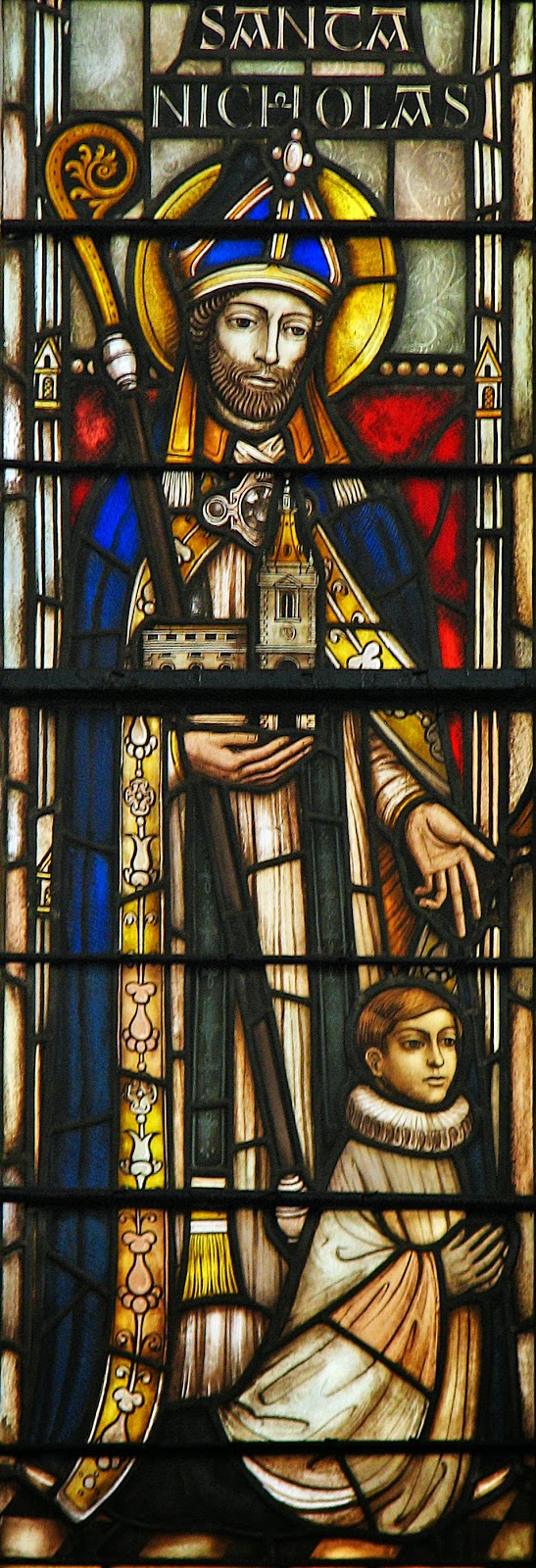
Stained Glass Window of St. Nicholas & a Chorister
While the legend of Saint Nicholas is prevalent throughout the world, there are very few surviving documents of Saint Nicholas.  Much of what we think we know is little more than legend, passed down through the generations and growing with every telling.  But what do we really know about Saint Nicholas?

The first known reference of Saint Nicholas dates back to between 510 and 515, with the writer Theodor, lector of Byzantinum, in the book 'Tripartite History.  This literature is entirely dependant on three 5th century historians: Socrates, Sozomen, and Theodor.  His name appears within Theodor's list of participants of the Council of Nicaea, where it says, 'Nicholas of Myra of Lycia.'

Several churches were built in his name - Emperor Theodosius II (401-550) had a church constructed in Myra which became known as the Church of St. Nicholas, while the Roman Emperor Justinian (527-565) restored a St. Nicholas church just outside of the summer palace of Blachernes.  The most significant documentation of Saint Nicholas appears in the biography of bishop Nicholas of Sion, where we are told, 'And going down to the metropolis of Myra, he went off to the martyrium of the glorious Saint Nicholas.'  This is considered to be 'confirmation that the man who would become Santa once existed.' 

While we know that he existed, Saint Nicholas remains elusive, even to the scholars who dedicate much of their life to studying him.  It is believed that Saint Nicholas served as a bishop in the 4th century in the town of Myra.  The first known 'biography' of this saint dates to the 8th or 9th century, long after his death, when a collection of tales about him was compiled by a Greek monk known as Michael the Archimadrite.

Those that have attempted to piece his life together have little to go on and rely on traditions and the few clues which remain from the times in which he lived.  Most of what we think we know is legend with no historical record. 

Other Legends of the Good Saint Nicholas

Santa Claus
Now that we at least know that Saint Nicholas was a real man, lets take a look at the other legends detailing the generosity of this saint.  The most well-known legend of Nicholas's generosity is the one I have detailed in the legend of Saint Nicholas above: that of the gifts of gold he left for a father who could not afford to give his daughters a dowry.  Some say that the daughter's father was preparing to sell his children into slavery and that Nicholas wished to save them from this fate.  In some accounts one of the bags of gold rolled into a stocking, while another was thrown down the chimney, and this is said to be the origin for Santa Claus coming down the chimney and filling a stocking or shoes with gifts.  The image of Santa Claus carrying a sack of presents is also said to originate with this legend.

Another legend explains how Nicholas became a bishop.  It is said that Nicholas believed that God would want him to live amongst the people, so he travelled to Myra, where the Archbishop had recently died.  Here the bishops were trying to choose a successor.  According to the legend the oldest bishop dreamed that he had been commanded to watch the doors of the cathedral the following morning and the first person to enter with the name Nicholas should be made bishop.  On the following morning Nicholas entered the cathedral and was immediately consecrated as Archbishop of Myra.

Throughout much of Europe Nicholas is known as the patron saint of schoolboys.  According to one legend, the devil came to the gates of a school in the middle of Saint Nicholas's feast day disguised as a beggar and a father, who honoured Saint Nicholas, sent his son to give this beggar money.  However, the boy was strangled by the demon.  Heartbroken, the father took his dead son into the house, crying, 'Saint Nicholas, is this my reward for the honours I have given you?'  Saint Nicholas heard the man and resurrected his son.

Nicholas of Myra
Another tale tells of how Nicholas brought three dismembered students back to life.  An Asian father sent his sons to a school in Athens, telling them to stop in Myra to receive blessings from Nicholas.  However, during a night's stay at an inn in Myra, the innkeeper and his wife killed the boys, cut up their bodies, and his the pieces inside barrels intended for salting meat.  They meant to sell them as pickled pork.  But Nicholas somehow sensed what had happened and accused the couple of murder.  The innkeeper and his wife were overwhelmed by this great saint and immediately felt remorse for what they had done.  Nicholas forgave the couple and the boys rose from the brine, whole and alive.

Other legends of Saint Nicholas are set during a trip by sea to Egypt and Palestine.  During a storm, Nicholas is said to have calmed to ocean.  When a sailor fell from a ship's mast and died, he was brought back to life by Nicholas.  Another tale tells of how an immoral sea captain tried to kidnap Nicholas but failed when a storm pushed the ship towards Myra, where Nicholas simply stepped off the ship and walked across the water back to land.

And the legends of his kindness don't end with his death.  The Crusaders from over seven hundred years after the death of Saint Nicholas credited him with freeing them from prison, restoring their health, and form blessing them with visions when they prayed to him.
St. Nicholas Saving Those in Danger at Sea

So Nicholas became the patron saint of children and, in addition, he is also said to have watched over seafarers, with 'several stories about him... [sounding] remarkably like activities previously attributed to Poseidon or Neptune.'  As seafarers were most often both travellers and merchants, Nicholas 'also became the patron saint of travellers in general, and merchants, and bankers, and even pawnbrokers.'

Throughout his life, Nicholas gained a reputation for his acts of kindness.  He is said to have saved the people of the city from famine and, when he died on December 6th 343, the people believed him to be a worker of miracles.  During the years following his death, Nicholas gained in popularity.  In around 1000 AD the legends of Saint Nicholas were taken to Russia, Lapps and Samoyeds.  He became the patron saint of Russia, amongst other countries and the custom of giving gifts on Nicholas' saint day, December 6th and the day of his death, came into being.

Judgement and Punishment

While Saint Nicholas is most often portrayed as generous and kind, some of the legends tell us that he was also a stern disciplinarian.  In 14th century French monastic schools, a monk dressed as Saint Nicholas would question and reprimand children, rewarding good children with sweets and cane the bad children with traditional birch twigs.  Over the next century this tradition of judgement, reward, and punishment spread to common households. 

Naughty children were often left a birch rod, with the people of Holland giving the following explanation: 'The monks of a certain church wanted the responses of Saint Nicholas sung in church.  The abbot refused, saying, 'I consider this music worldly and profane, and shall never give permission for it to be used in my church.'  The good saint, long dead and living in heaven, heard these words.  Nicholas... was so angered by the abbot's words that he descended from heaven in a rage, dragged the abbot out of bed by the hair, and beat him with a birch rod until he was nearly dead.  The point was well taken: from that day, the responses were included in the service.'

Sinterklaas and Black Pete
The Dutch people called Saint Nicholas Sinterklaas, who would arrive on December 5th, the eve of Saint Nicholas's Day.  The children probably viewed this time with both trepidation and fear.  Their Christmas-season ritual would begin with the preparation for a visit from Saint Nicholas.  The children would be drilled on their church lessons with a hope that they would be able to answer any questions the saint had for them.  The reward would be sweets or gifts, while the punishment for wrong answers was sticks and pieces of coal.  The children in Holland would sing a song to give thanks for his goodness and to welcome him, then sweets were thrown through the doorway to signal his arrival.  Saint Nicholas would enter, followed by his servant, Black Peter, who the Dutch called Zwarte Piet.

The Saint's Companion by Nashoba-Hostina
This was the source of the children's fear, for Black Peter was terrifying to behold.  He was a 'hairy, chained, horned, blackened, devilish monster' and he  had a very simple job.  While the children were drilled on their knowledge of the Bible, Black Pete would glare at the children, holding a gaping sack in his hairy claws and, every now and again, he would flash his enormous, razor-sharp canines at the children.  Then he would leap towards the children, growling and threatening to beat them with his rod.  If a child was particularly naughty, Nicholas would warn them that Black Pete might stuff him in his sack and carry them off to some hell until the following Christmas.  While Saint Nicholas always rescued the naughty children, giving them sticks or ashes as a punishment, this did not make for a lighthearted festival.

So far Saint Nicholas seems to have little connection with Christmas.  Legend states that he was generous but was also judgemental of naughty children, and would punish them, whether it was with a birch stick or a piece of coal.  We also have something of an origin for sitting on Santa's knee while he asks you if you've been good or bad.  However, he is connected with the eve and day of December 6th, not December 25th, with the only connection being the month of December.  And what of the red suit, the beard, the reindeer, the elves, and Santa's sleigh?  And what of Black Peter? 

It is commonly believed that the Dutch brought Saint Nicholas with them to America.  However, Saint Nicholas did not appear in America until after Santa Claus became established and the legend that the Dutch brought this figure with them to America was 'invented by Washington Irving in an 1809 satire, the fictional 'Knickerbocker History', and has no basis in fact.'  Evidently there are aspects of the legends of Saint Nicholas within modern Christmas customs, but we are still missing many of the details. 

Next time we will further explore the origins of Santa and our modern Christmas customs and traditions, including a closer look at Zwarte Piet and some of the other figures who may factor into our modern perception of Santa Claus.

Useful Resources

Saint Nicholas by Joe Wheeler
The True Saint Nicholas: Why He Matters to Christmas by William J. Bennett
Bad Santas: and other creepy Christmas characters by Paul Hawkins
Christmas: A Candid History by Bruce David Forbes
Explorers, Fortunes and Love Letters by New Netherland Institute
Christmas: Its Carols, Customs and Legends by Ruth Heller
Santa Claus, Last of the Wild Men by Phylis Siefker

Wednesday, 17 December 2014

The Origin of Santa Claus and the Customs of Christmas: Part Two


The Companions of Saint Nicholas by Spearhafoc
Last time we learned about Saint Nicholas: the legends of his generosity, of the punishments that might be doled out to naughty children, and of his connection with the modern Santa Claus.  We also learned a little bit about Zwarte Piet, or Black Peter.  Today we will further examine the companions of Santa Claus, as well as looking at some of the other forefathers of Santa Claus within Norse mythology.

Black Peter

Black Peter, like Santa Claus, is known by many names: Knecht Ruprecht, Pere Fouttard and Pelzabock der Hans Muff.

A modern postcard of Zwarte Piet
 According to Dutch tradition, Zwarte Piet was a Moorish slave who was freed by Sinterklaas.  In return for his freedome, Zwarte Piet devoted his life to serving Sinterklaas.  In Holland, Sinterklaas rides into Centennial Park on a white horse, led by Zwarte Piet during the town's Parade of Lights.  Sometimes Zwarte Piet rides a mule or walks behind Saint Nicholas.  He was the one to carry the presents for the good little children and the birch rods for the bad little children.  He was sometimes portrayed wearing clothes of a 16th century Spanish official.  He is said to have entered the house through the chimney to deliver presents.  His face has been blackened by the soot from the chimney.

The source of these legends are believed to be connected with both German and Dutch mythology, where the people were blessed by ghostly creatures capable of going up andx down chimneys like smoke.  Some traditions make Black Peter the devil who was defeated by Saint Nicholas, who then shackles him before the feast of Nicholas to do his bidding. 

Pere Fouttard
 Amongst the Germanic people Knecht Ruprecht was thought of as a 'grungy, sooty faced... farmhand or servant.'  He, like Black Peter, carries a sack and a rod.  The children would be asked to sing a religious song or to recite a religious poem.  If they were unable to do so, or if they had been naughty, Knecht Ruprecht would beat them, stuff them inside his sack and take them off to his cave in the Black Forest.

In France, Pere Fouttard would lead a donkey whose saddlebags were full of gifts.  He was dressed in black and was also known as the 'Evil Butcher' who was condemned to follow Saint Nicholas to make up for his past crimes: he would lure children into his butcher shop, where the children would meet their unfortunate end.  Children who had been naughty would be whipped.


A similar character can be found in Germany: the Krampus.  The Krampus was considered to be a 7 ft tall monster who possessed an extraordinary long tongue.  He carried a wicker basket, in which he would carry naughty children to his lair, and a whip, to punish the naughty children.  Today, in Austria, people still dress up as Krampuses and run down the streets, beating the 'bad' out of those they deem naughty.  Most families, however, use the story of the Krampus as a way to frighten their children into behaving.

The Krampus
As you can see, the unpleasant character of Black Peter and his aliases were, and in some countries still are, used as a means to make children behave themselves.  This tradition lives on in the 'better be good' attitude which accompanies Santa Claus and Christmas.  However, the punishment for misbehaviour has been lessened to a piece of coal rather than a beating with birch sticks and a trip to Hell is Black Peter's sack.

Some have argued that there are many problems with Saint Nicholas being the inspiration for the modern Santa Claus.  Santa has been portrayed as wearing a scruffy hair coat, with an unkept beard.  He is often covered in soot from sliding down the chimney and promises earthly rewards which he carries in a sack. 

Saint Nicholas, on the flip side, was meant be be just that - a saint.  So he was dressed in church attire and would have had heavenly aspirations.  Surely Saint Nicholas couldn't be considered materialistic.  However, when we look at Black Peter, we find 'a coat of hair, a disheveled beard, a bag, and ashes on his face.'  It seems that Black Peter has his own role to play within our modern perception of Santa Claus.

While Saint Nicholas and Black Peter both play a role in our modern perception of Santa Claus, there are others who help to form the modern basis for our Christmas gift-giver.  Many other ancient traditions have also been mixed into the legend.  One other influence Pagan gods of the Norse people..

The Pagan Gods of the Norse People


Midwinter by Skarbog
 Odin is usually portrayed as a long-bearded, one-eyed, old man and often appeared dressed in old robes and a hood.  In this guise he would grant gifts and boons as well as curses and catastophe.  He watched over the nine worlds, including the worlds of the elves.  Sometimes he was said to ride a flying, white horse with eight legs called Slepnir through the sky during Yule, when he would throw sweets to children.  The children would place their boots near the chimney and fill them with carrots, straw, or sugar for Odin's horse to eat and Odin would reward these children by replacing the food with gifts or sweets.  This practice, having survived Christianity, became associated with Saint Nicholas, with children still putting straw-filled shoes beside the chimney on every winter night in the hope that Saint Nicholas will reward them.

Before the Christmas tradition reached the lands of the Norse, the people celebrated Yule.  This winter holiday is associated with Odin and included feasting, drinking, and gift-giving, much like the Christmas traditions of today.  The terms Christmas and Yule have become interchangable.
While our modern Santa Claus cannot be said with certainty to have originated with Odin, there are definately similarities between this god and the holiday associated with him, and our modern Christmas.  Here we have the long beard of Santa Claus, the cloak and hood, a potential origin for Santa's elves and maybe even the reindeer.

Thor by derekulstad
 Another Norse god who is believed to be related to Santa Claus is Thor.  He was the god of peasants and the common people and was portrayed as an friendly and jolly elderly man, of heavy build, with a long white beard.  His element was fire and he was said to come down the chimney into his element, the fire.  Also, because of his element, his colour is red.  Thor was said to ride a chariot through the sky.  It was drawn by two white goats, whose names were Cracker and Gnasher.  Having fought against the ice and snow giants, Thor became the a god of Yule.  He was said to live in a palace among the icebergs in the Northland and was believed to help and protect people.  His symbol is that of a hammer, which is also the tool of a carpenter.  Thor himself was a skilled carpenter and his hammer was made by elves, who were also his helpers.

Today in Sweden Thor still represents Santa Claus, where children wait with great excitement for Jultomten; a gnome whose sleigh is drawn by the Julbocker, the goats of the god Thor.  He wears a red suit and cap and carries a bulging sack, much like our modern Santa.

The similarities between Thor and Santa Claus are very difficult to ignore.  Here we have the jovial old man, the long white beard, the trips up and down the chimney, the potential origin of Santa's red suit, a possible start for Santa's flying sleigh drawn by animals with similar names to our reindeer, and Santa's home at the North Pole.  We also have a skilled carpenter, whose symbol was a hammer, and the elves who are said to help him, much like Santa's elves.

Father winter by alexson1
Old Man Winter, also known as Father Winter, is another Norse character who has found a place within our modern Christmas.  Some believe that Old Man Winter is another personification of Odin on account of the giant white horse he was said to ride.  Depicted as wearing a hooded fur coat, this characted also had a long white beard and was welcomed into homes to enjoy the festivities.  During the 8th and 9th centuries, when the Vikings conquered Britain, Old Man Winter was introduced and became the English Father Christmas.

That's all for today.  Next time we will further examine Yule, the Winter Solstice, which may provide us with further clues of how the holiday of Christmas began.


Useful Resources

Oddball Michigan: A Guide to 450 Really Strange Places by Jerome Pohlen
Santa's Book of Knowledge by Santa Al Horton
Santa Claus: Is He for Your Child? by John L. Hoh
The Curious Tales of Santa Claus by Gregory Conte and Therese Conte
Santa Claus: Last of the Wild Men by Rhylis Siefker
About Christmas by Nicolae Sfetcu
The Story of Santa Claus by Joseph McCullough

Thursday, 30 October 2014

Some of Kent's Ghosts

There are so many purportedly haunted places throughout the world.  The stories are endless. This year I thought I'd learn a little more about the ghost stories of my own county, Kent, in the UK.  Known as the Garden of England, Kent has a wealth of history and, according to some reports, more ghosts appear in Kent than anywhere else in the UK.  When you take into account that this is where you'll find Pluckley which was crowned the most haunted village in England in 1989 and still retains its crown today.

Pluckley, near Ashford has the title of the most haunted village in England and has 12 recorded ghosts, although some sources state there are up to 24 in residence.  St Nicholas' Church is said to be home to the spirit of Lady Dering who died hundreds of years ago.  In hope of preserving her body, Lord Dering buried his deceased wife in an airtight lead coffin encased in two lead coffins and further encased inside an oak coffin with a red rose at her breast.  This quadruple coffin was then buried in the Dering vault, below the Dering Chapel in the south-east part of the church.  The coffins, however, didn't stop her spirit from returning on certain nights, still dressed in the finery she was buried in, still holding the red rose.  There are some suggestions that the lady was as wicked as she was beautiful.
The Dering Chapel also plays host to strange lights seen in the upper half of the stained glass window.  A woman's voice can also be heard in the churchyard, and strange, unexplained knocking noises echo throughout the Dering Chapel at night.

St Nicholas' Church, Pluckley


Another Lady Dering, most often known as the White Lady, is said to haunt the ruins of Surrenden Dering.  Yet another member of the Dering family, referred to as the Red Lady, is believed to haunt the churchyard.  This wishful, sad spirit searches for the baby she once lost.  She is believed to be the wife of one of the Derings who were lords of the manor of Pluckley for centuries.  Popularly, her spirit wanders the churchyard at night, sobbing  and searching for her lost child.  Why she is referred to as the Red Lady is unknown.

Greystone house, just down the hill from St Nicholas' Church, is said to be haunted by a monk from the 16th century.  One story recounts how he was in love with the Lady of Rose Court, a nearby Tudor house.  A more popular story tells thast he was the confessor to the same lady during the time in which Roman Catholic religion was banned.  If this were the case, it is likely that the monk would have met a grisly end.  He has been seen at night as little more than a shadow figure reflected on the walls of some of the newer homes along the path where he and the lady may have walked.

Rose Court plays host to a former owner whose voice can often be heard calling her dogs as she so often did in life.  The house has records to show that it has been standing for 250 years, although the original deeds were lost in a fire.  Rose Court is believed to have been built 100 years earlier than the records show.  The lady's voice can usually be heard between 4pm and 5pm, which is when she died.

Opposite the Black Horse pub a schoolmaster once hanged himself, or was hanged.  In around 1920, Smarden's schoolmaster made weekly visits to Pluckley where he would meet with Pluckley's school headmaster, Henry Tuff.  They would meet at the Black Horse to drink and discuss philosophy.  However, the schoolmaster went missing one summer and, a couple of weeks later, Richard Buss, the then miller, discovered his body hanging from one of the trees which grew just below the mill.  Some believe he can still be seen dangling from the trees which no longer stand here, having long since been cut down.  However, there are no recorded sightings of his spirit.

The ghost of a gypsy, sometimes known as the Watercress Lady for how she once sold watercress at the crossroads, has been glimpsed by people in the autumn near the crossroads.  It is believed that she died when a spark from her pipe ignited the whiskey she was drinking.

There are many accounts of the highwayman in Pluckley.  Unfortunately, there are no records as to who he was.  However, according to one account, in the second half of the 18th century, a local highwayman was cornered by Bow Street Runners and was chased through Pluckley.  At the crossroads is the site of an old, hollow oak, where the highwayman is said to have hidden in hopes the Bow Street Runners would pass him by.  Unfortunately, his horse stopped to graze, alerting one of the Bow Street Runners to his location.  After searching the area, the Bow Street Runner noticed the hollow oak and, guessing that the highwayman was hiding inside, stabbed his sword through a knothole, piercing the highwayman through the heart.  Another account tells of a footpad who hide inside the hollow oak awaiting unsuspecting travellers who he would execute as they passed.  Word of the footpad spread and a traveller decided he wouldn't fall victim to the same trick  He approached the corner, acting as if he were unaware of the danger, until he reached the hollow oak were he swiftly thrust his sword into the hollow, killing the footpad hiding within.

Among the other ghosts haunting Pluckley are the phantom horse-drawn carriage which can be heard clattering down Forge Hill towards Maltman's Hill.  This coach has been seen travelling through the village on several occasions.  One couple, on their way home just after midnight after babysitting their granddaughter one October night, spotted the coach, light streaming from its windows, as it travelled up the hill away from them.  Sounds of a coach turning in the courtyard of a local hotel have also been reported.  In November 1997, at about 7pm, one person claimed that their car was suddenly filled with the sounds of horses hooves on cobble.  The main street was once cobbled.  It should, however, be noted that several residents drive a variety of horse-drawn vehicles in the area.

Park Wood, once an actual wood, although no longer, is home to the spirit of a colonel who hanged himself from one of the trees.  Nothing is known of the colonel except that his spirit can be seen briskly marching through the area.

The Screaming man is said to haunt the brickworks where he apparently met his end, falling to his death into one of the clay holes on site.  While there are no reported sightings of his ghost, nor any reports of this tragic accident, it is believed that his screams can still be heard as his death replays over and over again.

The Black Horse, Pluckley

The Black Horse, which started its life as a farmhouse, then a bailiff's house, now a pub, sees its occupants often complaining about lost items, especially clothing, which go missing for long stretches of time before reappearing.  Despite rigorous searches, the missing items cannot be found until, when almost all hope of them reappearing is itself lost, they suddenly turn up in locations where they could not possibly have been missed.  Some compare these instances to the presence of a poltergeist.

While Pluckley has the title of most haunted village it is, by no means, the only haunted location in Kent.

Bluebell Hill

Bluebell Hill has its own ghost.  Many sightings of this spirit have been reported.  In 1992, three separate motorists reported knocking down a girl who ran into the path of their cars late at night.  Others claim to have picked up a female hitchhiker, who subsequently disappears from the car.  Some believe this to be the spirit of Susan Browne,  a bride-to-be, whose car crashed on the A229 in November 1965, on the eve of her wedding.   Susan, with three of her friends, was returning home from her hen night when her car spun out of control and collided with a Jaguar travelling in the opposite direction.  One of the girls died instantly at the scene of the accident.  Two of the girls later died in hospital.  There are so many sightings of this spirit, it would take me forever to tell you all of them, so I'll settle for the best known.  In 1974, Maurice Goodenough reported having run down a young girl on Bluebell Hill.  He told the police that while the girl's injuries were minor, she was in need of medical attention, so he'd wrapped the girl in a tartan rug and left her beside the road to go for help.  The police accompanied Maurice back to the scene of the accident but the girl had vanished, leaving the tartan rug on the side of the road where Maurice had left the girl.  The police found no blood, no damage to the car and no trace of the victim.  On November 10th, 1992, a man called Ian Sharp had a similar experience.  The young girl appeared, ran towards his car and, just before she disappeared beneath his car, looked him right in the eyes.  Ian Sharp searched beneath his car and the surrounding area but could find no trace of her.  After reporting the accident to the police, another search was conducted, but to no avail.  Yet again, there was no trace of an accident or the girl.  There have also been reported incidents of a young female hitchhiker at the top of Bluebell hill.  The driver pulls over, the girl gets in and on they go.  Then, when the driver stops to let the girl out, she's already disappeared.

Canterbury Cathedral

Canterbury Cathedral, known for its history which can be traced back to the 12th century, has a few ghosts of its own, although it is by no means the only haunted building in Canterbury.  An Archbishop named Simon Sudbury was murdered - beheaded -  by the head of the Peasants revolt, Wat Tyler, in 1381.  A tower was named after him and Sudbury's ghost sometimes appears here.  Witnesses have described a pale man with a long, grey beard.  Despite his head and body having been buried in separate places, his ghost appears whole.

A passage, nicknamed the Dark Entry, is believed to be haunted by the ghost of Nell Cook, who was once a servant at the cathedral.  After witnessing an affair between her employer and a woman, Cook went into a rage and poisoned both her employer and his lover.  As punishment for the murder's she committed, Cook was buried alive in the Dark Entry.  She is most often seen on Friday evenings just after dusk.  According to legend, any that witness this spirit will meet their end soon after.

There are, of course, many, many more sightings, claims and reports of ghostly goings on in Kent, not to mention the surrounding area... the numerous spirits of Dover Castle... the plague victims of lost village of Dode... the spitfire of Biggin' Hill... the horseman of Eastwell Manor.  There are simply too many to list here.  This is but a taste.

http://greenbard.net/greenbard/Pluckley.html
http://unusual-encounters.blogspot.co.uk/2014/06/blue-bell-hill.html
http://www.roadghosts.com/blue%20bell%20hill.htm
http://www.kentonline.co.uk/maidstone/news/ghost-story-7879/
http://stevenatkinson93.wordpress.com/2010/09/04/blue-bell-hill-the-story-whats-your-views/
http://www.unexplainable.net/ghost-paranormal/the_haunted_canterbury_cathedral_4137.php
The A-Z of British Ghosts - Peter Underwood

Images
http://churchcrawler-kentchurches.blogspot.co.uk/2010/10/st-nicholas-pluckley.html
http://www.britainexpress.com/attractions.htm?attraction=3330
http://cdn5.hauntedrooms.co.uk/wp-content/uploads/2013/05/blue-bell-hill-a229.jpg
http://www.sagatiata.net/wp-content/uploads/2014/03/Canterbury_Canterbury_cathedral_01.jpg