Thursday, 20 November 2014

King Arthur, Mordred and the Battle of Camlann

King Arthur's final battle was the Battle of Camlann, where he is fatally wounded by Mordred.  But who was Mordred and what events brought him to fatally wound King Arthur in the Battle of Camlann?


Mordred, as we know him, has evolved over the centuries, much like the other characters of Arthurian legend.  The question of who Mordred is varies from text to text.  In some texts he is King Arthur's nephew, while in others King Arthur is not just Mordred's uncle.  He is also Mordred's father.  Certainly, Mordred is probably best known to be the illegitimate and incestuous child of Arthur and one of his half-sisters, Morgause or Morgan Le Fay.  However, the story in which Morgan le Fay enticed Arthur into an incestuous affair, from which Mordred is conceived, is a misconception derived from the desire of modern writers to merge Morgan with her sister Morgause together as one.

The first mention of Mordred and the Battle of Camlann can be found in the Annales Cambriae, a 9th century collection of obscure Welsh material.  However, here he is known as Medraut rather than Mordred.

537:  The Battle of Camlann, in which Arthur and Medraut fell: and there was plague in Britain and Ireland.

While we are made aware of Arthur and Medraut's deaths, we are not told that they were on opposing sides of the battle, nor are we told the reason for the battle.


In Geoffrey of Monmouth's Historia Regum Britanniae, Mordred is called Modred and is presented as Arthur's nephew, the son of Lot and Morgause, who is sometimes known as Anna.

...which when Arthur intelligence of, he committed the government of the kingdome to his nephew Modred...

Sir Thomas Malory's Le Morte d'Arthur brings incest into the mix, with Mordred being born to Arthur and the wife of King Lot, Morgause.  It is not until later that King Arthur discovers that Morgause also happens to be his half-sister, daughter of Igraine and Gorlois.

And thither came to him, King Lot's wife (Morgause), of Orkney... with her four sons, Gawaine, Gaheris, Agravine, and Gareth, with many other knights and ladies.  For she was a passing fair lady, therefore the king cast great love unto her, and desired to lie by her; so they were agreed, and he begat upon her Mordred, and she was his sister, on his mother's side, Igraine...  But all this time King Arthur knew not that King Lot's wife was his sister.


When Arthur discovers the truth, Merlin tells him that Mordred must die as his existence is a threat to King Arthur's life.  Arthur has all of the boys born on the day of Mordred's birth, Mordred included, put onto ships which were set adrift.  While most aboard the ships die, Mordred survives.

Then King Arthur let send for all the children born on May-day, for Merlin told King Arthur that he should destroy him... born on May-day... and so he sent for them all, upon pain of death; and so there were found many lords' sons, and all were sent onto the King, and so was Mordred sent by King Lot's wife, and all were put in a ship on the sea, and some were four weeks old and some less.  And so by fortune the ship drove unto a castle, and wall all toriven, and destroyed the most part, save that Mordred was cast up and a good man found him and nourished him till he was fourteen years old.

In Wace's Roman de Brut, Mordred is again Arthur's nephew and his is in love with Guinever.

...Mordred was a man of high birth, and of many noble virtues, but he was not true.  He had set his heart on Guinevere, his kinswoman, but such love brought little honour to the queen.  Mordred had kept this love close, for easy enough it was to hide since who would be so bold as to deem that he loved his uncle's dame?


Accounts of Mordred consider him to be traiterous and he was introduced by Layamon, who translated Wace's Alliterative Morte Arthure, to the reader as 'Modred, wickedest of men; truth he had none to ever any man... to the queen was his resort - that was evilly done - to his uncle he did treachery.'  Layamon adds that Mordred and the queen did numerous sorrows to the land, losing their lives and souls as a result.

When Mordred reaches adulthood, he becomes one of Arthur's knights and Geoffrey tells us that, when Arthur was away on his Roman campaign, Mordred, who had been entrusted with Arthur's kingdom, seized Guinevere and the throne, paving the way for Arthur's final battle.

...But at the beginning of the following summer, as he was on his march towards Rome and was beginning to pass the Alps, he had news brought to him that his nephew Mordred, to whose care he had entrusted Britain, had by tyrannical and treasonable practices set the crown upon his own head; and that queen Guanhumara (Guinevere), in violation of her first marriage, had wickedly married him.


According to Sir Thomas Malory's Le Morte d'Arthur, when Arthur is away on his campaign, Mordred is left with the care of the kingdom and informs the people that Arthur was killed in battle.  He is crowned king and Guinevere agrees to marry him.

As Sir Mordred was ruler of all England, he did do make letters as though that they came from beyond the sea, and the letters specified that King Arthur was slain in battle with Sir Lancelot.  Wherefore Sir Mordred made a parliament, and called the lords together, and there he made them to choose him king, and so was he crowned at Canterbury, and held a feast there fifteen days; and afterward he drew him unto Winchester, and there he took the Queen Guinever, and said plainly that he would wed her which was his uncle's wife and his father's wife.  And so he made ready for the feast, and a day prefixed that they should be wedded; wherefore Queen Guinever was passing heavy.  But she durst not discover her heart, but spake fair, and agreed to Sir Mordred's will. 


The Dream of Rhonabwy, the latest of the tales included in the collection of the Mabinogion and believed to date from sometime betweel 1159 and 1200, tell us that Mordred is Arthur's nephew and also his foster-son.

I will tell thee.  I was one of the messengers between Arthur and Medrawd his nephew, at the battle of Camlan; and I was then a reckless youth, and through my desire for battle, I kindled strife between them, and stirred up wrath, when I was sent by Arthur the Emperor to reason with Medrawd, and to show him, that he was his foster-father and his uncle, and to seek for peace, lest the sons of the Kings of the Island of Britain, and of the nobles, should be slain.  And whereas Arthur charged me with the fairest sayings he could think of, I uttered unto Medrawd the harshest I could devise. And therefore am I called Iddawc Cordd Prydain, for from this did the battle of Camlan ensue. And three nights before the end of the battle of Camlan I left them, and went to the Llech Las in North Britain to do penance. And there I remained doing penance seven years, and after that I gained pardon.


Geoffrey of Monmouth tells us that when King Arthur discovers that his nephew is a traitor, a series of battles commence, with Mordred fleeing Arthur.  Mordred is twice beseiged but eventually decides to stay and fight, whether he might live or die.

Arthur, being inwardly grieved that he should so often escape, forthwith pursued him into that country as far as the river Cambula, where the other was expecting his coming.  And Mordred, as he was the boldest of men, and always the quickest at making an attack, immediately placed his troops in order, resolving either to conquer or to die, rather than continue his fight any longer.

And so Arthur's final battle commences, where many, including King Arthur, lose their lives.

For in this assault fell the wicked traitor himself, and many thousands with him.  But notwithstanding the loss of him, the rest did not flee, but running together from all parts of the field maintained their ground with undaunted courage.  The fight grew more furious than ever, and proved fatal to almost all the commanders and their forces...  And even the renowned king Arthur himself was mortally wounded.


Le Morte d'Arthur gives us more information about the battle between Mordred and King Arthur:

Then the king gat his spear in both his hands, and ran toward Sir Mordred, crying: Traitor, now is thy death-day come.  And when Sir Mordred heard Sir Arthur, he ran until him with his sword drawn in his hand.  And there King Arthur smote Sir Mordred under the shield, with a foin of his spear, throughout the body, more than a fathom.  And when Sir Mordred felt that he had his death wound he thrust himself with the might that he had up to the bur of King Arthur's spear.  And right so he smote his father.

Malory's account of this battle is in line with most of the other literature.  In some texts, while King Arthur is always fatally wounded, Mordred survives the battle.  Jean d'Outremeuse's Ly Myreur des Histors (The Mirror of Histories), an ambitious 14th century narrative claiming to be a history of the world from the flood to the 14th century, tells how Mordred apparently survives the Battle of Camlann only to be defeated by Lancelot.  Lancelot executes Guinevere and imprisons Mordred with her body.  Starving, Mordred eats her body but later dies of starvation.


While it is assumed that King Arthur dies as a result of this battle, sources do vary and the conclusion is often left open to interpretation.

That's all for today.  Next time we will look at the Avalon and the fate of King Arthur.


Annales Cambriae
Historia Regum Britanniae by Geoffrey of Monmouth
Le Morte d'Arthur by Sir Thomas Mallory
Roman de Brut by Wace
The Mabinogion: The Dream of Rhonabwy

Locating the 12 Great Battles of King Arthur: Part One


Nennius, in his Historia Brittonum (History of the Britons), records a list of twelve great victories in battle during Arthur's time as Dux Bellorum.  He claims to have made 'a heap' from all the chronicles avaliable to him, although many believe that most of his material is mythical.  Some historians have argued that twelve battles is just too great a number for one man's lifetime and believe that the possible locations for these battles are just too widespread for a single leader to have fought in each.  Nennius writes about the battles fought by Arthur as follows:

Then it was, that the magnanimous Arthur, with all the kings and military force of Britain fought against the Saxons.  And though there were many more noble than himself, yet he was twelve times chosen their commander, and was as often conqueror.
The first battle in which he was engaged was at the mouth of the river Gleni.
The second, third, fourth and fifth were on another river, by the Britons called Duglas (Dubglas) in the region of Linuis.
The sixth on the river Bassas.
The seventh in the wood of Celidon, which the Britons called Cat Coit Celidon.
The eighth was near Gurnion castle, where Arthur bore the image of the Holy Virgin, mother of God, upon his shoulders, and through the power of our Lord Jesus Christ, and the holy Mary, put the Saxons to flight, and pursued them the whole day with great slaughter.
The ninth was at the City of Legion, which is called Cair Lion.
The tenth was on the banks of the river Trat Treuroit.
The eleventh was on the mountain Breguoin, which we call Cat Bregion.
The twelfth was a most severe contest, when Arthur penetrated to the hill of Badon.  In this engagement, nine hundred and forty fell by his hand alone, no one but the Lord affording him assistance.
In all these engagements the Britons were successful.  For no strength can avail against the will of the Almighty.

Many historians and Arthurian experts have tried to link modern locations with those of these battles, although it is impossible to give positive matches.


The first battle in which he was engaged was at the mouth of the river Gleni.
There are two main contenders for the first battle at the river Gleni: the River Glen in Northumberland and the River Glen in Lincolnshire.  Unfortunately, the name Glen stems from the Celtic word for 'pure', so there were probably many rivers during the 6th century that had this name.

Yeavering Bell, a hillfort in Northumbria, near the town of Woller, overlooks a flat landscape where the River Glen flows into the River Till.  Some scholars have identified the meeting of these two rivers as the location of 'the mouth of the river Gleni.'  Excavations of Yeavering Bell have shown that it was occupied during the Arthurian period, making it a possibility that Arthur could have commanded his armies fighting the battle below.  It is believed that this battle would have been against the northward moving East Anglians.

However, some prefer the location of the River Glen in Lincolnshire.  This part of Britain was inhabited by the Angles and, being that Nennius sites four battles in the 'region of Linnuis', many scholars believe that Lincolnshire could also have been the location of the first battle.  This site appears to be more logical than Northumberland, purely because it seems to tie in better to the battles that followed.  However, some scholars disagree due to the many fens and swamps that cover Lincolnshire.  This battle is believed to have been against the first Bernician settlers.


A battle taking place at either of these locations could possibly be attributed to King Arthuis of the Pennines, who lived during the late 5th century.  Some do not agree that this battle can be attributed to Arthur.  There is a record of a battle which occurred at Yeavering in 632, when King Edwin's palace on the River Glen was burned by Penda of Mercia and Cadwallon of Wales.  It is possible that Nennius mistakenly attributed this battle to Arthur.

An alternative location for the first battle is Glen Water in Ayrshire at Darvel, although it has been suggested that this battle was not one against the Picts or Angles, but an internal power struggle.  Local legend, however, claims this as one of Arthur's battles, even dating it to 542.  But this date does not fit with the Battle of Badon, which has been given as 516.


The second, third, fourth and fifth were on another river, by the Britons called Duglas (Dubglas) in the region of Linuis.
The location of the second, third fourth and fifth battles which, according to Nennius, took place on 'another river... called Duglas in the region of Linuis' is the modern Douglas meaning 'black water'.  This means that it could be one of many rivers called Blackwater.  Rather than using the river's name to find the location, scholars have looked for the region of Linuis, which some have identified as Lincoln.  Lincoln was, during the Arthurian period, known as the Roman Lindum.  The surrounding area would then be known as Linnuis and is today known as Lindset.  While there is no River Douglas or Blackwater here, one of the waterways flowing from the muddy peat bogs could have been known as such.

Geoffrey of Monmouth, tells us that, when Arthur took the throne, he swore to rid Britain of the Saxon menace and set out to attack the Anglian stronghold at York.  On hearing this, the Deiran leader, Colgin, gathered an alliance of Saxons, Scots, and Picts before marching south to meet him.  The apparently clashed on the River Douglas.  Geoffrey also tells us of the Battle of Lincoln, possibly one of the successive battles taking place on the same river, which has been identified as Witham.


Another possible location is the River Douglas at Loch Lomond near Inverberg, which falls into the ancient province of Lennox.  The 2nd century geographer Ptolmy recorded the name Lindum with the Roman fort of Drumquhassle in the Lennox province.  This would have been a natural place for a battle to occur with the Picts invading the British territory of Strathclyde from the north, as in 750 with the Battle of Mugdock.  Skene's Celtic Scotland concludes that Lennox would be a fitting location:  'This was certainly one of the distincts about the wall called 'Guaul' which had been occupied by Octa's colony; and Nennius tells us elsewhere that Severus' Wall (Antonine Wall), which passed by Cairpentaloch to the mouth of the River Clyde, was called in the British speech 'Guaul'.

Again, some believe that this battle could be attributed to Arthuis of the Pennines.  Others believe that these battles may have been fought by Arthur ic Uibar, a possible derivative of Arthur's name.  Some have argued that Linnuis simply means Lake Region, therefore making other rivers, such as the Douglas near Wigan in Lancashire, the possible location.  More suited to the traditional Arthur are locations found in the south, including an imaginative identification with the Battle of Natanleag, which is now Netley in Hampshire, and the more convincing suggestion of the area around Ilchester in Somerset, which is the Roman Lindinis, possibly later corrupted to Linuis.  Flowing nearby is the River Divelish and Devil's Brook, which both derive from Dubglas.  It has been suggested that one of these may have marked the border of Dunnonia.

 
The sixth on the river Bassas.
 The sixth battle has only one convincing possible location.  Cambusland, in the southern suburbs of Glasgow.  This site already claims Arthurian associations as the burial place of Arthur's enemy, the Pictish chieftain Caw.  Some believe that he may even have been killed during this battle.  Early genealogies have listed Caw as the son of Gildas, while his daughter, Cwyllog, may have been the wife of Medrawt (Mordred).  This is a possible reference to a feud between the family of Gildas and King Arthur - a credible reason for Gildas' omission of Arthur's name from his work.

Though the name Bassas has not been satisfactorily traced, Cambuslang derives from the Latin camus-long meaning blight of ships, indicating that this could possibly have been, as suggested by Tlostoy, a sea-faring battle where one of the piratical brother's of Gildas met his end.

The seventh in the wood of Celidon, which the Britons called Cat Coit Celidon.
The seventh battle was identified by Geoffrey of Monmouth as having taken place in a wood just north of Lincoln.  However, it seems that Geoffrey may have been confused.  He tells us that this battle took place after the Saxon, Scottish and Pictish alliance fled north from the Battle of Lincoln, but Geoffrey does not seem to realise just how far they managed to travel before Arthur caught up with them and many identify the location as the Caledonian Forest in modern Scotland, then known as Coed Celyddon.  It could have originally stretched from the Solway to the Highlands, although Welsh tradition tells us that it reached the area of the Scottish border.  Tolstoy has narrowed the location to the borders of the present-day counties of Peebles, Lanark and Dumfries.  Here a Roman road crosses the mountains, making it an ideal location for a skirmish.  The enemy could have been a colony of Saxons from Dumfrieshire.


The Moffat region of Dumfrieshire, Penrith in Cumbria and Glasgow have also been suggested as possible locations for the Battle of Cat Coit Celidon.

This is another battle which may have been fought by Arthuis of the Pennines, who may have been fighting against the invading Scots.  It could also be a memory of the later Battle of Arfderydd, now known as Arthuret in Cumbria.  In 573, the British armies of King Gwendoleu of Caer-Winley and King Peredyr of Ebrauc fought a territorial battle over the fort of Caer-Laverock.  The battle is believed to be associated with Arthur because the original Merlin, or Myrddin, fled into the Celidon Forest after the battle.

That's all for today.  Next time we will look at the five remaining victories of King Arthur.

Useful Resources
Historia Brittonum by Nennius
Historia Regum Britanniae by Geoffrey of Monmouth
The Oxford Guide to Arthurian Literature and Legend by Alan Lupack
Revealing King Arthur: Swords, Stones and Digging for Camelot by Christopher Gidlow
King Arthur: The Truth Behind the Legend by Rodney Castleden

The Battles of King Arthur
King Arthur and His Battles

Tuesday, 18 November 2014

Looking for King Arthur's Camelot - Winchester

Today we will look at the one more potential location for King Arthur's Camelot - Winchester.

Despite William Caxton's assertion that Camelot was to be found in Wales, Sir Thomas Mallory, writing in Le Morte d'Arthur (1485), identified Winchester as King Arthur's Camelot:

...and so by adventure it swam down the stream to the City of Camelot, that is in English Winchester.


Winchester Castle

Winchester Castle, built in 1067 and within a year of the Norman Conquest, served for over a century as the seat of government and was, at the time, considered one of the greatest strongholds in England.  It was rebuilt and extended first by Henry III, who added the Great Hall, and then by Edward II who, with his wife, Margaret of France, narrowly escaped death when the castle's royal apartments were destroyed in a fire.  During the English Civil War the castle was held by royalist forces and finally fell in 1646 when Oliver Cromwell ordered its destruction.  As a consequence, very little remains from the early period.

Charles II later commissioned Sir Christopher Wren to build King's House, with a view of this new royal palace being elaborate enough to rival France's palace of Versailles.  However, James II abandoned the plans and only Henry III's Great Hall survived, giving us a small glimpse into how the original castle may have looked.


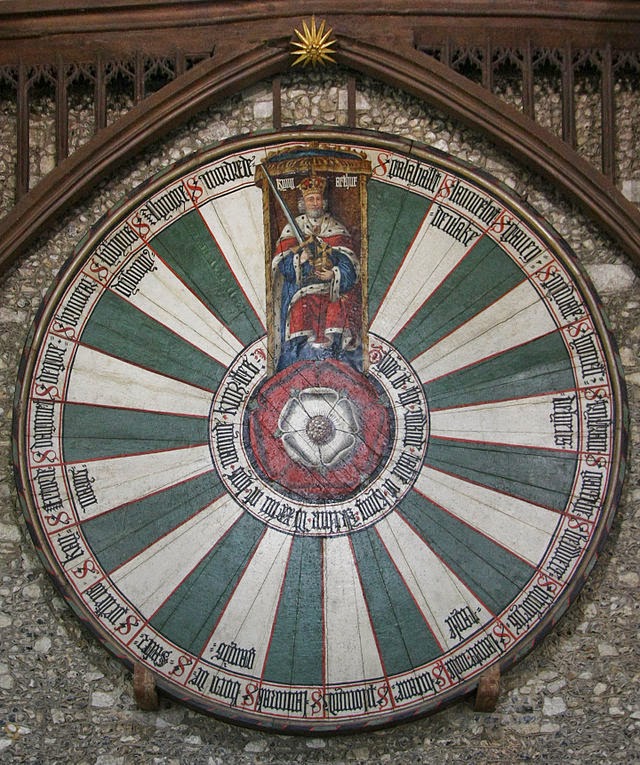
With a date too late for King Arthur, it is possible that Malory knew only that Winchester had been the captial of England and used it as his base for Camelot for this reason.  However, it is more likely that Malory was influenced by the presence of King Arthur's Round Table, which can still be seen in the Great Hall of Winchester Castle.  William Caxton used this table as proof of King Arthur's existence.


King Arthur's Round Table

The Round Table itself bears the names of various knights from Arthur's Court and was probably created for a Round Table tournament, a festival of the Middle Ages.  Made of oak, the table measures 18ft across and weighs 1.25 tonnes.  The paintwork is late, having been reworked  by order of King Henry VIII for the 1520 state visit of the Holy Roman Emperor Charles V, and depicts King Henry VIII sitting in King Arthur's seat above a Tudor rose.


Despite its Arthurian connections, the Winchester Round Table dates from no earlier than the 13th century, when it may have been constructed at the command of King Edward II.  It is believed King Edward II was considering a revival of the Round Table as an Order of Chivalry.  However, he changed his mind and decided on the Order of the Garter.


There seems to be little, if anything, else to connect Winchester with King Arthur's Camelot.  Winchester Castle itself was built in the 11th century, far too late for King Arthur.  And the Round Table which hangs in the great hall is again far too late, having been made in the 13th century or later.  Many believed that Malory, taking inspiration from the Round Table which hangs there, simply based his Camelot in Winchester as it was a known captial of England.


While there are many locations purported to be King Arthur's Camelot, many believe that the name itself is nothing more than an invention of Chretien de Troyes imagination.  After all, the name Camelot was unheard of until the late 1100s.  You would expect the name to appear in the oldest literature to tell of Arthur and his Court, yet it doesn't and, for this reason, most claim that Camelot is nothing more than a myth.

However, it is possible that the name Camelot was derived from another place name.  It is also interesting to note that Norma Goodrich, described as the foremost living authority on King Arthur, has been quoted saying that it was customary for a king to refer to the castle at which he was staying as 'Camelot'.  If this assertion is correct, it may be that there is not just one Camelot, but many.

Useful Resources

Le Morte d'Arthur by Sir Thomas Mallory
Revealing King Arthur: Swords, Stones and Digging for Camelot by Christopher Gidlow
King Arthur: The Truth Behind the Legend Paperback by Rodney Castleden
The Oxford Guide to Arthurian Literature and Legend by Alan Lupack

How King Arthur Worked
Britain Express - Winchester Castle

Avalon and the Death of King Arthur


The accounts of King Arthur's final battle remain much the same throughout later literature, with Arthur being taken to Avalon after he is mortally wounded as we are told by Geoffrey of Monmouth:

...and being carried thence to the Isle of Avallon to be cured of his wounds, he gave up the crown of Britain to his kinsman Constantine, the son of Cador, duke of Cornwall, in the five hundred and forty-second year of our Lord's incarnation.

While all literature tells us that Arthur is badly wounded in the Battle of Camlann, the date of the battle seems to vary and we are often not told whether King Arthur dies from his wounds after reaching Avalon.  In Wace's Roman de Brut, this final detail is left open for the reader's interpretation.

...Arthur himself was wounded in the body to the death.  He caused him to be borne to Avalon for the searching of his hurts.  He is yet in Avalon, awaited of the Britons; for as they say and deem he will return from whence he went to live again.  Master Wace, the writer of this book, cannot add more to this matter of his end than was spoken by Merlin the prophet.  Merlin said of Arthur - if I read aright - that his end should be hidden in doubtfulness.  The prophet spoke truly.  Men have ever doubted and - I am persuaded - will always doubt whether he liveth or is dead.


Like is Geoffrey's Historia, Wace tells us that Arthur bade that he should be carried to Avalon in this hope in the year 642 of the Incarnation.  He gives a much later date for the battle but agrees with Geoffrey that Arthur hands over his kingdom to Constantine: commanding him to hold it as king until he returned to his own.  The earl took the land to his keeping.  He held it as hidden, but nevertheless Arthur never came again.

The end of Arthur's life is much the same in Malory's Le Morte d'Arthur, with Arthur being taken to Avalon by Morgan le Fay to be healed of his wounds. 

Comfort thyself, said the king, and do as well as thou mayst, for in me is no trust for to trust in; for I will into the vale of Avilion to heal me of my grievous wound: and if thou hear never more of me pray for my soul.
Avalon by raysheaf

Malory does not tell us that Arthur dies from his wounds, again leaving it up to the reader to interpret.

Yet some men say in many parts of England that King Arthur is not dead, but had by the will of our Lord Jesu into another place; and men say that he shall come again, and he shall win the holy cross.  I will not say it shall be so, but rather I will say, here in this world he changed his life.  But many men say that there is written upon his tomb this verse: Hic jacet Arthurus, Rex quondam, Rexque futurus.

Despite these accounts leaving King Arthur's fate open to interpretation, later tradition assumes that Arthur died and was buried in Avalon, which is traditionally identified with Glastonbury.  Glastonbury has been deemed as suitable for a High-King,; the most holy place in Britain due to Glastonbury's Vetusta Ecclesia or Old-Church, which is said to have been founded by St. Joseph of Arimathea.  The Isle of Avalon is also known as the 'place of apple' and apparently Glastonbury was once known as the 'Isle of Avalon'.  While no one today would consider Glastonbury to be an island, in the 5th century it was surrounded by lakes and marshes for several kilometres.  And it was, for centuries, noted for its delicious, red apples.  While this is an interesting coincidence, it is not absolute proof that Glastonbury is the Avalon of Arthurian legend.


Glastonbury was once the richest and most important abbey in the country but, in the 12th century, the abbey and some of the surrounding buildings burned to the ground.  Then, in 1190, the monks were in desperate need of pilgrim-attracting  relics.  After receiving information, which had been passed onto King Henry II by 'an ancient Welsh band', that King Arthur had been buried on the grounds of Glastonbury.  They dug beneath 'two pyramids' and later claimed that they had discovered the bones of both King Arthur and Guinevere.  To prove that the bones were authentic the monks produced an inscribed leaden cross which they claimed to have discovered above the grave.

Gerald of Wales, a medieval historian, wrote two accounts of this claimed discovery.  One was included in Liber de Principis instructione, written in 1193.
"Leaden cross found in Arthur's grave, Glastonbury" William Camden

In my own lifetime Arthur's body was discovered at Glastonbury although the legends had always encouraged us to believe that there was something otherworldly about his ending, that he had resisted death and had been spirited away to some far-distant spot.  The body was hidden deep in the earth in a hollowed-out oak bole and between two stone pyramids which had been set up long ago in the churchyard there...  It had been provided with most unusual indications, which were, indeed, little short of miraculous, for beneath it, and not on top, as would be the custom nowadays, there was a stone slab, with a leaden cross attached to its underside.  I have seen this cross myself and I have traced the letting which was cut into it on the side turned toward the stone, instead of being on the outer side and immediately visible.
The inscription reads as follows:

HERE IN THE ISLE OF AVALON LIES
BURIED THE RENOWNED KING ARTHUR,
WITH GUINEVERE, HIS SECOND WIFE

...There has been some indication in the Abbey records that the body would be discovered on this spot, and another clue was provided by lettering carved on the pyramids, but this had been almost erased by the passage of the years...  However, it was Henry II, King of England, who had told the monks that, according to a story which he had heard from some old British soothsayer, they would find Arthur's body buried at least 16ft in the ground, not in a stone coffin but in a hollowed-out oak bole.  It had been sunk as deep as that, and carefully concealed so that it could never be discovered by the Saxons.

There were other accounts of the discovery of the grave and the cross which appeared in various other chronicles, all of which included or omitted details which others did not.  It total there are at least five other versions of the discovery, all of which have differing details.  These inconsistencies led many scholars to believe that a great hoax had been perpetrated by the Glastonbury monks.  Adding to their suspicions aroused by these differing accounts, the possibility of this having been a hoax gains strength when the Glastonbury monks' other possible motives came to their attention.
In 1184, Glastonbury abbey church, the greatest in England, and some say 'possibly in all of Christiandom', was completely destroyed by fire - just a few short years before the 'discovery' was made.  Their greatest pilgrim attraction, the Old Church, burned along with it.  The monks' chief benefactor, King Henry II, died and King Richard was unconcerned, leaving the monks with no one to finance their efforts to rebuild.  The location of Arthur's grave had never been identified nor even speculated about, giving the monks an opportunity to provide a location for it.  To top it all off, the Norman Kings were concerned about the possibility of a Welsh rebellion and were keen to prove that King Arthur was indeed dead, meaning he would be unable to lead a rebellion.  This would, in turn, discourage the rebellion and provide peace of mind.  Some speculate that the Norman Kings and Glastonbury monks may have even planned the hoax together.

The Old Church as it may have looked in 712AD
The monks apparently documented the discovery of the tomb but, like in many historical 'discoveries', all the physical evidence - the bones, coffin, and the leaden cross - has been lost, leaving us with nothing but the tracings made before it disappeared.  Unfortunately, there is no way to say if these tracings are accurate or not.  The inscription, however, gives the opportunity to date the lettering.  On closer examination the style of some letters within the text were not used until long after King Arthur's time, meaning the cross was almost certainly a forgery.

All we can really glean from Arthurian literature is that Arthur fought and was wounded during the Battle of Camlann before being taken to the Isle of Avalon.  Whether he died from his wounds is left unclear, although we can assume that he did eventually die.  Where he was buried is not known for certain, but some believe that his grave was discovered in 1190 by the Glastonbury monks, while others believe that King Arthur never existed.  And then there are those that think King Arthur and his knights still live but are sleeping, waiting for when they are most needed.


Locating the 12 Great Battles of King Arthur: Part Two

In the last post we looked at the 1st seven battles of King Arthur and their potential locations.  Today we will look at the final five battles which ended in victory.


The eighth was near Gurnion castle, where Arthur bore the image of the Holy Virgin, mother of God, upon his shoulders, and through the power of our Lord Jesus Christ, and the holy Mary, put the Saxons to flight, and pursued them the whole day with great slaughter.
The quote taken for the eighth battle suffers confusion due to the translation of certain Welsh words being misinterpreted.  '...where Arthur bore the image of the Holy Virgin, mother of God, upon his shoulders,..'  The words shield and shoulder may well have been mixed up.  Geoffrey of Monmouth tells us that Arthur bore armonial bearings of both the cross and virgin, more likely on his shield; the arms later adopted by Glastonbury Abbey.

The site for this battle is difficult to identify.  The name Gurnion, also known as Guinnion, is considered to be similar to the Roman fort of Vinovium at Binchester, Durham, although Land's End, Caer Guidn in the British language, has also been suggested.  Another theory suggests a translation of the Saxon Battle of Wihtgarasburh, the Isle of Wight or, in Welsh, Gwyn.  However, some believe that either of the walled towns called Vents by the Romans to be more likely locations.  One of these became the modern Caer-Went in Gwent, where the other is now Winchester in Hampshire.  The latter was the location of a pre-Camlann battle between Arthur and his nephew Mordred, as told by Geoffrey of Monmouth, although modern historians believe a more likely enemy to have been the Saxon invader, Cerdic, who fought in around the year 500AD.


During its transition between names, Winchester was the Romano-British Caer-Guinntguic or Caer Guinn.  -guic would be a corrupt of -iog, which is a standard place-name ending.  -ion was used in a similar way and, despite there being no record of it, an acceptable name would be Caer Guinnion, as with Caer Leir being recorded as Caer Lerion, and Caer Celef having been recorded as Caer Celemion.

The ninth was at the City of Legion, which is called Caer Lion.
The ninth battle can be possibly identified with two locations, both of which were known as City of the Legions or Urbe Legionis.  Some identify the battle to have taken place at Caerleon, where others believe it could have taken place at Chester, at either end of the Welsh border.  Both of these places were home to Roman Legions at various times throughout the Roman occupation.  It is also possible that York bore such a title.  Chester was known as Caer Legion, where Caerleon was known as Caer Legion guer Uisc (Caerleon-upon-Usk), although the later suffix is often lost.


Chester is often the most preferred option, having been recorded in the Annales Cambriae as Urbs Legionis.  This was the site of the Battle of Chester.  In 613, King Aethelfrith of Bernicia invaded the Welsh Kingdoms in order to stop King Iago of Gwynedd from restoring Edwin, an old enemy of the Deiran throne.  The armies of Gwynedd, Powys, Pergwern and Dumnonia fought against him but were defeated at the Battle of Chester, with King Iago of Gwynedd and Selyf Sarffgadau of Powys being killed.  It is thought that this battle could have been taken back 100 years to the time of Arthur.

In Llongborth I saw Arthur,
And brave men who hewed down with steel,
Emperor, and conductor of the toil. 

                                                         From Geraint son of Erbin, Black Book of Caermarthen

Tolstoy, however, prefers Exeter, known to the Romans as Isca Dumnonorium and by the British as Caer Wisc.  A poem in the Black Book of Caermarthen, called Gerint son of Erbin, suggests that this battle took place either at sea or around a harbour.  This is due to the word Llongborth, which may refer to a ship harbour.  Geraint, the hero who fell in this battle, was from Devon, making Exomouth another possible candidate.


The tenth was on the banks of the river Trat Treuroit.
The tenth battle at Trat Treuroit, also known as Tribuit and, more properly, Tryfrwyd, is mentioned in the Black Book of Caermarthen.  Cai Hir (the Tall), Arthur's foster brother of traditional legend, is said to have fought there against a foe called Ganulwyd.  It is believed that Arthur, as Cai's patron in the poem, was the British commander during the battle.

Cai entreated him,
While he killed every third person.
When Celli was lost,
Cuelli was found; and rejoiced
Cai, as long as he hewed down.
Arthur distributed gifts,
The blood trickled down.

                                                     From Arthur and the Porter, Black Book of Caermarthen

Some have identified the location of this battle as the River Frew at Stirling.  Others have suggested the River Ribble in Lancashire, the Severn at Gloucester, and also the Eden at Carlisle.

The eleventh was on the mountain Breguoin, which we call Cat Bregion.
The eleventh battle location was identified by Geoffrey of Monmouth as Edinburgh and most don't disagree with this as there is very little evidence to challenge his identification.  It is known that Edinburgh Castle was occupied during this time and was a strategic point of importance being at the centre of the Kingdom of Gododdin.  It has been suggested that this battle was connected with King Lot of Gododdin, one of the eleven kings who rebelled against Arthur during the start of his reign.


Geoffrey calls Edinburgh Castle the Castle of the Maidens or the Dolorous Castle.  Edinburgh's alias was Din-Eityn, which relates that the settlement is on top of a rock.  During the 7th century there was the Siege of Din-Eityn which some believe has been pushed back to  the time of Arthur.  In a 10th century version of Nennius' History, the battle location is given the alternative name of Breguoin.  Some have suggested that this could be a corruption of Bravonius, a Roman name for Leintwardine in Herefordshire.  This is believed to have been a battle which may have involved King Athrwys of Ergyng, though this location was more often known as Branogenium.

Anoter alternative is that the battle stems from Bremenium, now High Rochester in Northumberland, the site of King Urien Rheged's Battle of the Cells pf Brewyn.  More obscure possible locations include Brent Knoll in Somerset, Ribchester in Lancashire, and Cirencester in Gloucestershire.  Some have also suggested that the tenth and eleventh battles were actually one single, long and hard fought battle.


The twelfth was a most severe contest, when Arthur penetrated to the hill of Badon.  In this engagement, nine hundred and forty fell by his hand alone, no one but the Lord offending his assistance.

516
The Battle of Badon, in which Arthur carried the Cross of our Lord Jesus Christ for three days and three nights on his shoulders and the Britons were the victors.
                                                         Annales Cambriae

The twelfth battle, according to Nennius Arthur's last victorious battle, was the Battle of Badon.  And with this battle we have actual historical evidence to support Nennius' writing.  Popular opinion bases the Battle of Badon between 490 and 516AD, but pinning down the exact date is a cause of much dispute.

It is believed that this battle took place above the city of Bath in Somerset, at Little Solisbury.  Bath was referred to by the Britons and the Celts as Bathon, giving the phonetic spelling of Badon.  The Welsh Monk Gildas states that the Battle of Badon HIll was won by Ambrosius Aurelianus.

After this, sometimes our countrymen, sometimes the enemy, won the field, to the end that our Lord might this land try after his accustomed manner these his Israelites, whether they loved him or not until the year of the siege of Bath-hill, when took place also the last almost, though not the least slaughter of our cruel foes, which was (as I am sure) forty-four years and one month after the landing of the Saxons, and also the time of my own nativity.


Tolstoy identifies the location as Bathamption, a hill just outside of Bath, tying in nicely with Geoffrey's suggestion.  Despite Bath being a very popular contender for the location of this battle, there have been other suggestions.  These include Bawden Hill in Lothian, Dumbarton Rock in Strathclyde, Mynydd Baedon in Glamorgan, Little Salway Hill in Somerset and Brenth Knoll, also in Somerset.  Modern theory, however, suggests one of the many Badburys around the country, giving us countless possibilities for the location of this battle.

That's all for today.  Next time we will look at the final battle of King Arthur.


Useful Resources
  
Historia Brittonum by Nennius
Annales Cambriae
The Black Book of Carmarthen
Gildas (c.504-570): Works

Historia Regum Britanniae by Geoffrey of Monmouth
The Oxford Guide to Arthurian Literature and Legend by Alan Lupack
Revealing King Arthur: Swords, Stones and Digging for Camelot by Christopher Gidlow
King Arthur: The Truth Behind the Legend by Rodney Castleden
The Historic King Arthur: Authenticating the Celtic Hero of Post-Roman Britain By Frank D. Reno

The Battles of King Arthur
King Arthur and His BattlesThe Battle of Mount Badon by Sam Boyer
The Deadliest Blogger


Monday, 17 November 2014

Looking For King Arthur's Camelot - Caerleon: The City of Legions


Caerleon: The City of Legions

Although Chretien de Troyes mentioned Caerleon and Camelot separately, Geoffrey of Monmouth tells of how Arthur held his Court at The City of Legions, and there is little doubt that this was Caerleon in Wales, although Geoffrey does not give it the name Camelot.


'...he [Arthur] pitched upon the City of Legions [Caerleon] as a proper place for his purpose. For besides its great wealth above the other cities, its situation, which was in Glamorganshire upon the river Uske, near the Severn sea, was most pleasant, and fit for so great a solemnity. For on one side it was washed by that noble river, so that the kings and princes from the countries beyond the seas might have the convenience of sailing up to it. On the other side, the beauty of the meadows and groves, and magnificence of the royal palaces with lofty gilded roofs that adorned it, made it even rival the grandeur of Rome. It was also famous for two churches; whereof one was build in honour of the martyr Julius, and adorned with a choir of virgins, who had devoted themselves wholly to the service of God; but the other, which was founded in memory of St. Aaron, his companion, and maintained a convent of canons, was the third metropolitan church of Britain. Besides, there was a college of two hundred philosophers, who, being learned in astronomy and the other arts, were diligent in observing the courses of the stars, and gave Arthur true predictions of the events that would happen at that time. In this place, therefore, which afforded such delights, were preparations made for the ensuing festival.'


With it's splendid Roman remains, Caerleon would have been an impressive place for Arthur to hold Court for important rulers.  We can also be fairly sure that only a professional army could have defended the Roman fortress ruins.  However, some believe Caerleon may have just been a meeting place for Arthur and so we should look at the surrounding hilltops for possible locations of his 'castle'.  Interestingly, such a site exists less than a mile north of the village - a fortification known as Belinstocke.

Caerleon is another site that is said to have a hidden cave where King Arthur and his knights slumber.  Here they are said to wait to be called on to save their country in its hour of need.  One local tale tells of a farmer who met a mounted man wearing a 3-cornered hat, who promised to show him something amazing.  He took the farmer to the middle of a woods, stopping in front of a sheer rock face.  He pushed a large boulder away to reveal a hidden cave.  The man led the farmer inside, passing two bells and descending into a huge underground cavern.  Here the farmer observed over a thousand knights, with King Arthur at their head.  All slept.  On leaving, the farmer knocked one of the two great bells, waking the sleeping men who immediately asked, 'Is is time?'  The man told them it was not yet time and that they should continue to sleep.  The knights returned to their slumber.  The man and the farmer left the cave, where they parted ways without a word.  The farmer is said to have searched for the cave many times but could never find it again.


In the preface of Le Mort d'Arthur by Sir Thomas Mallory, William Caxton tells us that Camelot is located in Wales, describing ruins of a city that sound much like Caerleon.

'...in Wales, in the town of Camelot, the great stones and the marvellous works of iron lying underground, and the royal vaults which many now living have seen.

This part of Wales, believed to be Gwent, became a Dark Age kingdom which was ruled by Atrwys ap Meurig, who is believed by some to be 'the real King Arthur'.


Caerleon is especially noted for Arthur's Table, the Roman amphitheatre, which is where King Arthur is said to have been appointed St. Dyfric as an Archbishop of St. Aaron's Cathedral in Caerleon.  When the Caerleon Excavation Committee formed in 1926, Sir Mortimer Wheeler, the Director of the National Museum in Wales, made the most of the connection between King Arthur's Round Table and the Roman amphitheatre, commenting that it was 'likely to attract considerable funds required for a long-term programme of work.'  Wheeler announced his project to the media, with the Daily Mail soon offering to give the Committee £1,000 for exclusive rights and daily reports of the excavation of''King Arthur's Round Table'.  By the time the agreement was made, the Daily Mail had tripled their offer and carried daily 'sensational' reports, despite Wheeler being accused of shameless exploitaton and no Dark Age remains were reported.

But Wheeler's connection between King Arthur's Round Table and the Roman amphitheatre was not the first.  In 1587, Thomas Churchyard wrote of the Roman amphitheatre at Caerleon:

In Arthur's tyme, a table round,
Was where at he sate:
As yet a plot of goodly ground,
Sets forth that rare estate...


And this is not the earliest connection between the two.  According to a French source, Chronique Religieus de St Denys, in 1405 the French army, who had landed at Milford Haven to support Owain Glyn Dwr in his uprising against the English Crown, went to Caerleon, once known as the legionary fortress Isca.  They are then said to have visited 'The Round Table of Arthurian legend', which was in fact the Roman amphitheatre.  Those that believe Caerleon is a contender for Arthur's Camelot claim that the addition of Arthur's Table strengthens the theory.


That's it for today.  Tomorrow we will look at one more potential contender for King Arthur's Camelot.  Until next time.


Useful Resources

Le Morte D'Arthur by Sir Thomas Malory
Historia Refum Britanniae [History of the Kings of Britain] by Geoffrey of Monmouth
King Arthur: The Truth Behind the Legend by Rodney Castleden
Revealing King Arthur: Swords, Stones and Digging for Camelot by Christopher Gidlow
Caerleon and Arthur

King Arthur: The Men That Made The Legend

Many have raised the question of whether King Arthur was a real person or an entirely mythical creation.  Unfortunately there is no historical evidence that the King Arthur ever existed.  However, this doesn't mean that he and his accomplishments were merely an invention of the mind.  It's more plausible that King Arthur was a combination of many different men who existed at different points throughout history.  Let's take a look at some of the men who may be connected to the King Arthur we know today.


Magnus Maximus

One of the greatest figures in Britain towards the end of the Roman Empire was Magnus Maximus - the Prince Macsen, the Macsen Wledig of Welsh legend.  General Magnus Clemens Maximus was a Celt and an uncle of the Welsh King Coel Godhehog (believed to have been the Old King Cole of the nursery rhyme) by marriage.  Born to a poor Spanish family, Maximus took up a military career and served under Theodasius the Elder in Britain in 369AD and in Africa from 373 to 375AD.  He was rewarded with overall military command in Britain for his efforts, where he successfully campaigned against the Scots and Picts.

The army are said to have been very much dissatisfied with their emperor Gratian.  They were particularly jealous of the privileges given to barbarian units fighting for the emperor, which sparked disagreements between the soldiers.  This led to the British garrison revolting in 383AD, with the soldiers proclaiming Maximus as the new emperor of the west.  When Gratian marched west with his troops to meet with an usurper as Lutetia, his troops deserted him, changing their allegiance to Maximus.  Gratian fled but Maximus 'Master of Horse' caught up with him and Gratian was assasinated.


Maximus established his captial at Treviri, beginning negotiations with Theodasius, who reluctantly recognized him as emperor.  With this recognition, Maximus adopted the name Flavius, portraying himself as a member of the imperial house.  As an orthodox Catholic, Maximus vehemently chased down and punished heretics and pagans.

In 387AD, Maximus made his son, Flavius Victor, co-emperor and invaded Italy, successfully banishing Valentinian II, who fled with his mother to Theodasius in Constantinople.  Maximus then moved to increase his influence but was attacked by Theodasius.  In 388AD, Maximus was captured and, while he pleaded for mercy, was executed.  His sone was also captured and put to death.

Maximus's campaigns against the Picts and Scots probably inspired and influenced some of the later legends of King Arthur's own campaigns against them.


Ambrosius Aurelianus

While too ancient to have been King Arthur,  Ambrosius Aurelianus, sometimes referred to as Aurelius Ambrosius, was a powerful Romano-British leader in Britain.  He was well known for his campaigns against the Saxons and some have questioned whether he may have led the British forces during the Battle of Badon Hill.  The date of the Battle of Badon Hill, while disputed, is widely accepted by scholars to have taken place in around 500AD.


In Gildus's 'On the Ruin of Britain', he tells us that, following a colossal Saxon invasion, Aurelianus was the only person to remain calm, even having suffered the death of his family and countless Roman settlers during the attack.  As a result, Aurelianus became the commander of the survivors and led them in battle against the Saxons, winning them their first victory.

...as the poet says,—"With their unnumbered vows they burden heaven," that they might not be brought to utter destruction, took arms under the conduct of Ambrosius Aurelianus, a modest man, who of all the Roman nation was then alone in the confusion of this troubled period by chance left alive. His parents, who for their merit were adorned with the purple, had been slain in these same broils, and now his progeny in these our days, although shamefully degenerated from the worthiness of their ancestors, provoke to battle their cruel conquerors, and by the goodness of our Lord obtain the victory.

Gildas tells us that Aurelianus' parents 'were adorned with the purple,..implying that he was a descendant of Roman emperors.  While he is spoken of in Gildas' writing, we are not told who commanded during the Battle of Badon.  Many are of the opinion that Aurelianus lived in the generation before the Battle of Badon took place.


Geoffrey of Monmouth, who is regarded as somewhat unreliable, makes Aurelianus a King of Britain as well as the older brother of Uther Pendragon (Arthur's father), thus forging a connection between King Arthur and Aurelianus.  It is considered unlikely that Aurelianus commanded the British forces during the Battle of Badon, as he is believed to have been in his prime in the early 5th century.  However, his conquests against the Saxons may have influenced the modern view of King Arthur.

Lucius Artorius Castus

Lucius Artorius Castus is believed to have been a Sarmatian cavalry officer during the late 2nd and 3rd century, making him 400 years too young to have actually been King Arthur.  It's believed his deeds had an influence in the later Arthurian tales, along with the Sarmatians and their beliefs.  The theory that King Arthur was ultimately based on Castus was first suggested by Kemp Malone and was revived by C. Scott Littleton and Linda  A. Malcor in 1994.  At this point it was also suggested that the nomadic Alans and Sarmatians, who settled in Western Europe in late Antiquity, also influenced the legends.


All we know of Castus comes from twi Latin inscriptions which were discovered during the 19th century in Podstrana.  After a long and memorable career in the Roman army as a centurian and primus pilus, Castus was promoted to praedectus legionis of the VI Victrix, a unit based in Eboracum (York) from 122AD.  He served as third-in-command of the legion, taking responsibility for the upkeep of the legionary headquarters.  Castus was later given the temporary title of dux legionum, making him responsible for units with British associations in an expedition against an unknown enemy on the Continent.  After this he apparently became a civil governor of the province of Liburnia, where he died and was buried.

Malcor suggests that Castus first fought against the Sarmations early inhis military career.  This gave him valuable insight into their unique fighting style and led to his assignment  of command over a small group of Sarmatians based in Ribchester in 181AD.  Malcor also proposes that Castus also led these Sarmatians during a campaign against invading Cadedonians, who overwhelmed Hadrian's Wall between 183 and 185AD.  After the collapse of Castus' legion, Malcor believes that he returned to the city of Eboracum before he was sent to lead cavalry cohorts against an uprising in what is modern Brittany, then Armorica.


During this time, the Sarmatians were allowed to keep to their own customs, gods and traditions, which included the religious practise of worshipping a 'sword in the stone'.  They fought beneath a windsack-style banner in the shape of a dragon.  Excalibur was originally known as Caliburn meaning white steel.  A tribe of Sarmatian smiths, who were known as Kalybes, had the words chalylous meaning steel and eburnus meaning white.  Some believe that the name Caliburn comes from these two words -  chaly + burn.  Sarmatian legend also tells of a fearsome warrior who wielded an unstoppable sword which had connections with a magical water ritual, with some drawing a connection with Excalibur.  Castus himself fought on horseback beneath a dragon banner, dressed in steel armour, wielding a white-steel sword, making him sound almost medieval.


While some think it nothing more than coincidence, many believe that Castus' very definitive career in the military and the historical customs and traditions of the Sarmatians may have influenced and inspired events in later Arthurian literature and legend.

Riothamus

According to Geoffrey Ashe, who has studied King Arthur for around 50 years, King Arthur could have been inspired by the Dark Age ruler, Riothamus.  Riothamus is historically documented at around the right time to fit in with Arthurian legend.  He is believed to have gone on an expedition to France, on a resuce mission to help one of the last Roman emperors to fight of a barbarian army.  Arthurian legend tells us that King Arthur went to France.

Another link can be made when looking at the defeat of these two men.  Riothamus' defeat came as a result of deadly betrayal, after which he disappeared and was last seen in Avalon in Burgandy.  This gives his story a remarkable resemblence to the legend of King Arthur.   


The only thing that doesn't fit is the name.  Ashe commented, 'He is recorded as Riothamus, which, in Irish, is a title meaning the High King or Supreme King.'  Some wonder if, as Riothamus is merely a title, he may have been King Arthur.  Without historical evidence, however, it is impossible to say.  But with his connection to Avalon, he may have influenced the tales of King Arthur.

Arthur ap meurig Tewdrig

This theory, first proposed in the 18th century, claims that the basis for King Arthur was a historical king of Glamorgan and Gwent: Arthur ap meurig Tewdrig.  He was a Christian based in Caerleon and died in around 575AD, with his body being taken to the coast by ship up the River Ewenny.  According to some sources, he was buried in a cave by a saint who is said to have been Arthur's cousin.  Here his body was left for many years, keeping his death a secret until his son, Morgan, was old enough to take his place.


Alan Wilson and Buram Blackett claimed to have discovered a cave in a wood near the River Ewenny.  The cave itself is called Coed-y-mwstwr and has been described as a man-made cavity or grave.  The body was later buried in St. Peter's Church.  Wilson and Blackett also discovered a 5cwt sword-shaped stone bearing the inscription REX ARTORIUS FILI MARICUS, which translates to King Arthur son of Meurig.  The stone was removed to Cardiff.

While there is no historical record of the deeds Arthur may have committed during his lifetime, his basis in Caerleon and the belief that his body was removed by ship seems to link in with our legendary King Arthur.

Other Possible Links

Graham Phillips suggested that a 5th centiru king who may have ruled one of the last British strongholds may have provided inspiration for King Arthur.  During the Roman times, the four major cities were London, Lincoln, York, and Viriconium.  Where London, Lincoln and York fell to the Saxon onslaught, Viriconium remained and was ruled by Owain Ddolantgwyn.  Owain's son was known as 'The Bear'.  When looking at the modern Welsh language, which is derived from ancient British, an interesting coincidence is revealed.  The Welsh word for 'bear' is 'arth', and the Latin word is 'ursis', which leads us to 'Arthursis'.  King Arthur was sometimes known as The Bear, and some claim that Owain's son may have provided inspiration in the legend.


Two other men possibly associated to the evolution of the King Arthur of legend are King Athrwys of Ergyng and King Arthuis of the Pennines.  King Arthur is believed to have held court at Caerleon, which was once deep in the heart of King Athrwys kingdom.  King Arthuis is said to have battled against the Picts on numerous occasions.  Some believe that, with such similar names, these men may have played their parts in the later legend of King Arthur.

While we will probably never know if King Arthur was real or totally mythical, many believe that his roots lie in historical events and men like those written here - a mixture of myth and reality and a combination of many different men who committed deeds much like those found in the legend of King Arthur.


That's all for today.  Until next time.

Useful Resources

King Arthur: The Truth Behind the Legend by Rodney Castleden
Revealing King Arthur: Swords, Stones and Digging for Camelot by Christopher Gidlow
The Historic King Arthur: Authenticating the Celtic Hero of Post-Roman Britain By Frank D. Reno
King Arthur: Hero and Legend By Richard Barber
Magnus Maximus