Showing posts with label Table. Show all posts

Tuesday, 18 November 2014

Looking for King Arthur's Camelot - Winchester

Today we will look at the one more potential location for King Arthur's Camelot - Winchester.

Despite William Caxton's assertion that Camelot was to be found in Wales, Sir Thomas Mallory, writing in Le Morte d'Arthur (1485), identified Winchester as King Arthur's Camelot:

...and so by adventure it swam down the stream to the City of Camelot, that is in English Winchester.


Winchester Castle

Winchester Castle, built in 1067 and within a year of the Norman Conquest, served for over a century as the seat of government and was, at the time, considered one of the greatest strongholds in England.  It was rebuilt and extended first by Henry III, who added the Great Hall, and then by Edward II who, with his wife, Margaret of France, narrowly escaped death when the castle's royal apartments were destroyed in a fire.  During the English Civil War the castle was held by royalist forces and finally fell in 1646 when Oliver Cromwell ordered its destruction.  As a consequence, very little remains from the early period.

Charles II later commissioned Sir Christopher Wren to build King's House, with a view of this new royal palace being elaborate enough to rival France's palace of Versailles.  However, James II abandoned the plans and only Henry III's Great Hall survived, giving us a small glimpse into how the original castle may have looked.


With a date too late for King Arthur, it is possible that Malory knew only that Winchester had been the captial of England and used it as his base for Camelot for this reason.  However, it is more likely that Malory was influenced by the presence of King Arthur's Round Table, which can still be seen in the Great Hall of Winchester Castle.  William Caxton used this table as proof of King Arthur's existence.


King Arthur's Round Table

The Round Table itself bears the names of various knights from Arthur's Court and was probably created for a Round Table tournament, a festival of the Middle Ages.  Made of oak, the table measures 18ft across and weighs 1.25 tonnes.  The paintwork is late, having been reworked  by order of King Henry VIII for the 1520 state visit of the Holy Roman Emperor Charles V, and depicts King Henry VIII sitting in King Arthur's seat above a Tudor rose.
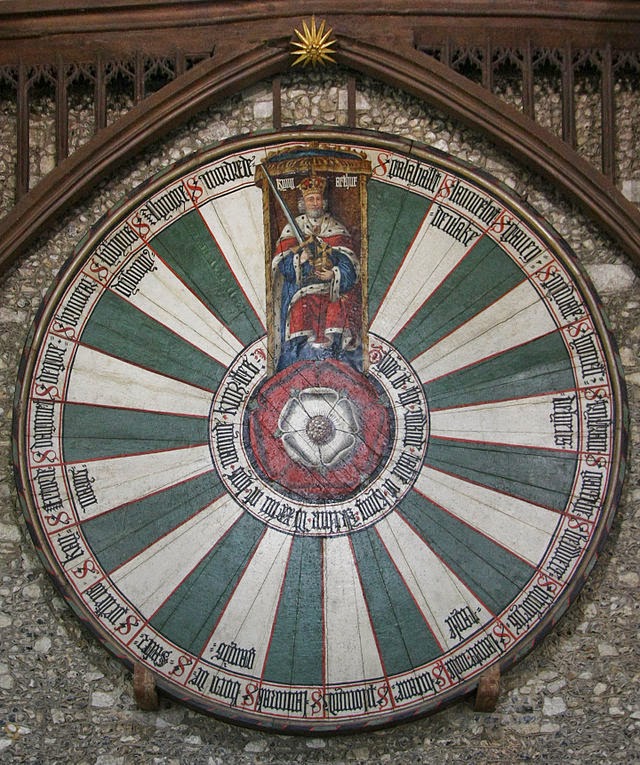

Despite its Arthurian connections, the Winchester Round Table dates from no earlier than the 13th century, when it may have been constructed at the command of King Edward II.  It is believed King Edward II was considering a revival of the Round Table as an Order of Chivalry.  However, he changed his mind and decided on the Order of the Garter.


There seems to be little, if anything, else to connect Winchester with King Arthur's Camelot.  Winchester Castle itself was built in the 11th century, far too late for King Arthur.  And the Round Table which hangs in the great hall is again far too late, having been made in the 13th century or later.  Many believed that Malory, taking inspiration from the Round Table which hangs there, simply based his Camelot in Winchester as it was a known captial of England.


While there are many locations purported to be King Arthur's Camelot, many believe that the name itself is nothing more than an invention of Chretien de Troyes imagination.  After all, the name Camelot was unheard of until the late 1100s.  You would expect the name to appear in the oldest literature to tell of Arthur and his Court, yet it doesn't and, for this reason, most claim that Camelot is nothing more than a myth.

However, it is possible that the name Camelot was derived from another place name.  It is also interesting to note that Norma Goodrich, described as the foremost living authority on King Arthur, has been quoted saying that it was customary for a king to refer to the castle at which he was staying as 'Camelot'.  If this assertion is correct, it may be that there is not just one Camelot, but many.

Useful Resources

Le Morte d'Arthur by Sir Thomas Mallory
Revealing King Arthur: Swords, Stones and Digging for Camelot by Christopher Gidlow
King Arthur: The Truth Behind the Legend Paperback by Rodney Castleden
The Oxford Guide to Arthurian Literature and Legend by Alan Lupack

How King Arthur Worked
Britain Express - Winchester Castle

Monday, 17 November 2014

Looking For King Arthur's Camelot - Caerleon: The City of Legions


Caerleon: The City of Legions

Although Chretien de Troyes mentioned Caerleon and Camelot separately, Geoffrey of Monmouth tells of how Arthur held his Court at The City of Legions, and there is little doubt that this was Caerleon in Wales, although Geoffrey does not give it the name Camelot.


'...he [Arthur] pitched upon the City of Legions [Caerleon] as a proper place for his purpose. For besides its great wealth above the other cities, its situation, which was in Glamorganshire upon the river Uske, near the Severn sea, was most pleasant, and fit for so great a solemnity. For on one side it was washed by that noble river, so that the kings and princes from the countries beyond the seas might have the convenience of sailing up to it. On the other side, the beauty of the meadows and groves, and magnificence of the royal palaces with lofty gilded roofs that adorned it, made it even rival the grandeur of Rome. It was also famous for two churches; whereof one was build in honour of the martyr Julius, and adorned with a choir of virgins, who had devoted themselves wholly to the service of God; but the other, which was founded in memory of St. Aaron, his companion, and maintained a convent of canons, was the third metropolitan church of Britain. Besides, there was a college of two hundred philosophers, who, being learned in astronomy and the other arts, were diligent in observing the courses of the stars, and gave Arthur true predictions of the events that would happen at that time. In this place, therefore, which afforded such delights, were preparations made for the ensuing festival.'


With it's splendid Roman remains, Caerleon would have been an impressive place for Arthur to hold Court for important rulers.  We can also be fairly sure that only a professional army could have defended the Roman fortress ruins.  However, some believe Caerleon may have just been a meeting place for Arthur and so we should look at the surrounding hilltops for possible locations of his 'castle'.  Interestingly, such a site exists less than a mile north of the village - a fortification known as Belinstocke.

Caerleon is another site that is said to have a hidden cave where King Arthur and his knights slumber.  Here they are said to wait to be called on to save their country in its hour of need.  One local tale tells of a farmer who met a mounted man wearing a 3-cornered hat, who promised to show him something amazing.  He took the farmer to the middle of a woods, stopping in front of a sheer rock face.  He pushed a large boulder away to reveal a hidden cave.  The man led the farmer inside, passing two bells and descending into a huge underground cavern.  Here the farmer observed over a thousand knights, with King Arthur at their head.  All slept.  On leaving, the farmer knocked one of the two great bells, waking the sleeping men who immediately asked, 'Is is time?'  The man told them it was not yet time and that they should continue to sleep.  The knights returned to their slumber.  The man and the farmer left the cave, where they parted ways without a word.  The farmer is said to have searched for the cave many times but could never find it again.


In the preface of Le Mort d'Arthur by Sir Thomas Mallory, William Caxton tells us that Camelot is located in Wales, describing ruins of a city that sound much like Caerleon.

'...in Wales, in the town of Camelot, the great stones and the marvellous works of iron lying underground, and the royal vaults which many now living have seen.

This part of Wales, believed to be Gwent, became a Dark Age kingdom which was ruled by Atrwys ap Meurig, who is believed by some to be 'the real King Arthur'.


Caerleon is especially noted for Arthur's Table, the Roman amphitheatre, which is where King Arthur is said to have been appointed St. Dyfric as an Archbishop of St. Aaron's Cathedral in Caerleon.  When the Caerleon Excavation Committee formed in 1926, Sir Mortimer Wheeler, the Director of the National Museum in Wales, made the most of the connection between King Arthur's Round Table and the Roman amphitheatre, commenting that it was 'likely to attract considerable funds required for a long-term programme of work.'  Wheeler announced his project to the media, with the Daily Mail soon offering to give the Committee £1,000 for exclusive rights and daily reports of the excavation of''King Arthur's Round Table'.  By the time the agreement was made, the Daily Mail had tripled their offer and carried daily 'sensational' reports, despite Wheeler being accused of shameless exploitaton and no Dark Age remains were reported.

But Wheeler's connection between King Arthur's Round Table and the Roman amphitheatre was not the first.  In 1587, Thomas Churchyard wrote of the Roman amphitheatre at Caerleon:

In Arthur's tyme, a table round,
Was where at he sate:
As yet a plot of goodly ground,
Sets forth that rare estate...


And this is not the earliest connection between the two.  According to a French source, Chronique Religieus de St Denys, in 1405 the French army, who had landed at Milford Haven to support Owain Glyn Dwr in his uprising against the English Crown, went to Caerleon, once known as the legionary fortress Isca.  They are then said to have visited 'The Round Table of Arthurian legend', which was in fact the Roman amphitheatre.  Those that believe Caerleon is a contender for Arthur's Camelot claim that the addition of Arthur's Table strengthens the theory.


That's it for today.  Tomorrow we will look at one more potential contender for King Arthur's Camelot.  Until next time.


Useful Resources

Le Morte D'Arthur by Sir Thomas Malory
Historia Refum Britanniae [History of the Kings of Britain] by Geoffrey of Monmouth
King Arthur: The Truth Behind the Legend by Rodney Castleden
Revealing King Arthur: Swords, Stones and Digging for Camelot by Christopher Gidlow
Caerleon and Arthur