Showing posts with label castle. Show all posts

Tuesday, 18 November 2014

Looking for King Arthur's Camelot - Winchester

Today we will look at the one more potential location for King Arthur's Camelot - Winchester.

Despite William Caxton's assertion that Camelot was to be found in Wales, Sir Thomas Mallory, writing in Le Morte d'Arthur (1485), identified Winchester as King Arthur's Camelot:

...and so by adventure it swam down the stream to the City of Camelot, that is in English Winchester.


Winchester Castle

Winchester Castle, built in 1067 and within a year of the Norman Conquest, served for over a century as the seat of government and was, at the time, considered one of the greatest strongholds in England.  It was rebuilt and extended first by Henry III, who added the Great Hall, and then by Edward II who, with his wife, Margaret of France, narrowly escaped death when the castle's royal apartments were destroyed in a fire.  During the English Civil War the castle was held by royalist forces and finally fell in 1646 when Oliver Cromwell ordered its destruction.  As a consequence, very little remains from the early period.

Charles II later commissioned Sir Christopher Wren to build King's House, with a view of this new royal palace being elaborate enough to rival France's palace of Versailles.  However, James II abandoned the plans and only Henry III's Great Hall survived, giving us a small glimpse into how the original castle may have looked.


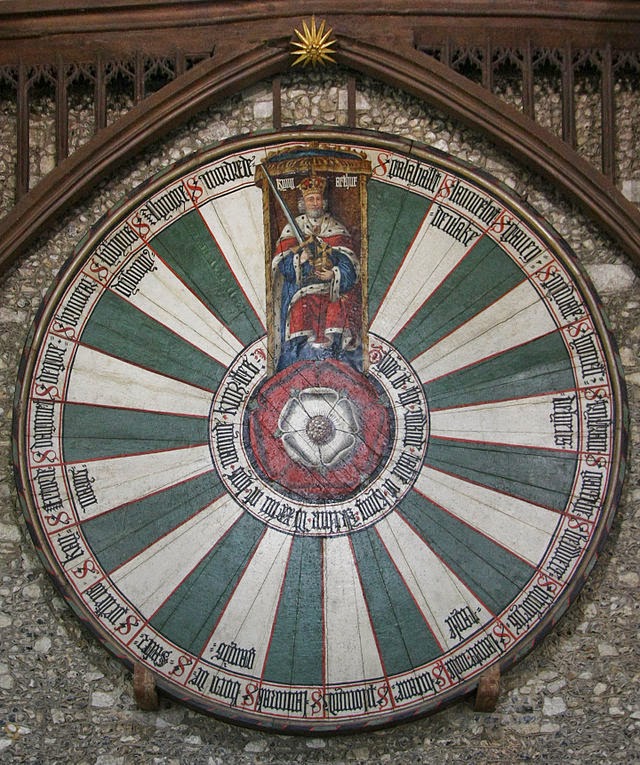
With a date too late for King Arthur, it is possible that Malory knew only that Winchester had been the captial of England and used it as his base for Camelot for this reason.  However, it is more likely that Malory was influenced by the presence of King Arthur's Round Table, which can still be seen in the Great Hall of Winchester Castle.  William Caxton used this table as proof of King Arthur's existence.


King Arthur's Round Table

The Round Table itself bears the names of various knights from Arthur's Court and was probably created for a Round Table tournament, a festival of the Middle Ages.  Made of oak, the table measures 18ft across and weighs 1.25 tonnes.  The paintwork is late, having been reworked  by order of King Henry VIII for the 1520 state visit of the Holy Roman Emperor Charles V, and depicts King Henry VIII sitting in King Arthur's seat above a Tudor rose.


Despite its Arthurian connections, the Winchester Round Table dates from no earlier than the 13th century, when it may have been constructed at the command of King Edward II.  It is believed King Edward II was considering a revival of the Round Table as an Order of Chivalry.  However, he changed his mind and decided on the Order of the Garter.


There seems to be little, if anything, else to connect Winchester with King Arthur's Camelot.  Winchester Castle itself was built in the 11th century, far too late for King Arthur.  And the Round Table which hangs in the great hall is again far too late, having been made in the 13th century or later.  Many believed that Malory, taking inspiration from the Round Table which hangs there, simply based his Camelot in Winchester as it was a known captial of England.


While there are many locations purported to be King Arthur's Camelot, many believe that the name itself is nothing more than an invention of Chretien de Troyes imagination.  After all, the name Camelot was unheard of until the late 1100s.  You would expect the name to appear in the oldest literature to tell of Arthur and his Court, yet it doesn't and, for this reason, most claim that Camelot is nothing more than a myth.

However, it is possible that the name Camelot was derived from another place name.  It is also interesting to note that Norma Goodrich, described as the foremost living authority on King Arthur, has been quoted saying that it was customary for a king to refer to the castle at which he was staying as 'Camelot'.  If this assertion is correct, it may be that there is not just one Camelot, but many.

Useful Resources

Le Morte d'Arthur by Sir Thomas Mallory
Revealing King Arthur: Swords, Stones and Digging for Camelot by Christopher Gidlow
King Arthur: The Truth Behind the Legend Paperback by Rodney Castleden
The Oxford Guide to Arthurian Literature and Legend by Alan Lupack

How King Arthur Worked
Britain Express - Winchester Castle

Locating the 12 Great Battles of King Arthur: Part Two

In the last post we looked at the 1st seven battles of King Arthur and their potential locations.  Today we will look at the final five battles which ended in victory.


The eighth was near Gurnion castle, where Arthur bore the image of the Holy Virgin, mother of God, upon his shoulders, and through the power of our Lord Jesus Christ, and the holy Mary, put the Saxons to flight, and pursued them the whole day with great slaughter.
The quote taken for the eighth battle suffers confusion due to the translation of certain Welsh words being misinterpreted.  '...where Arthur bore the image of the Holy Virgin, mother of God, upon his shoulders,..'  The words shield and shoulder may well have been mixed up.  Geoffrey of Monmouth tells us that Arthur bore armonial bearings of both the cross and virgin, more likely on his shield; the arms later adopted by Glastonbury Abbey.

The site for this battle is difficult to identify.  The name Gurnion, also known as Guinnion, is considered to be similar to the Roman fort of Vinovium at Binchester, Durham, although Land's End, Caer Guidn in the British language, has also been suggested.  Another theory suggests a translation of the Saxon Battle of Wihtgarasburh, the Isle of Wight or, in Welsh, Gwyn.  However, some believe that either of the walled towns called Vents by the Romans to be more likely locations.  One of these became the modern Caer-Went in Gwent, where the other is now Winchester in Hampshire.  The latter was the location of a pre-Camlann battle between Arthur and his nephew Mordred, as told by Geoffrey of Monmouth, although modern historians believe a more likely enemy to have been the Saxon invader, Cerdic, who fought in around the year 500AD.


During its transition between names, Winchester was the Romano-British Caer-Guinntguic or Caer Guinn.  -guic would be a corrupt of -iog, which is a standard place-name ending.  -ion was used in a similar way and, despite there being no record of it, an acceptable name would be Caer Guinnion, as with Caer Leir being recorded as Caer Lerion, and Caer Celef having been recorded as Caer Celemion.

The ninth was at the City of Legion, which is called Caer Lion.
The ninth battle can be possibly identified with two locations, both of which were known as City of the Legions or Urbe Legionis.  Some identify the battle to have taken place at Caerleon, where others believe it could have taken place at Chester, at either end of the Welsh border.  Both of these places were home to Roman Legions at various times throughout the Roman occupation.  It is also possible that York bore such a title.  Chester was known as Caer Legion, where Caerleon was known as Caer Legion guer Uisc (Caerleon-upon-Usk), although the later suffix is often lost.


Chester is often the most preferred option, having been recorded in the Annales Cambriae as Urbs Legionis.  This was the site of the Battle of Chester.  In 613, King Aethelfrith of Bernicia invaded the Welsh Kingdoms in order to stop King Iago of Gwynedd from restoring Edwin, an old enemy of the Deiran throne.  The armies of Gwynedd, Powys, Pergwern and Dumnonia fought against him but were defeated at the Battle of Chester, with King Iago of Gwynedd and Selyf Sarffgadau of Powys being killed.  It is thought that this battle could have been taken back 100 years to the time of Arthur.

In Llongborth I saw Arthur,
And brave men who hewed down with steel,
Emperor, and conductor of the toil. 

                                                         From Geraint son of Erbin, Black Book of Caermarthen

Tolstoy, however, prefers Exeter, known to the Romans as Isca Dumnonorium and by the British as Caer Wisc.  A poem in the Black Book of Caermarthen, called Gerint son of Erbin, suggests that this battle took place either at sea or around a harbour.  This is due to the word Llongborth, which may refer to a ship harbour.  Geraint, the hero who fell in this battle, was from Devon, making Exomouth another possible candidate.


The tenth was on the banks of the river Trat Treuroit.
The tenth battle at Trat Treuroit, also known as Tribuit and, more properly, Tryfrwyd, is mentioned in the Black Book of Caermarthen.  Cai Hir (the Tall), Arthur's foster brother of traditional legend, is said to have fought there against a foe called Ganulwyd.  It is believed that Arthur, as Cai's patron in the poem, was the British commander during the battle.

Cai entreated him,
While he killed every third person.
When Celli was lost,
Cuelli was found; and rejoiced
Cai, as long as he hewed down.
Arthur distributed gifts,
The blood trickled down.

                                                     From Arthur and the Porter, Black Book of Caermarthen

Some have identified the location of this battle as the River Frew at Stirling.  Others have suggested the River Ribble in Lancashire, the Severn at Gloucester, and also the Eden at Carlisle.

The eleventh was on the mountain Breguoin, which we call Cat Bregion.
The eleventh battle location was identified by Geoffrey of Monmouth as Edinburgh and most don't disagree with this as there is very little evidence to challenge his identification.  It is known that Edinburgh Castle was occupied during this time and was a strategic point of importance being at the centre of the Kingdom of Gododdin.  It has been suggested that this battle was connected with King Lot of Gododdin, one of the eleven kings who rebelled against Arthur during the start of his reign.


Geoffrey calls Edinburgh Castle the Castle of the Maidens or the Dolorous Castle.  Edinburgh's alias was Din-Eityn, which relates that the settlement is on top of a rock.  During the 7th century there was the Siege of Din-Eityn which some believe has been pushed back to  the time of Arthur.  In a 10th century version of Nennius' History, the battle location is given the alternative name of Breguoin.  Some have suggested that this could be a corruption of Bravonius, a Roman name for Leintwardine in Herefordshire.  This is believed to have been a battle which may have involved King Athrwys of Ergyng, though this location was more often known as Branogenium.

Anoter alternative is that the battle stems from Bremenium, now High Rochester in Northumberland, the site of King Urien Rheged's Battle of the Cells pf Brewyn.  More obscure possible locations include Brent Knoll in Somerset, Ribchester in Lancashire, and Cirencester in Gloucestershire.  Some have also suggested that the tenth and eleventh battles were actually one single, long and hard fought battle.


The twelfth was a most severe contest, when Arthur penetrated to the hill of Badon.  In this engagement, nine hundred and forty fell by his hand alone, no one but the Lord offending his assistance.

516
The Battle of Badon, in which Arthur carried the Cross of our Lord Jesus Christ for three days and three nights on his shoulders and the Britons were the victors.
                                                         Annales Cambriae

The twelfth battle, according to Nennius Arthur's last victorious battle, was the Battle of Badon.  And with this battle we have actual historical evidence to support Nennius' writing.  Popular opinion bases the Battle of Badon between 490 and 516AD, but pinning down the exact date is a cause of much dispute.

It is believed that this battle took place above the city of Bath in Somerset, at Little Solisbury.  Bath was referred to by the Britons and the Celts as Bathon, giving the phonetic spelling of Badon.  The Welsh Monk Gildas states that the Battle of Badon HIll was won by Ambrosius Aurelianus.

After this, sometimes our countrymen, sometimes the enemy, won the field, to the end that our Lord might this land try after his accustomed manner these his Israelites, whether they loved him or not until the year of the siege of Bath-hill, when took place also the last almost, though not the least slaughter of our cruel foes, which was (as I am sure) forty-four years and one month after the landing of the Saxons, and also the time of my own nativity.


Tolstoy identifies the location as Bathamption, a hill just outside of Bath, tying in nicely with Geoffrey's suggestion.  Despite Bath being a very popular contender for the location of this battle, there have been other suggestions.  These include Bawden Hill in Lothian, Dumbarton Rock in Strathclyde, Mynydd Baedon in Glamorgan, Little Salway Hill in Somerset and Brenth Knoll, also in Somerset.  Modern theory, however, suggests one of the many Badburys around the country, giving us countless possibilities for the location of this battle.

That's all for today.  Next time we will look at the final battle of King Arthur.


Useful Resources
  
Historia Brittonum by Nennius
Annales Cambriae
The Black Book of Carmarthen
Gildas (c.504-570): Works

Historia Regum Britanniae by Geoffrey of Monmouth
The Oxford Guide to Arthurian Literature and Legend by Alan Lupack
Revealing King Arthur: Swords, Stones and Digging for Camelot by Christopher Gidlow
King Arthur: The Truth Behind the Legend by Rodney Castleden
The Historic King Arthur: Authenticating the Celtic Hero of Post-Roman Britain By Frank D. Reno

The Battles of King Arthur
King Arthur and His BattlesThe Battle of Mount Badon by Sam Boyer
The Deadliest Blogger



Sunday, 16 November 2014

Looking For King Arthur's Camelot - Cadbury Castle

Camelot is a place surrounded by myths and legends which have created the enduring impression of a wonderful, mythical castle and land; where knights in shining armour lived to a noble Code of Chivalry.  These legends are so deeply ingrained into our minds that many have gone in search of evidence that this place did in fact exist.  Although we have an image of this fantastical castle in our minds, some have said that we should not be looking for a castle at all, and that we should be looking for a wooden lodge.  Over the next few posts we will look at three different locations which have been proposed as the possible location of Camelot and King Arthur's Court.


Cadbury Castle

In order to find Camelot, we need to look at the legends of Camelot in more detail.  The oldest literature concerning Camelot can be found in Chretien de Troyes romance Lancelot, written between 1170 and 1185.

Upon a certain Ascension Day King Arthur had come from Caerleon, and had held a very magnificent court at Camelot as was fitting on such a day.


One of the most popular locations for a possible Camelot is Cadbury Castle, located by the River Cam.  This site shows signs of refortifications at around the right time for King Arthur.  There are also many postholes which could possible indicate a large feasting hall.  The hill at South Cadbury had long been associated with Arthurian folklore. There is a belief that Arthur and his knights are eternally sleeping in a cave beneath the hill and, on Christmas Eve, they are believed to ride along the top of the hill.  One 14th century author, John Leland, claimed that the name Camelot came from local tradition.  While visiting Somerset, Leland maintained that Camelot was the name of a hill by the village of South Cadbury.  He first recorded the link between King Arthur, Camelot, and Cadbury in 1542:

Right at the South end of South Cadbury Church stands Camelot.  This was once a noted town or castle, set on a real peak of a hill, and with marvellously strong natural defenses...  Roman coins of gold, silver, and copper have been turned up in large quantities during ploughing there, and also in fields at the foot of the hill, especially on the East side.  Many other antiquities have also been found, including at Camelot, within memory, a silver horseshoe.  The only information local people can offer is that they have heard that Arthur frequently came to Camelot.


When archaeological research first began in the area, an old man from the village anxiously asked if they had come to remove the King.

In the 1950s, Dr Raleigh Radford, a recognized expert on Dark Age Britain, examined samples of pottery and coins found on the hill and concluded that they belonged to Arthur's period.  Apparently, this evidence was enough for the formation of the Camelot Research Committee, including members such as the British historians and archaeologists C.A. Raleigh Radford, Geoffrey Ashe and Phillip Rahtz, under the direction of Leslie Alcock.  The very name of the Committee suggested that the excavations at Cadbury were specifically searching for proof of King Arthur and his Court.  Any finds from Arthur's period were then taken as proof of exactly that, and the media were quick to jump on the King Arthur bandwagon, not to mention the local tourist industry which will now not hear of any other site being suggested as Camelot.


From July 15th to August 6th, 1966, there was a trial excavation at the site to see if there was enough physical evidence to justify a full scale excavation.  Three sites were identified and excavated along the 18 acre hilltop.

Sit Mortimer Wheeler, an archaeologist, commented, 'King Henry VIII's appointed antiquary, John Leland, found that this place was known to local folk as Camelot.  Sober-minded historians have hesitated to scorn the ancient belief that, about 500AD, there was a veritable Arthur, whether king or soldier of fortune.  Now archaeology has given fresh substance to this Arthurian Camelot.


Discoveries covering a large timespan from the Neolithic (300BC) period, to an occupation in the 1st millenium included mass amounts of bronzes and Bronze Age pottery.  The pre-Roman Iron Age provided loom weights, weaving combs and La Tane III brooches.  Further evidence was discovered from the Roman period, marked by 3rd and 4th century pottery./  The next level provided mass amounts of Tintagel Class B pottery, which indicates a major occupation during the Dark Ages.

Alcock commented: 'We have achieved the main objectives of our first years work.  We are now able to show that this fortification belongs to the 6th century, that is to say the period of Arthur himself.  We've made enough finds - particularly of pottery and metal objects - to tie down this date quite quickly.'


This trial excavation provided enough evidence to warrant a full scale excavation of the site, which occurred throughout the summer of 1970.  The new evidence discovered during this time further supported the theory of a Dark Age military stronghold.  At this point, the Committee made use of geophysical prospecting, giving them a way to select the most beneficial areas to excavate.  An area of 1000sq metres was selected.  One trench revealed more than five structural phases, at least two of which were post-Roman.  They also discovered that, during the fort's re-occupation in the decond half of the 5th century, earlier defences were reconstructed and fortified.  This refortification consisted of a 16ft thick unmortared stone wall, with blocks of Roman masonry on top of it.  This is in addition to the surrounding earthbank, an internal drystone wall and a gate tower with two entrances.  Additional postholes indicated more buildings and a small 'amount of Tintagel-like sherds of Class A, B, and D pottery were also discovered.'  These finds of imported pottery suggested a peasant's hovel, where the widely scattered pottery indicated a 'civilized settlement.'  Due to the quantity of imported luxury goods, it was also suggested that the occupants of the fortified settlement were people of standing.

Only an important chieftain would have been able to afford to import the luxury goods found and to build on the scale discovered at Cadbury.  The size of Cadbury Castle itself has led to the suggestion that a High-King such as Arthur would be the most likely to have resided here.  However, Cadbury lay in the Kingdom of Dumnonia and there seems little reason to doubt that it was the capital of Dumnonian Kings due to its incomparable size and the discoveries of luxury goods on the site.  Strengthening this theory is the possible interpretation of the name.  It is usually translated as Battle-Fort, but Cadbury may really mean Cado's Fort.  Cado was the name of an early 6th century King of Dumnonia.  It has been suggested that the Arthurian connection with Cadbury stems from confusion with the now forgotten pre-Roman king Arvirogus.


That's it for today.  Tomorrow we will look at the claim that Caerleon is King Arthur's Camelot.  Until next time.

Useful Resources

The Oxford Guide to Arthurian Literature and Legend by Alan Lupack
King Arthur: The Truth Behind the Legend by Rodney Castleden
Revealing King Arthur: Swords, Stones and Digging for Camelot by Christopher Gidlow

Four Arthurian Romances by Chretien de Troyes
Britannia - Cadbury Castle: King Arthur's Camelot
The South Cadbury Excavations
The UnMuseum - Camelot
‘Have You Come to Take the King Away?’: A Survey of Archaeology and Folklore in Context