Showing posts with label Poseidon. Show all posts

Friday, 14 November 2014

Atlantis: Part Two: Inspired by Ancient Egypt?

Today we're going to look at the potential connections between Plato's Atlantis and the Ancient Egyptians.

The Temple of Edfu and the Edfu Building Texts

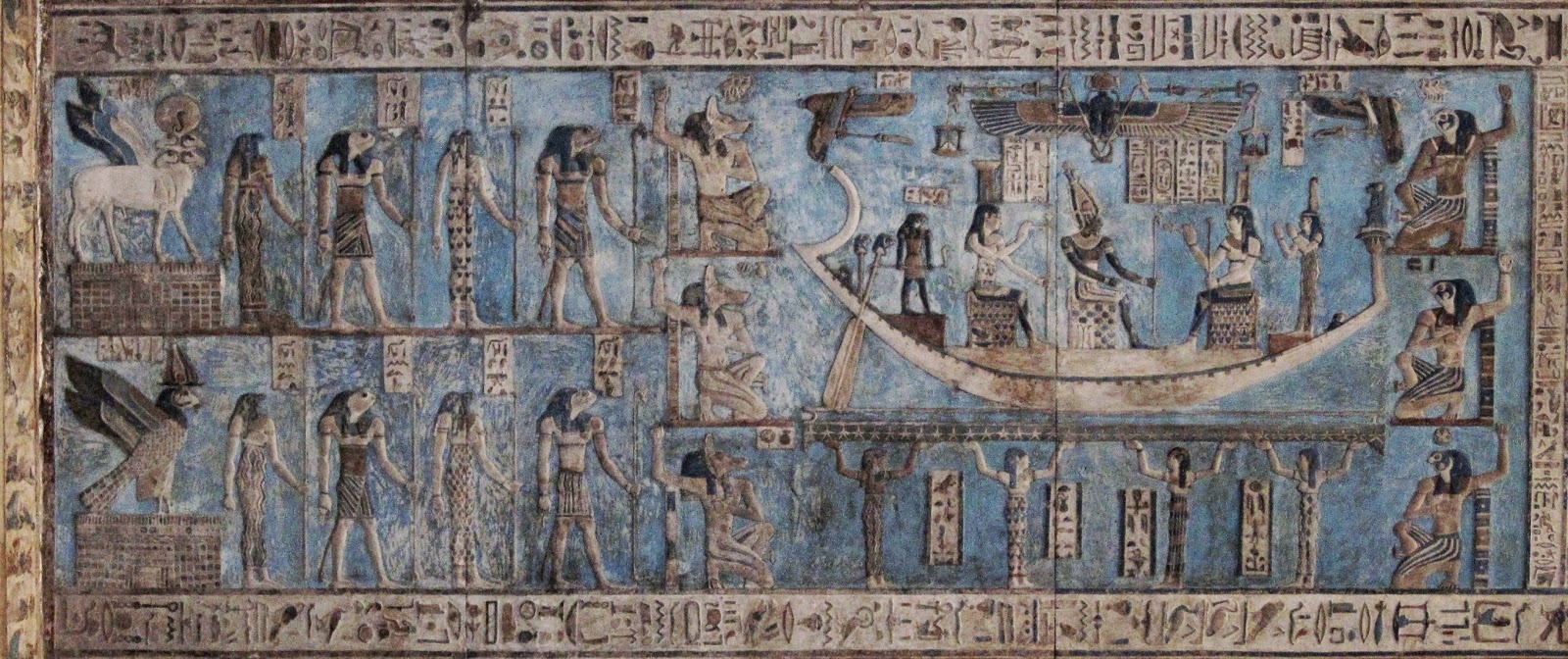
Located in the town of Edfu is the Temple of Horus, also known as the Temple of Edfu.  Dating to between 237 and 57BC, it is considered to be the best-preserved temple in Egypt and, inscribed upon its walls, are the Edfu Building Texts.  These texts mostly concern the history of the building of the temple.  However, they also 'hints at the existence of certain mythological events.'  While the Edfu Temple is by no means the oldest, the inscriptions show us beliefs which are believed to be much more ancient.


According to Egyptologist E.A.E Reymond, '...there are enshrined fragments of the oldest conception of the origin of the earth...  In spite of the lack of other relevant documents, we are inclined to conclude that the Edfu accounts of the origin of the primaeval island, and of its function in the creation of the physical world of gods and men, disclose genuine thoughts and beliefs of a remote date.'   Here I will post an except summary of the events which are described on the walls of the temple of Edfu.  If you want to read the entire interpretation of the Edfu inscriptions, Ian Driscoll and Matthew Kurtz Atlantis: Egyptian Genesis is well worth a look.


     In the beginning, there was only water and nothing more.  There wasn't even darkness because there was no light to compare the darkness to... there was only the all, and the all simply was.
     Then, within the all, something stirred and the first company of gods, the Primeval Ones emerged.  These would be the gods of creation... formless, shapeless, incorporeal beings.  These gods were the Fathers and the Mothers who created the egg; they planted the seed of the earth within the waters of creation and the primeval ocean became mother to the first landmass, the foundation ground of all creation upon which the gods descended.


     The Primeval Ones made the new landmass, an island, larger and made a mountain, a High Hill at the centre of the island and this was the centre of creation.  Here the Primeval Ones lived and were led by the god of Earth, known in the texts only as 'This One'.  The Earth god is accompanied by two protective beings.  This group of gods gather around a tall pillar made of reeds, at the edge of a reed pool,in the centre of the island hill which serves as the seat of the power of the gods.
     There is a break in the text then the light is gone and there is darkness.  The island lies beneath the water and its divine inhabitants are gone.  And there is only water.  Some terrible catastrophe has occurred - the island had been attacked by a great serpent and a storm which has descended upon the island soon after.  Unable to defend themselves, those divine beings were destroyed and the island has been almost totally submerged by frothing waters.


Egyptian Genesis and Plato's Atlantis: A Comparison

So how does the Egyptian Genesis compare to Plato's Atlantis.  When both are read, side by side, it's difficult to argue that these two stories are strikingly similar and the themes of both stories are essentially the same.

In both texts there is an island was led by a god - the god of the Earth 'This One' in the Egyptian Genesis and Poseidon, god of the sea and 'The Earthshaker' in Plato's Atlantis.  In the Egyptian Genesis the land is new, a creation of the gods from the primeval waters, where in Plato's Atlantis the island is assigned to Poseidon after the gods  'distributed the whole earth into portions'.  It has been claimed that, 'In stating that the land had yet to be divided amongst the gods, Plato makes it clear that the reader is entering in upon a scene which must have taken place not long after the creation of the earth itself...'


Plato's Criteas tells us that the holy temple of Poseidon was built on top of the mountain which lay at the centre of the island.  In the Egyptian Genesis the Primeval Ones had a reed pillar which marked the centre of the island and the god's seat of power.  This pillar bears similarities to the 'pillar of orichalcum, which was situated in the middle of the temple of Poseidon...' where the kings would take their sacrifice, the bull - it is, essentially, the god's seat of power.

In the Egyptian Genesis the 'Primeval Ones are several times equated with the Ogdoad of Hermopolis, a city of Upper Egypt sacred to the god Thoth.'  Hermopolis, meaning 'the city of Hermes' in Greek, was known as Khmunu, or the City of the Eight, in Egypt.  The Ogdoad were eight deities, four pairs of gods with each pair representing the four sources, or creative powers.  These 'twins'  could be considered our comparison with Poseidon's 'five pairs of twin male children'

And, finally, we have the destruction, where the Atlantians were defeated by the Athenians, with the submergence of Atlantis occurring shortly after.

Atlantis, 'gathering its whole power together, attempted to enslave, at a single stroke, your country and ours and all the territory within the strait.  It was then, Solon, that the power and courage and strength of your city became clear for all men to see... she over came the invaders and celebrated a victory; she rescued those not yet enslaved from the slavery threatening them, and she generously freed all overs living within the Pillars of Heracules.  At a later time there were earthquakes and floods of extraordinary violence, and in a single dreadful day and night all your fighting men were swallowed up by the earth, and the island of Atlantis was similarly swallowed up by the sea and vanished; this is why the sea in that area is to this day impassable to navigation, which is hindered by mud just below the surface, the remains of the sunken island.' 


In the Egyptian Genesis were discover that  'the island came under attack from an enemy serpent' and  once the inhabitants had perished 'their dwellings [were] destroyed and their primordial home [was] almost entirely enveloped by the lashing water.'  It has been suggested that the serpent is one of the serpent gods of the  Ogdoad and can be loosely compared to Zeus in Plato's Atlantis.

So, in comparing the legend of Atlantis with the mythology of Edfu we have unmistakably similar themes - the creation of the central hill or mountain, the ruling divine twins, the central pillar, the temple of the god and the destruction of the island and its inhabitants through battle and an inundation of violent waters.


Plato's Atlantis can be dated to around 9,600 BC and it is believed the Edfu Building Texts are 'the oldest conception of the origin of the earth'.  Egypt's temple records were believed to date back 10,000 years, with Herodotus stating that 'from the first king of Egypt to the last, there had elapsed 11,340 years' and Manetho, writing n 250 BC, stating that Egypt's history 'goes back at least 24,900.'  This means that the Edfu inscription could easily be old enough to account for the dating of Atlantis.   This presents a plausible case for the Edfu Temple inscriptions providing an inspiration in the legend of Plato's Atlantis. 

Heredotus' Account of Egypt and Atlantis

Interestingly, when looking for accounts similar to those of Atlantis, Heredotus, in An Account of Egypt, written in around 440 BC, tells us of an Egyptian dynasty which is not only strikingly similar to the inhabitants of Atlantis but also gives us a firmer theory for Ancient Egypt providing the inspiration for the Plato's legend of Atlantis.


'Being set free after the reign of the priest of Hephaistos (Ptah in Egypt), the Egyptians, since they could not live any time without a king, set up over them twelve kings, having divided all Egypt into twelve parts. These made intermarriages with one another and reigned, making agreement that they would not put down one another by force, nor seek to get an advantage over one another, but would live in perfect friendship: and the reason why they made these agreements, guarding them very strongly from violation, was this, namely that an oracle had been given to them at first when they began to exercise their rule, that he of them who should pour a libation with a bronze cup in the temple of Hephaistos, should be king of all Egypt (for they used to assemble together in all the temples).'


In comparing this except with Plato's Critias, we can see what similarities there are between this Egyptian dynasty and Plato's Atlantis:

'He [Poseidon] also begat and brought up five pairs of twin male children; and dividing the island of Atlantis into ten portions, he gave to the first-born of the eldest pair his mother's dwelling and the surrounding allotment, which was the largest and best, and made him king over the rest; the others he made princes, and gave them rule over many men, and a large territory... Each of the ten kings in his own division and in his own city had the absolute control of the citizens, and, in most cases, of the laws, punishing and slaying whomsoever he would. Now the order of precedence among them and their mutual relations were regulated by the commands of Poseidon which the law had handed down. These were inscribed by the first kings on a pillar of orichalcum, which was situated in the middle of the island, at the temple of Poseidon,.. Now on the pillar, besides the laws, there was inscribed an oath invoking mighty curses on the disobedient.'


During their meetings at the temple, the Plato's kings would take part in religious rituals, 'including pouring libations for the god and sharing a sacred cup':

'...whither the kings were gathered together every fifth and every sixth year alternately, thus giving equal honour to the odd and to the even number. And when they were gathered together they consulted about their common interests, and enquired if any one had transgressed in anything and passed judgement...Then they drew from the bowl in golden cups and pouring a libation on the fire, they swore that they would judge according to the laws on the pillar, and would punish him who in any point had already transgressed them, and that for the future they would not, if they could help, offend against the writing on the pillar, and would neither command others, nor obey any ruler who commanded them, to act otherwise than according to the laws of their father Poseidon.'


While it's easy to see the similarities between the Egyptian dynasty mentioned in the except with the Atlantians, it's also important to know how old this Egyptian dynasty was.  Our first clue is presented when we are told that the Egyptians have been 'set free after the reign of the priest of Hephaistos'. 
The 3rd century BC historian Mantheo, in his History of Egypt, tells us that Hephaistos, or Hephaestus was the 'first man (or god) in Egypt... who is also renowned among the Egyptians as the discoverer of fire.'  We are also told that, '...the god Hephaestus, was king for 9000 years.'  Now Hephaestus is actually the Greek name for the Egyptian Ptah, whose rule is said to have begun in around 18,420 BC and his rule could have ended in around 9,420 BC.  The date is awfully close to the date of Atlantis, making it more plausible that this dynasty, whether real or imagined, may have provided Plato with additional inspiration for his legend of Atlantis.

That's it for today.  Tomorrow we will take a look at some of these theories in which historical disasters can account for the destruction of Atlantis.  Until next time.


Useful Resources

Atlantis: Egyptian Genesis by Ian Driscoll and Matthew Kurtz
Herodotus' Histories: Book 2
Plato's Timaeus
Plato's Critias
Manetho
Mythical Origin of the Egyptian Temple by E.A.E. Reymond

http://www.crystalinks.com/turincanon.html
http://www.ancientegyptonline.co.uk/ogdoad.html
http://www.halexandria.org/dward204.htm

Thursday, 13 November 2014

Atlantis - Part One: Plato's Lost City


The legend of Atlantis has gripped the imagination of humanity since the time of the ancients.  It has sparked many debates amongst historians and scholars and has inspired endless searches to either prove of disprove the fact behind the legend.  Here we will look at the Plato's story of Atlantis and it's age.

The legend of Atlantis in its known form originates from two writings of Plato - Timaeus and Critias, written in around 360 BC.  Here I will tell you the story of Atlantis, using quotes from these two documents.  For full excepts from Timaeus and Critias follow the links.


The legend of Atlantis, which Solon learns from an Egyptian priest during a visit to the land of the Nile, starts with a description of how the island was created by the gods, who divided the earth between them, each taking a piece to rule.  Poseidon was given rule of Atlantis, which he found to have three inhabitants: Evenor, his wife Leucippe, and their daughter, Cleito.  When Cleito's parents died, Poseidon took her as his wife and inclosed the hill in which she dwelt all round, making alternated zones of sea and land larger and smaller, encircling one another; there were two of land and three of water, which he turned as with a lathe, each having its circumference equidistant every way from the centre, so that no man could get to the island...


Poseidon made the island one with paradisiacal qualities:   

He himself, being a god, found no difficulty in making special arrangements for the centre island, bringing up two springs of water from beneath the earth, one of warm water and the other of cold, and making every variety of food to spring up abundantly from the soil... 
     There was an abundance of wood for carpenter's work, and sufficient maintenance for tame and wild animals. Moreover, there were a great number of elephants in the island; for as there was provision for all other sorts of animals, both for those which live in lakes and marshes and rivers, and also for those which live in mountains and on plains, so there was for the animal which is the largest and most voracious of all. Also whatever fragrant things there now are in the earth, whether roots, or herbage, or woods, or essences which distil from fruit and flower, grew and thrived in that land; also the fruit which admits of cultivation, both the dry sort, which is given us for nourishment and any other which we use for food-we call them all by the common name pulse, and the fruits having a hard rind, affording drinks and meats and ointments, and good store of chestnuts and the like, which furnish pleasure and amusement, and are fruits which spoil with keeping, and the pleasant kinds of dessert, with which we console ourselves after dinner, when we are tired of eating-all these that sacred island which then beheld the light of the sun, brought forth fair and wondrous and in infinite abundance...


Life on the island of Atlantis thrived, with the kings who descended from Poseidon and Cleito's union building houses, palaces and the temple of Poseidon where the people could worship the god who gave them this wonderful paradise and to conduct the ritual sacrifice of a great bull which was to absolve them of any wrongs they may have committed .  Poseidon's laws and commands on the ruling of Atlantis were inscribed by the first kings on a pillar of orichalcum, which was situated in the middle of the island, at the temple of Poseidon, whither the kings were gathered together every fifth and every sixth year alternately, thus giving equal honour to the odd and to the even number  

Every fifth or sixth year the kings would bring a sacrifice for Poseidon - a great bull whose throat was slit so that the blood fell upon the sacred inscription. Now on the pillar, besides the laws, there was inscribed an oath invoking mighty curses on the disobedient. When therefore, after slaying the bull in the accustomed manner, they had burnt its limbs, they filled a bowl of wine and cast in a clot of blood for each of them; the rest of the victim they put in the fire, after having purified the column all round. Then they drew from the bowl in golden cups and pouring a libation on the fire, they swore that they would judge according to the laws on the pillar, and would punish him who in any point had already transgressed them, and that for the future they would not, if they could help, offend against the writing on the pillar, and would neither command others, nor obey any ruler who commanded them, to act otherwise than according to the laws of their father Poseidon.


Life on Atlantis was simple, virtuous and peaceful.  For generations the divine nature lasted in them, they were obedient to the laws, and well-affectioned towards the god, whose seed they were; for they possessed true and in every way great spirits, uniting gentleness with wisdom in the various chances of life, and in their intercourse with one another. They despised everything but virtue, caring little for their present state of life, and thinking lightly of the possession of gold and other property, which seemed only a burden to them; neither were they intoxicated by luxury; nor did wealth deprive them of their self-control; but they were sober, and saw clearly that all these goods are increased by virtue and friendship with one another, whereas by too great regard and respect for them, they are lost and friendship with them.  

But in time this began to change.  The people became greedy and indulgent, and when the divine portion began to fade away, and became diluted too often and too much with the mortal admixture, and the human nature got the upper hand, Zeus decided that they should be punished.  The desruction of Atlantis came when there occurred violent earthquakes and floods; and in a single day and night of misfortune all your warlike men in a body sank into the earth, and the island of Atlantis in like manner disappeared in the depths of the sea.

And that was the end of Atlantis.  But where does this story actually come from and c?  I best place to discover the roots of the legend of Atlantis is probably Egypt, where the priest first told Solon of this story.


Dating Atlantis
To help us discover where the tale of Atlatis originates, as well as enable us to identify any credible theories for the site of Atlantis, we must first try to discover an approximate date for the age of Atlantis.  According to Plato, in Timaeus, the priest tells Solon ''The age of our institutions is given in our sacred records as eight thousand years, and the citizens whose laws andwhose finest achievements I will now briefly describe to you therefore lived nine thousand years ago…”  

So, before we can date the lives of the citizens of Atlantis, we must first date Solon's visit to Egypt.  According to Herodotus, in Book I of his Histories (450s BC), Solon, having left his native country for this reason and for the sake of seeing various lands, came to Amasis in Egypt..  This means that Solon probabheard the legend of Atlantis in around 570BC.  Therefore we can, if we take this account as gospel, date Atlantis to around 9600BC.


However, if we use information from Plato, who states, 'Let me begin by observing first of all, that nine thousand was the sum of years which had elapsed since the war which was said to have taken place between those who dwelt outside the Pillars of Heracles and all who dwelt within them...,' Atlantis would be generations older. 

And, to make matters even more complicated, we must also take into account that the time-keeping of the ancients can be somewhat skewed, as shown in the Royal Canon of Turin or the Turin List.  This fragmented papyrus is believed to date back to the reign of Ramesses II (1303-1213 BC) and is an extensive record of kings compiled by the Egyptians.  The reign of a king, according to this list, could be anywhere between 300 and 7,000 years in length.  Therefore, any date we might give to Atlantis is assuming that the dating we've been given by Plato is correct in either the first or second instance.

That's it for today.  Tomorrow we'll look for the possible inspirations and origins of the Atlantis from Egypt.  Until next time.


Useful Resources
Plato's Timaeus
Plato's Critias
Herodotus - Histories Book I
Atlantis: Egyptian Genesis by Ian Driscoll & Matthew Kurtz

Tuesday, 11 November 2014

Mythology and Legend of Natural Disasters - Part Four - The Great Flood

For forty days the flood kept coming on the earth, and as the waters increased they lifted the ark high above the earth.  The waters rose and increased greatly on the earth, and the ark floated on the surface of the water.  They rose greatly on the earth, and all the high mountains under the entire heavens were covered.  The waters rose and covered the mountains to the depth of more than fifteen cubits.  Every living thing that moved on land perished - birds, livestock, wild animals, all the creatures that swarm over the earth, and all mankind.  Everything on dry land that had the breath of life in its nostrils died.  Every living thing on the face of the earth was wiped out; people and animals and the creatures that move along the ground and the birds were wiped from the earth.  Only Noah was left, and those with him in the ark.
The waters flooded the earth for a hundred and fifty days.

                    -  Genesis 17-24


The story of a Great Flood in mythology is a myth shared among many cultures aross the globe, but if you were to think of one example it would probably be Noah and the Great Flood or, perhaps, Noah's Ark.  There are, however, many others - from the Babylonian Epic of Gilgamesh to the Dreamtime Flood of Australia.  In many of these places, the Great Flood myth has its roots in real history, although the flood itself may not have been as great as it is portrayed.  Let's take a look at some of these flood myths from a variety of different cultures and see how similar they are to the most well known Noah and the Great Flood.


While Noah's Ark is the most well known story it is, by no means, the oldest.  The Great Flood, myth dates back to Sumerian times, with this particular myth going right the way back to the 7th century BC.  The story, in this case a poem, tells us of the creation of both animals and humans, along wth the five cities Eridu, Badtibira, Larak, Sippar, and Shuruppak.  It goes on to say that the gods had decreed there would be a flood which would wipe out humanity.  One of the gods, probably the water god Enki, decides that he will save mankind and tells Ziusundra (the Noah of this poem) to build a boat in order to save himself.

All the windstorms, exceedingly powerful, attacked as one,
The deluge raged over the surfaces of the earth.
After, for seven days and seven nights,
The deluge had raged in the land,
And the huge boat had been tossed about on the great waters,
Utu came forth, who sheds light on heaven and earth.
Ziusudra opened a window of the huge boat,
Ziusudra, the king,
Before Utu prostrated himself,
The king kills an ox, slaughters a sheep.


Unfortunately, large parts of the poem have been destroyed and much of it is missing.  However, it does make apparent the similarities between the ancient Sumerian myth and that of Noah's Ark.


The Babylonian Epic of Gilgamesh, however, is detailed and mostly complete, with striking similarities to the Genesis version.  I'll just give you a quote here, but the can read the complete version here http://www.sacred-texts.com/ane/mba/mba15.htm.  In this tale, which was written in the 7th century BC, Utnapishtim tells Gilgamesh, who is searching for immortality, of how te god Ea, had warned him of the coming of the Great Flood and instructed him to build a boat to save himself and his family and his livelihood. 

     At the dawn of day I saw rising athwart the heavens a dark cloud, and in the midst of it Ramman thundered.  Nebo and Merodach went in front, speeding like emissaries over hills and plains.  The cables of the ship let loose.
     The Ninip, the tempest god, came night, and the storm broke in fury before him.  All the earth spirits leapt up with flaming torches and the whole land was aflare.  The thunder god swept over the heavens, blotting out the sunlight and bringing thick darkness.  Rain poured down the whole day long, and the earth was covered with water; the rivers were swollen; the land was in confusion; men stumbled about in the darkness, battling with the elements.  Brothers were unable to see brothers; no man could recognize his friends...  The spirits above looked down and beheld the rising flood and were afraid: they fled away, and in the heaven of Anu they crouched like to hounds in the protecting enclosures.
     In time Ishtar, the lady of the gods, cried out distressfully, saying: 'The elder race both perished and turned to clay because that I have consented to evil counsel in the assembly of the gods.  Alas!  I have allowed my people to be destroyed.  I gave being to man, but where is he?  Like the offspring of fish he cumbers the deep.'
     The earth spirits were weeping with Ishtar: the sat down cowering with tightened lips and spake not; they mourned in silence.
     Six days and six night went past, and the tempest raged over the waters which gradually covered the land.  But when the seventh day came, the wind fell, the whirling waters grew peaceful, and the sea retreated.  The storm was over and the rain of destruction had ceased.  I looked forth.  I called aloud over the waters.  But all mankind had perished and turned to clay.  Where fields had been I saw marshes only.


In the Hindu mythology of India, contained within the Matsya Purana and Shatapatha Brahmana, we are told of Manu, who is washinig his hands in a river when a fish swims into his hands and begs him to save its life.  Manu puts the fish into a jar, which the fish soon outgrows.  So Manu puts the fish into a tank and, when it outgrows the tank, into a river and finally into the ocean.  At this point the fish warns Manu of the coming deluge and tells him to build a boat:


Along the ocean in that stately ship was borne the lord of men, and through
Its dancing, tumbling billows, and its roaring waters; and the bark,
Tossed to and fro by violent winds, reeled on the surface of the deep,
Staggering and trembling like a drunken woman.  Land was seen no more.
No far horizon, nor the space between; for everywhere around
Spead the wild waste of waters, reeking atmosphere, and boundless sky.
And now when all the world was deluged, nought appeared above the waves
But Manu and the seven sages, and the fish that drew the bark.
Unwearied, thus for years on years the fish propelled the ship across
The heaped-up waters, till at length it bore the vessel to the peak
Of Himavān; then softly smiling, thus the fish addressed the sage:
 'Haste, now, to bind thy ship to this high crag. Know me, the lord of all,
 The great Creator Brahmā, mightier than all might, omnipotent.


The whole version of the Hindu Great Flood can be found here.

In Ancient Greece, Poseidon was one of the three greatest deities, with the power to summon earthquakes and storms.  If he felt slighted or angry, Poseidon might even release a great flood, as occurs in the following myth:


Poseidon and the Flood

     The gods vied for power over Greece's largest city and its surrounding area, known as Attica.  Athena and Poseidon were especially keen to be named patron deity of the city, and to decide which one of them would win the title, they declared that they would compete to provide the people there with the greatest gift.
     Poseidon went to the Acropolis (the hill overlooking Athens) and struck the ground with his trident, whereupon a spring of salt water began to flow.  Athena made a much more useful gift, the first  olive tree, planting it on the Acropolis.  But to make the final decision fair, Zeus called together all the gods to hear evidence, including testimony form Cecrops, king of Attica, who confirmed that Athena's tree was indeed the first olive tree ever seen on the Acropolis.  Athena won the day, and has been the goddess of Athens ever since.
     Poseidon was furious at the other gods' decision and brought down his trident on the Aegean Sea with an almighty crash.  A great wave rose up and cascaded over the plain of Eleusis where Athens stood.  Although flooded for a long time, the city finally recovered, and the Athenians could once more enjoy food, oil, and wood from Athen's olive trees.


There are a large number of Mesoamerican flood myths which have been recorded in written form or passed down through the generations orally.  The Aztec myth in particular has its similarities with Noah's Ark.


Tata and Nena - An Aztec legend

During the era of the fourth sun, the Sun of Water, the people grew very wicked and stopped worshiping the gods.  The gods became very angry and the God of the rains, Tlaloc, decreed that there would be a flood which would destroy the world.  However, there was one devout couple which were deserving of life - Tata and Nena.  Tlaloc warned the couple of the coming deluge.  He instructed them to hollow out an enormous log and to hide inside it with two ears of corn for them to eat.
Tata and Nega did as they were instructed and, when the rains came, they hid inside the enormous hollow log.  When the rains subsided, Tata and Nena directed the log to dry land and here they caught a fish.  But Tlaloc was very angry with them.  He'd told them to eat only the ears of corn they'd taken with them.  So Tata and Nena were transformed into dogs.  The gods soon destroyed the world and brought in the era of the Fifth Sun.


The planets altered their courses, the Earth fell to pieces, and the water in its bosom rushed upwards with violence and overflowed the earth.
            From China's Imperial Library

Chinese mythology relates how the Emperor of Heaven, Tien Ti, wanted to destroy humanity with a worldwide flood.  The text tells us that the god Yeu took pity on the downing men and sent a giant turtle to save them before turning the turtle into new land.
Another Chinese text tells us the following:

The pillars supporting the sky crumbled, and the chains from which the earth was suspended shivered to pieces.  Sun, moon, and stars poured down into the northwest, where the sky became low; rivers, seas, rushed down to the southeast, where the earth sank.  A great conflagration burst out.  Flood raged.


Slovenia have a myth of how the laziness of the first people was the cause of a great flood which killed everyone but the watchman, Kranyatz.

The Great Flood of Slovenia


     The first humans enjoyed a life of paradisical ease in a valley where everything grew without the need for toil.  The valley was irrigated by seven rivers that flowed from an egg, and was surrounded by high mountains.  The people became very lazy and complacent: they could not even be bothered to pick the bread that grew on the trees, but instead set fire to the trees so that the bread fell into their hands.  The people decided to break the egg and each take as much water as they wanted.  The egg split with a roar like thunder and water poured from it, filling the valley, until there was nothing but an enormous lake.
     All the people died except Kranyatz, the watchman on guard on the highest mountain top.  Kurent stretched down and held out his walking stick - a vine - to save Kranyatz, who clung to its tendrils for nine years until the flood waters receded, nourishing himself in the meantime on the vine's grapes.


The Australian Aborigines also have a Great Flood legend.  This is one of my favourites and tells of a drought which preceded the Great Flood after the water had been swallowed by an enormous frog.


A Legend of the Great Flood


    In the dream-time, a terrible drought swept across the land.  The leaves of the trees turned brown and fell from the branches, the flowers drooped their heads and died, and the green grass qithered as though the spirit from the barren mountain had breathed upon it with a breath of fire.  When the hot wind blew, the dead reeds rattled in the river bed, and the burning sands shimmered like a silver lagoon.
    All the water had left the rippling creeks, and deep, still water holes. In the clear blue sky the sun was a mass of molten gold; the clouds no longer drifted across the hills, and the only darkness that fell across the land was the shadow of night and death.
    After many had died of thirst, all the animals in the land met together in a great council to discover the cause of the drought. They travelled many miles. Some came from the bush, and others from the distant mountains.
    The sea-birds left their homes in the cliffs where the white surf thundered, and flew without resting many days and nights. When they all arrived at the chosen meeting place in Central Australia, they discovered that a frog of enormous size had swallowed all the water in the land, and thus caused the drought. After much serious discussion, it was decided that the only way to obtain the water again was to make the frog laugh. The question now arose as to which animal should begin the performance, and, after a heated argument, the pride of place was given to the Kookaburra.
    The animals then formed themselves into a huge circle with the frog in the centre. Red kangaroos, grey wallaroos, rock and swamp wallabies, kangaroo rats, bandicoots, native bears and ring-tailed possums all sat together. The emu and the native companion forgot their quarrel and the bell bird his chimes. Even a butcher bird looked pleasantly at a brown snake, and the porcupine forgot to bristle. A truce had been called in the war of the bush.
    Now, the Kookaburra, seated himself on the limb of a tree, and, with a wicked twinkle in his eye, looked straight at the big, bloated frog, ruffled his brown feathers, and began to laugh. At first, he made a low gurgling sound deep in his throat, as though he was smiling to himself, but gradually he raised his voice and laughed louder and louder until the bush re-echoed with the sound of his merriment. The other animals looked on with very serious faces, but the frog gave no sign. He just blinked his eyes and looked as stupid as only a frog can look.
    The Kookaburra continued to laugh until he nearly choked and fell off the tree, but all without success. The next competitor was a frill-lizard. It extended the frill around its throat, and, puffing out its jaws, capered up and down. But there was no humor in the frog; he did not even look at the lizard, and laughter was out of the question. It was then suggested that the dancing of the native companion might tickle the fancy of the frog. So the native companion danced until she was tired, but all her graceful and grotesque figures failed to arouse the interest of the frog.
    The position was very serious, and the council of animals was at its wits' end for a reasonable suggestion. In their anxiety to solve the difficulty, they all spoke at once, and the din was indescribable. Above the noise could be heard a frantic cry of distress. A carpet snake was endeavoring to swallow a porcupine. The bristles had stuck in his throat, and a kookaburra, who had a firm grip of his tail, was making an effort to fly away with him.
    Close by, two bandicoots were fighting over the possession of a sweet root, but, while they were busily engaged in scratching each other, a possum stole it. They then forgot their quarrel and chased the possum, who escaped danger by climbing a tree and swinging from a branch by his tail. In this peculiar position he ate the root at his leisure, much to the disgust of the bandicoots below.
    After peace and quiet had been restored, the question of the drought was again considered. A big eel, who lived in a deep water hole in the river, suggested that he should be given an opportunity of making the frog laugh. Many of the animals laughed at the idea, but, in despair, they agreed to give him a trial. The eel then began to wriggle in front of the frog. At first he wriggled slowly, then faster and faster until his head and tail met. Then he slowed down and wriggled like a snake with the shivers. After a few minutes, he changed his position, and flopped about like a well-bitten grub on an ant bed.
    The frog opened his sleepy eyes, his big body quivered, his face relaxed, and, at last, he burst into a laugh that sounded like rolling thunder. The water poured from his mouth in a flood. It filled the deepest rivers and covered the land. Only the highest mountain peaks were visible, like islands in the sea. Many men and animals were drowned.
    The pelican-who was a blackfellow at this time -sailed from island to island in a great canoe and rescued any blackfellow he saw. At last he came to an island on which there were many people. In their midst he saw a beautiful woman, and f ell in love with her. He rescued all the men on this island until the woman alone remained. Every time he made a journey she would ask him to take her with the men, but he would reply: "There are many in the canoe. I will carry you next time." He did this several times, and at last the woman guessed that he was going to take her to his camp. She then determined to escape from the pelican. While he was away, she wrapped a log in her possum rug, and placed it near the gunyah; then, as the flood was subsiding, she escaped to the bush. When he returned, he called to her, but, receiving no answer, he walked over to the possum rug and touched it with his foot. It, however, did not move. He then tore the rug away from what he supposed was a woman, but, when he found a log, he was very angry, and resolved to be revenged. He painted himself with white clay, and set out to look for the other blackfellows, with the intention of killing them. But the first pelican he met was so frightened by his strange appearance, that it struck him with a club and killed him. Since that time pelicans have been black and white in remembrance of the Great Flood.
    The flood gradually subsided, and the land was again clothed in the green garments of spring. Through the tall green reeds the voice of the night wind whispered soft music to the river. And, when the dawn came from the eastern sky, the birds sang a song of welcome to the new flood-a flood of golden sunlight.


For more legends from the Aborigines, this page is fantastic.


For more flood myths, this website is great.

That's it for today.  Tomorrow we will look at the Myths and Legends of Lost Locations.  Until next time.


Useful Resources

 https://www.biblegateway.com/passage/?search=Genesis+5:32-10:1
http://www.sacred-texts.com/ane/sum/sum09.htm#page_97
http://www.newworldencyclopedia.org/entry/Great_Flood
http://www.bibliotecapleyades.net/mitos_creacion/mitos_diluvio.htm
http://www.sacred-texts.com/hin/hmvp/hmvp19.htm
http://www.bigorrin.org/archive33.htm
Hindu Mythology, Vedic and Puranic by W.J. Wilkins
Some Myths and Legends of the Australian Aborigines by W. J. Thomas
From the First Rising Sun: The Real First Part of Prehistory of the Cherokee People and Nation According to Oral Traditions, Legends and Myths by Charla Jean Morris
DK Eyewitness Companions: Mythology by Philip Wilkinson and Neil Philip