Today we're going to look at the potential connections between Plato's Atlantis and the Ancient Egyptians.
The Temple of Edfu and the Edfu Building Texts
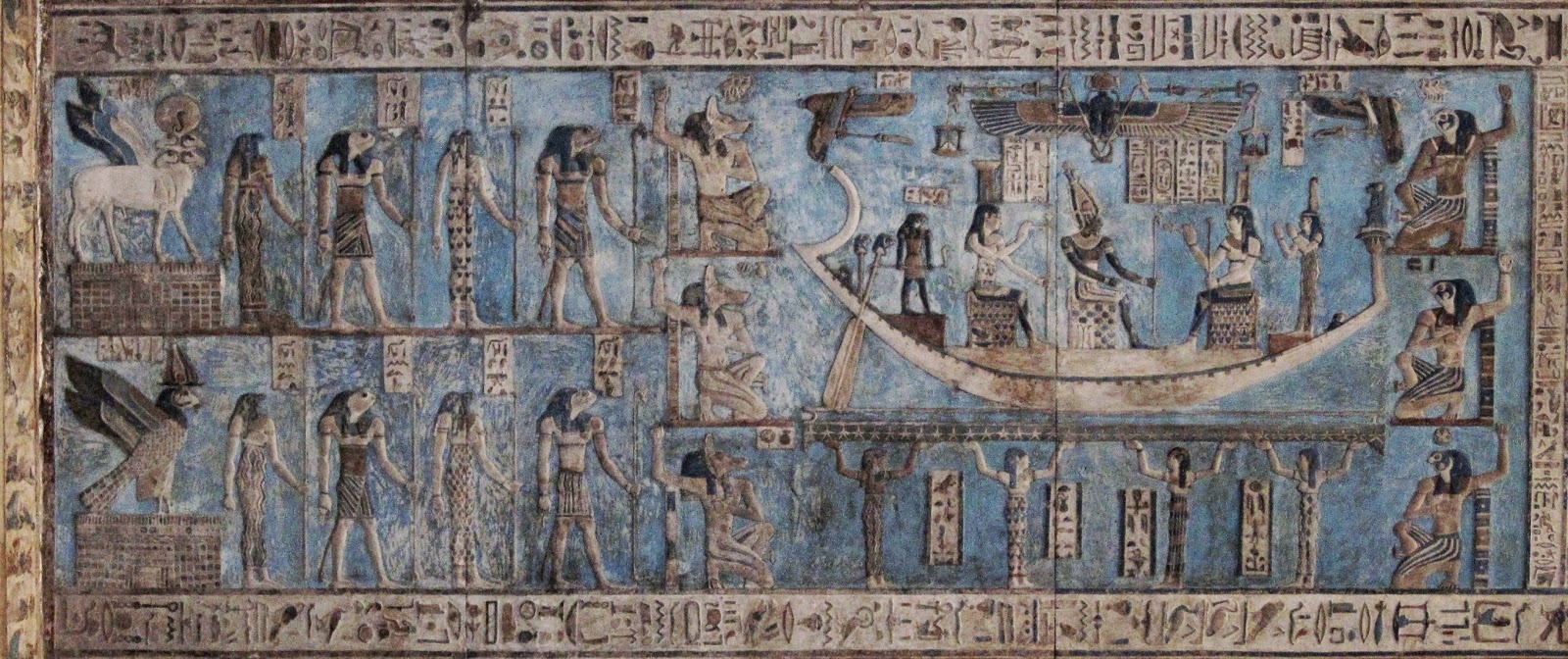
Located in the town of Edfu is the Temple of Horus, also known as the Temple of Edfu. Dating to between 237 and 57BC, it is considered to be the best-preserved temple in Egypt and, inscribed upon its walls, are the Edfu Building Texts. These texts mostly concern the history of the building of the temple. However, they also '
hints at the existence of certain mythological events.' While the Edfu Temple is by no means the oldest, the inscriptions show us beliefs which are believed to be much more ancient.
According to Egyptologist E.A.E Reymond, '
...there are enshrined fragments of the oldest conception of the origin of the earth... In spite of the lack of other relevant documents, we are inclined to conclude that the Edfu accounts of the origin of the primaeval island, and of its function in the creation of the physical world of gods and men, disclose genuine thoughts and beliefs of a remote date.' Here I will post an except summary of the events which are described on the walls of the temple of Edfu. If you want to read the entire interpretation of the Edfu inscriptions, Ian Driscoll and Matthew Kurtz
Atlantis: Egyptian Genesis is well worth a look.
In the beginning, there was only water and nothing more. There wasn't even darkness because there was no light to compare the darkness to...
there was only the all, and the all simply was.
Then, within the all, something stirred and the first company of gods, the Primeval Ones emerged. These would be the gods of creation...
formless, shapeless, incorporeal beings. These gods were the Fathers and the Mothers who created the egg; they planted the seed of the earth within the waters of creation and
the primeval ocean became mother to the first landmass, the foundation ground of all creation upon which the gods descended.
The Primeval Ones made the new landmass, an island, larger and made a mountain, a High Hill at the centre of the island and this was the centre of creation. Here the Primeval Ones lived and were led by the god of Earth, known in the texts only as 'This One'. The Earth god is accompanied by two protective beings. This group of gods gather around a tall pillar made of reeds, at the edge of a reed pool,in the centre of the island hill which serves as the seat of the power of the gods.
There is a break in the text then the light is gone and there is darkness. The island lies beneath the water and its divine inhabitants are gone. And there is only water. Some terrible catastrophe has occurred - the island had been attacked by a great serpent and a storm which has descended upon the island soon after. Unable to defend themselves, those divine beings were destroyed and the island has been almost totally submerged by frothing waters.
Egyptian Genesis and Plato's Atlantis: A Comparison
So how does the Egyptian Genesis compare to Plato's Atlantis. When both are read, side by side, it's difficult to argue that these two stories are strikingly similar and the themes of both stories are essentially the same.
In both texts there is an island was led by a god - the god of the Earth 'This One' in the Egyptian Genesis and Poseidon, god of the sea and 'The Earthshaker' in Plato's Atlantis. In the Egyptian Genesis the land is new, a creation of the gods from the primeval waters, where in Plato's Atlantis the island is assigned to Poseidon after the gods '
distributed the whole earth into portions'. It has been claimed that, '
In stating that the land had yet to be divided amongst the gods, Plato makes it clear that the reader is entering in upon a scene which must have taken place not long after the creation of the earth itself...'
Plato's Criteas tells us that the holy temple of Poseidon was built on top of the mountain which lay at the centre of the island. In the Egyptian Genesis the Primeval Ones had a reed pillar which marked the centre of the island and the god's seat of power. This pillar bears similarities to the
'pillar of orichalcum, which was situated in the middle of the temple of Poseidon...' where the kings would take their sacrifice, the bull - it is, essentially, the god's seat of power.
In the Egyptian Genesis the 'Primeval Ones are several times equated with the Ogdoad of Hermopolis, a city of Upper Egypt sacred to the god Thoth.' Hermopolis, meaning 'the city of Hermes' in Greek, was known as Khmunu, or the City of the Eight, in Egypt. The Ogdoad were eight deities, four pairs of gods with each pair representing the four sources, or creative powers. These 'twins' could be considered our comparison with Poseidon's 'five pairs of twin male children'
And, finally, we have the destruction, where the Atlantians were defeated by the Athenians, with the submergence of Atlantis occurring shortly after.
Atlantis,
'gathering its whole power together, attempted to enslave, at a single stroke, your country and ours and all the territory within the strait. It was then, Solon, that the power and courage and strength of your city became clear for all men to see... she over came the invaders and celebrated a victory; she rescued those not yet enslaved from the slavery threatening them, and she generously freed all overs living within the Pillars of Heracules. At a later time there were earthquakes and floods of extraordinary violence, and in a single dreadful day and night all your fighting men were swallowed up by the earth, and the island of Atlantis was similarly swallowed up by the sea and vanished; this is why the sea in that area is to this day impassable to navigation, which is hindered by mud just below the surface, the remains of the sunken island.'
In the Egyptian Genesis were discover that '
the island came under attack from an enemy serpent' and once the inhabitants had perished
'their dwellings [were]
destroyed and their primordial home [was]
almost entirely enveloped by the lashing water.' It has been suggested that the serpent is one of the serpent gods of the Ogdoad and can be loosely compared to Zeus in Plato's Atlantis.
So, in comparing the legend of Atlantis with the mythology of Edfu we have unmistakably similar themes - the creation of the central hill or mountain, the ruling divine twins, the central pillar, the temple of the god and the destruction of the island and its inhabitants through battle and an inundation of violent waters.
Plato's Atlantis can be dated to around 9,600 BC and it is believed the Edfu Building Texts are
'the oldest conception of the origin of the earth'. Egypt's temple records were believed to date back 10,000 years, with Herodotus stating that
'from the first king of Egypt to the last, there had elapsed 11,340 years' and Manetho, writing n 250 BC, stating that Egypt's history 'goes back at least 24,900.' This means that the Edfu inscription could easily be old enough to account for the dating of Atlantis. This presents a plausible case for the Edfu Temple inscriptions providing an inspiration in the legend of Plato's Atlantis.
Heredotus' Account of Egypt and Atlantis
Interestingly, when looking for accounts similar to those of Atlantis, Heredotus, in An Account of Egypt, written in around 440 BC, tells us of an Egyptian dynasty which is not only strikingly similar to the inhabitants of Atlantis but also gives us a firmer theory for Ancient Egypt providing the inspiration for the Plato's legend of Atlantis.

'Being set free after the reign of the priest of Hephaistos (Ptah in Egypt), the Egyptians, since they could not live any time without a king, set up over them twelve kings, having divided all Egypt into twelve parts. These made intermarriages with one another and reigned, making agreement that they would not put down one another by force, nor seek to get an advantage over one another, but would live in perfect friendship: and the reason why they made these agreements, guarding them very strongly from violation, was this, namely that an oracle had been given to them at first when they began to exercise their rule, that he of them who should pour a libation with a bronze cup in the temple of Hephaistos, should be king of all Egypt (for they used to assemble together in all the temples).'
In comparing this except with Plato's Critias, we can see what similarities there are between this Egyptian dynasty and Plato's Atlantis:
'
He [Poseidon]
also begat and brought up five pairs of twin male children; and dividing the island of Atlantis into ten portions, he gave to the first-born of the eldest pair his mother's dwelling and the surrounding allotment, which was the largest and best, and made him king over the rest; the others he made princes, and gave them rule over many men, and a large territory... Each of the ten kings in his own division and in his own city had the absolute control of the citizens, and, in most cases, of the laws, punishing and slaying whomsoever he would. Now the order of precedence among them and their mutual relations were regulated by the commands of Poseidon which the law had handed down. These were inscribed by the first kings on a pillar of orichalcum, which was situated in the middle of the island, at the temple of Poseidon,.. Now on the pillar, besides the laws, there was inscribed an oath invoking mighty curses on the disobedient.'
During their meetings at the temple, the Plato's kings would take part in religious rituals, 'including pouring libations for the god and sharing a sacred cup':
'...whither the kings were gathered together every fifth and every sixth year alternately, thus giving equal honour to the odd and to the even number. And when they were gathered together they consulted about their common interests, and enquired if any one had transgressed in anything and passed judgement...Then they drew from the bowl in golden cups and pouring a libation on the fire, they swore that they would judge according to the laws on the pillar, and would punish him who in any point had already transgressed them, and that for the future they would not, if they could help, offend against the writing on the pillar, and would neither command others, nor obey any ruler who commanded them, to act otherwise than according to the laws of their father Poseidon.'

While it's easy to see the similarities between the Egyptian dynasty mentioned in the except with the Atlantians, it's also important to know how old this Egyptian dynasty was. Our first clue is presented when we are told that the Egyptians have been 'set free after the reign of the priest of Hephaistos'.
The 3rd century BC historian Mantheo, in his History of Egypt, tells us that Hephaistos, or Hephaestus was the '
first man (or god) in Egypt... who is also renowned among the Egyptians as the discoverer of fire.' We are also told that, '
...the god Hephaestus, was king for 9000 years.' Now Hephaestus is actually the Greek name for the Egyptian Ptah, whose rule is said to have begun in around 18,420 BC and his rule could have ended in around 9,420 BC. The date is awfully close to the date of Atlantis, making it more plausible that this dynasty, whether real or imagined, may have provided Plato with additional inspiration for his legend of Atlantis.
That's it for today. Tomorrow we will take a look at some of these theories in which historical disasters can account for the destruction of Atlantis. Until next time.
Useful Resources
Atlantis: Egyptian Genesis by Ian Driscoll and Matthew Kurtz
Herodotus' Histories: Book 2
Plato's Timaeus
Plato's Critias
Manetho
Mythical Origin of the Egyptian Temple by E.A.E. Reymond
http://www.crystalinks.com/turincanon.html
http://www.ancientegyptonline.co.uk/ogdoad.html
http://www.halexandria.org/dward204.htm


.jpg)