Today we're going to look at the potential connections between Plato's Atlantis and the Ancient Egyptians.
The Temple of Edfu and the Edfu Building Texts
Located in the town of Edfu is the Temple of Horus, also known as the Temple of Edfu. Dating to between 237 and 57BC, it is considered to be the best-preserved temple in Egypt and, inscribed upon its walls, are the Edfu Building Texts. These texts mostly concern the history of the building of the temple. However, they also 'hints at the existence of certain mythological events.' While the Edfu Temple is by no means the oldest, the inscriptions show us beliefs which are believed to be much more ancient.
According to Egyptologist E.A.E Reymond, '...there are enshrined fragments of the oldest conception of the origin of the earth... In spite of the lack of other relevant documents, we are inclined to conclude that the Edfu accounts of the origin of the primaeval island, and of its function in the creation of the physical world of gods and men, disclose genuine thoughts and beliefs of a remote date.' Here I will post an except summary of the events which are described on the walls of the temple of Edfu. If you want to read the entire interpretation of the Edfu inscriptions, Ian Driscoll and Matthew Kurtz Atlantis: Egyptian Genesis is well worth a look.
In the beginning, there was only water and nothing more. There wasn't even darkness because there was no light to compare the darkness to... there was only the all, and the all simply was.
Then, within the all, something stirred and the first company of gods, the Primeval Ones emerged. These would be the gods of creation... formless, shapeless, incorporeal beings. These gods were the Fathers and the Mothers who created the egg; they planted the seed of the earth within the waters of creation and the primeval ocean became mother to the first landmass, the foundation ground of all creation upon which the gods descended.
The Primeval Ones made the new landmass, an island, larger and made a mountain, a High Hill at the centre of the island and this was the centre of creation. Here the Primeval Ones lived and were led by the god of Earth, known in the texts only as 'This One'. The Earth god is accompanied by two protective beings. This group of gods gather around a tall pillar made of reeds, at the edge of a reed pool,in the centre of the island hill which serves as the seat of the power of the gods.
There is a break in the text then the light is gone and there is darkness. The island lies beneath the water and its divine inhabitants are gone. And there is only water. Some terrible catastrophe has occurred - the island had been attacked by a great serpent and a storm which has descended upon the island soon after. Unable to defend themselves, those divine beings were destroyed and the island has been almost totally submerged by frothing waters.
Egyptian Genesis and Plato's Atlantis: A Comparison
So how does the Egyptian Genesis compare to Plato's Atlantis. When both are read, side by side, it's difficult to argue that these two stories are strikingly similar and the themes of both stories are essentially the same.
In both texts there is an island was led by a god - the god of the Earth 'This One' in the Egyptian Genesis and Poseidon, god of the sea and 'The Earthshaker' in Plato's Atlantis. In the Egyptian Genesis the land is new, a creation of the gods from the primeval waters, where in Plato's Atlantis the island is assigned to Poseidon after the gods 'distributed the whole earth into portions'. It has been claimed that, 'In stating that the land had yet to be divided amongst the gods, Plato makes it clear that the reader is entering in upon a scene which must have taken place not long after the creation of the earth itself...'
Plato's Criteas tells us that the holy temple of Poseidon was built on top of the mountain which lay at the centre of the island. In the Egyptian Genesis the Primeval Ones had a reed pillar which marked the centre of the island and the god's seat of power. This pillar bears similarities to the 'pillar of orichalcum, which was situated in the middle of the temple of Poseidon...' where the kings would take their sacrifice, the bull - it is, essentially, the god's seat of power.
In the Egyptian Genesis the 'Primeval Ones are several times equated with the Ogdoad of Hermopolis, a city of Upper Egypt sacred to the god Thoth.' Hermopolis, meaning 'the city of Hermes' in Greek, was known as Khmunu, or the City of the Eight, in Egypt. The Ogdoad were eight deities, four pairs of gods with each pair representing the four sources, or creative powers. These 'twins' could be considered our comparison with Poseidon's 'five pairs of twin male children'
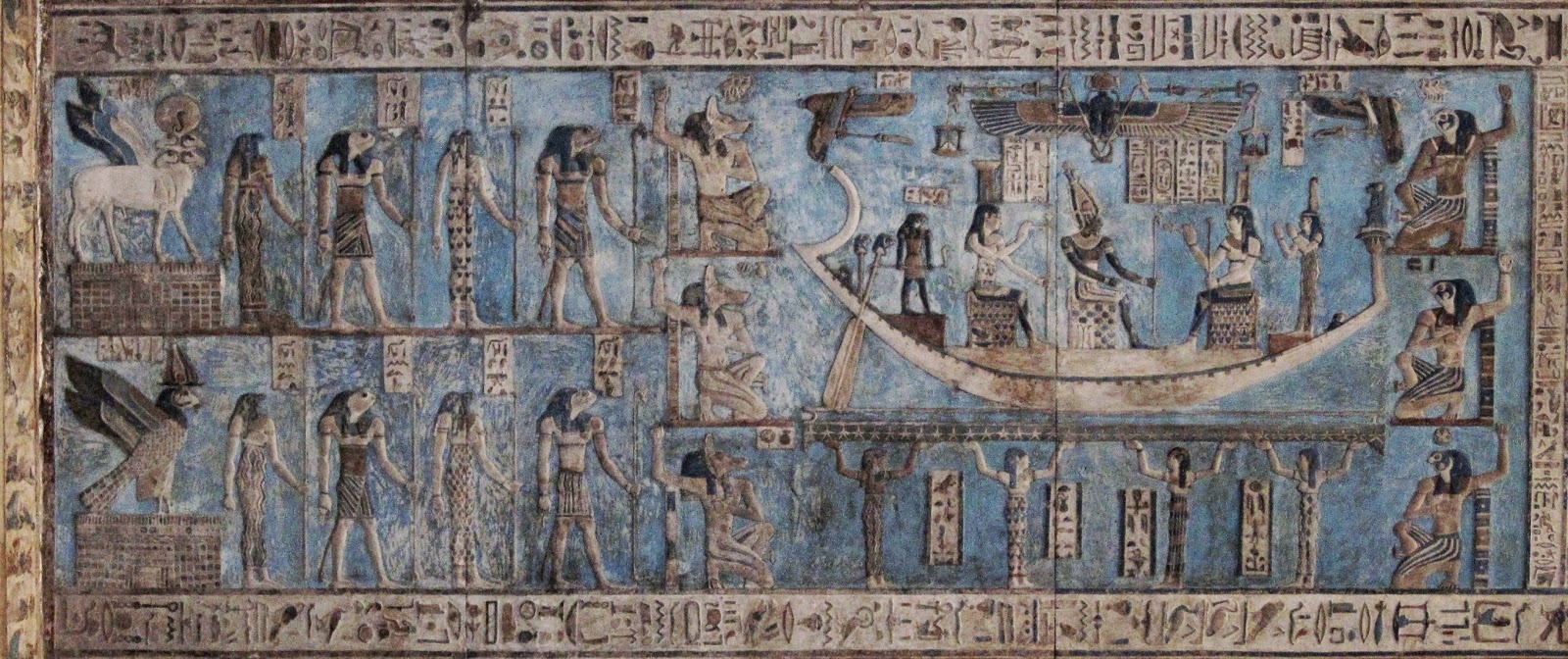
And, finally, we have the destruction, where the Atlantians were defeated by the Athenians, with the submergence of Atlantis occurring shortly after.
Atlantis, 'gathering its whole power together, attempted to enslave, at a single stroke, your country and ours and all the territory within the strait. It was then, Solon, that the power and courage and strength of your city became clear for all men to see... she over came the invaders and celebrated a victory; she rescued those not yet enslaved from the slavery threatening them, and she generously freed all overs living within the Pillars of Heracules. At a later time there were earthquakes and floods of extraordinary violence, and in a single dreadful day and night all your fighting men were swallowed up by the earth, and the island of Atlantis was similarly swallowed up by the sea and vanished; this is why the sea in that area is to this day impassable to navigation, which is hindered by mud just below the surface, the remains of the sunken island.'
In the Egyptian Genesis were discover that 'the island came under attack from an enemy serpent' and once the inhabitants had perished 'their dwellings [were] destroyed and their primordial home [was] almost entirely enveloped by the lashing water.' It has been suggested that the serpent is one of the serpent gods of the Ogdoad and can be loosely compared to Zeus in Plato's Atlantis.
So, in comparing the legend of Atlantis with the mythology of Edfu we have unmistakably similar themes - the creation of the central hill or mountain, the ruling divine twins, the central pillar, the temple of the god and the destruction of the island and its inhabitants through battle and an inundation of violent waters.
Plato's Atlantis can be dated to around 9,600 BC and it is believed the Edfu Building Texts are 'the oldest conception of the origin of the earth'. Egypt's temple records were believed to date back 10,000 years, with Herodotus stating that 'from the first king of Egypt to the last, there had elapsed 11,340 years' and Manetho, writing n 250 BC, stating that Egypt's history 'goes back at least 24,900.' This means that the Edfu inscription could easily be old enough to account for the dating of Atlantis. This presents a plausible case for the Edfu Temple inscriptions providing an inspiration in the legend of Plato's Atlantis.
Heredotus' Account of Egypt and Atlantis
Interestingly, when looking for accounts similar to those of Atlantis, Heredotus, in An Account of Egypt, written in around 440 BC, tells us of an Egyptian dynasty which is not only strikingly similar to the inhabitants of Atlantis but also gives us a firmer theory for Ancient Egypt providing the inspiration for the Plato's legend of Atlantis.
'Being set free after the reign of the priest of Hephaistos (Ptah in Egypt), the Egyptians, since they could not live any time without a king, set up over them twelve kings, having divided all Egypt into twelve parts. These made intermarriages with one another and reigned, making agreement that they would not put down one another by force, nor seek to get an advantage over one another, but would live in perfect friendship: and the reason why they made these agreements, guarding them very strongly from violation, was this, namely that an oracle had been given to them at first when they began to exercise their rule, that he of them who should pour a libation with a bronze cup in the temple of Hephaistos, should be king of all Egypt (for they used to assemble together in all the temples).'
In comparing this except with Plato's Critias, we can see what similarities there are between this Egyptian dynasty and Plato's Atlantis:
'He [Poseidon] also begat and brought up five pairs of twin male children; and dividing the island of Atlantis into ten portions, he gave to the first-born of the eldest pair his mother's dwelling and the surrounding allotment, which was the largest and best, and made him king over the rest; the others he made princes, and gave them rule over many men, and a large territory... Each of the ten kings in his own division and in his own city had the absolute control of the citizens, and, in most cases, of the laws, punishing and slaying whomsoever he would. Now the order of precedence among them and their mutual relations were regulated by the commands of Poseidon which the law had handed down. These were inscribed by the first kings on a pillar of orichalcum, which was situated in the middle of the island, at the temple of Poseidon,.. Now on the pillar, besides the laws, there was inscribed an oath invoking mighty curses on the disobedient.'
During their meetings at the temple, the Plato's kings would take part in religious rituals, 'including pouring libations for the god and sharing a sacred cup':
'...whither the kings were gathered together every fifth and every sixth year alternately, thus giving equal honour to the odd and to the even number. And when they were gathered together they consulted about their common interests, and enquired if any one had transgressed in anything and passed judgement...Then they drew from the bowl in golden cups and pouring a libation on the fire, they swore that they would judge according to the laws on the pillar, and would punish him who in any point had already transgressed them, and that for the future they would not, if they could help, offend against the writing on the pillar, and would neither command others, nor obey any ruler who commanded them, to act otherwise than according to the laws of their father Poseidon.'
While it's easy to see the similarities between the Egyptian dynasty mentioned in the except with the Atlantians, it's also important to know how old this Egyptian dynasty was. Our first clue is presented when we are told that the Egyptians have been 'set free after the reign of the priest of Hephaistos'.
The 3rd century BC historian Mantheo, in his History of Egypt, tells us that Hephaistos, or Hephaestus was the 'first man (or god) in Egypt... who is also renowned among the Egyptians as the discoverer of fire.' We are also told that, '...the god Hephaestus, was king for 9000 years.' Now Hephaestus is actually the Greek name for the Egyptian Ptah, whose rule is said to have begun in around 18,420 BC and his rule could have ended in around 9,420 BC. The date is awfully close to the date of Atlantis, making it more plausible that this dynasty, whether real or imagined, may have provided Plato with additional inspiration for his legend of Atlantis.
That's it for today. Tomorrow we will take a look at some of these theories in which historical disasters can account for the destruction of Atlantis. Until next time.
Useful Resources
Atlantis: Egyptian Genesis by Ian Driscoll and Matthew Kurtz
Herodotus' Histories: Book 2
Plato's Timaeus
Plato's Critias
Manetho
Mythical Origin of the Egyptian Temple by E.A.E. Reymond
http://www.crystalinks.com/turincanon.html
http://www.ancientegyptonline.co.uk/ogdoad.html
http://www.halexandria.org/dward204.htm
Showing posts with label Plato. Show all posts
Friday, 14 November 2014
Thursday, 13 November 2014
Atlantis: Part Three: The Thera Theory
While some believe that Plato's Atlantis was inspired by ancient mythology, others contend that it is in fact based on a real, historical civilization which was destroyed by some kind of natural disaster. Today we will look at the Thera volcano theory which presents Crete or the Island of Thera as the potential Atlantis and the Minoan civilization as potential Atlantians.
The Minoan Civilization and the Thera Volcano
The Minoans flourished on Crete, the largest Greek island, from around 2000BC to 1500BC. Their settlements, cemeteries and tombs have been found throughout the island.
They were sophisitcated civilization, with evidence of hieroglyphic and Linear A scripts, art, a range of pottery and hand-turned ceramics, decorated with depictions of flowers, plants and sea life. Within the palaces were spectacular frescoes from wall to floor revealing the peoples love of nature as well as giving us an idea of their religious, funeral and communal practices. Their craftsmanship with stone, ivory, faience and metal was excellent, with examples including minutely carved rings and seals made of gold, delicate ivory sculptures and beautiful jars of alabaster.
The Minoans influence over both Egypt and the Near East, making their contact with the people throughout the Aegean, evident and being due to their sea-faring abilities. Later trade in pottery and consumables like wine and oil for precious materials like ivory.
Minoan inhabitation of Crete can be dated by looking at four complex palace structure sites which were discovered in Knossos, Phaistos, Malia and Zakros. Each structure is two or three stories high and covered several thousand square metres. It has been suggested that these structures acted as centres for trade, religion, administration and politics. The buildings can be dated to two periods - 2,000BC and, following earthquakes and fires, 1,700BC. Their final destruction, which was caused by an earthqyake, fire or possible invasion, dates to between 1,500 and 1,450BC. While the lack of fortification suggests a reasonably peaceful existence between communities, the presence of swords, daggers, armour and other objects used in times of war might suggest that peace was not a constant within Minoan society.
Sometime between 1630 and 1500 BC the Thera volcano erupted. The eruption has been compared to 40 atomic bombs and is believed to be the second largest volcanic eruption in human history.
Earthquakes preceeding the eruption itself would have plagued the Minoan people, then ash would have plunged large areas of the Mediterranean, followed by the collapse of the island of Thera into the sea. 'Pre-eruption Thera was a large island dominated by water-filled embayment to the south and a central highland to the north. During the Thera eruption, the central highland collapsed to form the full extent of the present-day caldera and the three islands of the Santorini archipelago.'
The collapse of the island of Thera caused a tsunami which would have destroyed coastal ports and settlements in the surrounding region. 'A two-hundred-foot-tall wall of water swept over Crete and wreaked havoc.., which accompanying earthquakes badly damaged the inland captial, Knossos.'
Scientists have suggested that the eruption of Thera may be connected to the decline of the Minoan people of nearby Crete. However, the destruction of the Minoan people has been controversial and is often disputed.
The reason for this dispute is the dating of the Thera eruption which was originally believed to have taken place in 1450BC, around the same time as the downfall of the Minoans. However, more recent findings placed the eruption between 1627 and 1600BC meaning '...it is unlikely that either eruptive fallout or the associated tsunami played a direct, decisive role in the fall of the Minoan civilization on Crete.' However, Despite this being the popular opinion, 'this massive explove eruption on Santorini does not seem to have been recorded, either by the Cretan Minoans or the ancient Egyptians...' and some argue that the eruption played a significant role in the downfall of the Minoans.
The fate of the Minoan people who inhabited the island of Thera is also fiercely disputed. These are those who believe: 'It is likely that the inhabitants had sufficient warning to evacuate the island before the Minoan eruption, since the excavations ... have not uncovered any human skeletons' And there are those that believe the Minoans never left the island. 'Akrotiri's chief archaeologist, Christos Doumas, believes the people of Akrotiri didn't survive, and that the bodies are still to be uncovered, huddled at the harbour where they were trapped by the eruption as they waited to escape. He believes it's highly unlikely that scores of boats were waiting in the harbour to save them.'
The Minoan World in Comparison with Atlantis
The lost world of the Minoans has intrigued humanity for thousands of years and many historians have suggested that, 'The whole description of Atlantis... has features so thoroughly Minoan...' that Plato must have used them as a basis for his Atlantis. With vast and elaborate palaces, the first paved roads in Europe and running water, Minoan civilization has been described as 'very structured, heirarchical and rather complex'. Comparison can be drawn between 'the great harbour, shipping, elaborate bathrooms, stadium and the bull sacrifice which can all be found in Minoan archaeology.'
This theory first arose in 1909 with K.T. Frost, a professor of history. While the theory was dismissed by academics because of both the timing and the location, it was revived by archeologist Professor Marinatos in the 1930s, after the discovery of substantial Minoan ruins and pumice stone in Amnistos in Crete, as well as evidence of a tsunami. In 1950, he expanded on this theory, having excavated a Minoan era town near Akrotiri on Thera. However, the question of the date and location still plagued the theory.
In the 1960s, the seismologist A.G. Galanopoulos claimed that he could make Plato's Atlantis fit Minoan Crete with the suggestion that Plato had overestimated the age of the eruption tenfold, meaning that Atlantis should be dated to around the 1st millennium BC. Professor Archibald Ray commented, 'Professor Galanopoulos... suggested that an additional zero had been added in translation to all large numbers. Consequently, the date would be more like nine hundred years before Solon's visit to Egypt. If so, we apply the same logic to population and island size, produce a more acceptable description more in accordance with Minoan Crete and its destruction by the explosive eruption of Thera.' Galanopoulos also suggested that Plato's 'Pillars of Hercules' referred to 'two promontories (a promontory is a raised mass of land declined abruptly from only one side) on the south coast of Greece,' and that the island of Thera was the centre of Minoan life, with the islands slopes being adorned with temples and palaces which were then buried during Thera's eruption.
'From the island you could easily pass to other islands, and from them to the entire continent which surrounds the interior sea. What there is on this side of the strait of which we are speaking resembles a vast gateway... and the land which surround it is a real continent.'
Those that support the Thera theory point to Plato's description of the surrounding area, stating, '... Atlantis was a large island... there were other islands near Atlantis and these were in an interor sea near to a continent. These geographical data apply perfectly to Crete and the Aegean Sea. '
Supporters of the theory also tell us, 'Even the concentric arrangement of the Atlantean captial, as described by Plato, may to this day be seen in the waters of Santorini Bay.'
In Plato's Critias we are told, 'The stone which was used in the work they quarried from underneath the centre island, and from underneath the zones, on the outer as well as the inner side. One kind was white, another black, and a third red...' Santorini is one of the few places in the world which has beaches of white, black and red sand, which supporters of the theory claim reinforces the claim that Atlantis is based on the rise and fall of Minoan civilization.
Supporters also claim that further description of Atlantis within Plato's Criteas gives credence to the theory, being 'an accurate description of Crete and Knossos...'
Plato writes: '...a plain located near the sea opening in the central part of the island and the most fertile plains; about it a circle of mountains stretching to the sea, a circle open at the center and protecting the plain from the icy blasts of the north; in these superb mountains, numerous villages, rich and populous; in the plain, a magnificent city, the palaces and temples of which are constructed from stones of three colors -white, black, and red - drawn from the very bosom of the island; here and there mines yielding all the minerals useful to man; finally the shores of the island eat perpendieularly and commanding from above the tumultuous sea.'
Plato also tells us that the kings of Atlantis 'had under their dominion the entire island as well as several other islands and some parts of the continent. Besides on the hither side of the strait they were still reigning over Libya as far as Egypt and over Europe as far as the Tyrrhenian.' So Atlantis was a kingdom of power and supporters believe that this can be applied to Minoan Crete. 'Crete may easily have ruled over many islands of the Aegean, it may well have riled over the Peloponnesus at the time of Mycenae and Tiryns, it may well have ruled over the North African coast of Cyrenaica.'
While the theory that Thera's eruption being the inspiration for Plato's is the most accepted by archeologists, it is not without its critics, who believe there are simply too many details which don't match up to Plato's description of Atlantis.
'The problem with this apparently neat soloution to the Atlantis mystery is that the culture and history of Minoan Crete is a very poor match for Atlantis.'
The island of Thera is believed to have only provided a small outpost colony for the Minoans. It was not their city of the Minoans, unlike in Atlantis. The Minoans never attempted ' to occupy Italy or Libya, nor did they threaten to invade Egypt, as the Atlantians were supposed to have done.' The Minoans are believed to have been mostly peaceful, being more interested in trade than they were in waging war, while Plato portrays Atlantians as aggressive, with war acting as a central theme in Critias.
While supporters state that the presence of concentric circles 'may to this day be seen in the waters of Santorini Bay,' Dorothy B. Vitaliano, a geologist who specialises in volcanology, reported that these concentric arrangements were 'not in existence before the Bronze Age eruption of the volcano; it has been created by subsequent activity which built up the Kameni Islands in the middle of the bay, to which a substantial amount of land was added as recently as 1926. Any traces of the precollapse topography would long since have been buried beneath the pile of lave whose highest portions emerge to form these lands.'
When looking at Plato's writings, we are told: 'The entire circuit of the wall, which went round the outermost zone, they covered with a coating of brass, and the circuit of the next wall they coated in tin, and the third, which encompoassed the citadel, flashed with the red light of orichalcum... All the outside of the temple... they covered with silver, and the pinnacles with gold... the roof was... curiously wrought everywhere with gold and silver and orichalcum, and all the other parts, the walls and pillars and floor, they coated with orichalcum.'
There is no evidence on either Crete or Thera of walls plated in metal and Plato's description has been said to sound 'like a Bronze Age Phoenician temple' with the statues of Poseidon, the kings and queens being 'more reminiscent of Egyptian or Classical Greek... or even Etruscan.' The Minoans had no inscribed pillars and they had no sculptures to match Plato's colossal statues.
Another difference lies in the religious worship of their deities. Plato tells us: 'Here was Poseidon's own temple which was a stadium in length, and half a stadium in width, and of a proportionate height, having a strange barbaric appearance.' Here the kings would come every fifth or sixth year to offer sacrifice to their god. However, the Minoans worshipped their deities in sacred caves and hilltop sanctuaries. The Atlantians worshipped Poseidon, god of the sea, where the Minoans had a variety of deities including the Earth Mother, Goddess of the Hunt and the God of Beasts.
There is no evidence of the immense and complex canals or irrigation systems which are described by Plato. Nor is there a possibility for Plato's deepwater ports, 'because the main channel would have been fould by the ebb and flow of the tides that do occur 'beyond the Pillars of Heracles.''
Plato writes that 'there were a great number of elephants in the island...' but elephants were not known to the Minoans. Nor is there any evidence that the Minoans suffered a military defeat by a weaker, poorer, less technologically advanced civilization as was the case in the relating of Atlantis.
And, while Crete was hit by a tsunami following the eruption of Thera, 'few significant Minoan towns or cities were on that shoreline. Of those that were, most were built well back from the sea or on high bluffs - perhaps to avoid the threat of tsunamis.' The ash of the Thera volcano has been theorized to have devastated Minoan crops, but in actuality 'the ash dumped on Crete was only a few centimeters deep - and only on the eastern end of the island.'
It's also important to remember that Plato dated Atlantis to around 9,600BC. Those that object to the theory of Thera and Crete being the basis of Atlantis think it 'unlikely that the age of the inundation could be overestimated by tenfold. Without this 'convenient' overestimation of times and sizes, Marinatos's theory does not have much merit.'
Despite the many differences between the Minoan civilization and Atlantis and the many differences in opinion, the Thera theory remains the most accepted theory by archeologists.
What do you think?
There are many other theories on Atlantis. Many propose that the location of the lost city might be found somewhere in the Mediterranean - with islands, apart from Thera and Sanotrini, such as Cyprus, Malta and Sardinia having been suggested. There are those that claim that the true site of Atlantis might be found in Antarctica, Indonesia or the Caribbean. There are the theories that present the Black Sea as a plausible place for the inspiration of the legend and others which believe the submerged island of Spartel near the Straits of Gibraltar is a plausible location. Despite the many theories and the many people which are for or against, the city of Atlantis remains lost and may never be discovered.
That's it for today. Until next time.
Roots of Cacaclysm: Geopulsation and the Atlantis Supervolcano in History by Richard Welch
Sunken Realms: A Survey pf Underwater Ruins from Around the World by Karen Mutton
Atlantis or Minoan Crete by Edwin Swift Balch
Island Colonization: The Origin and Development of Island Communities by Ian Thornton and Tim New
The Destruction of Atlantis: Compelling Evidence of the Sudden Fall of the Legendary Civilization by Frank Joseph
The Lost Empire of Atlantis: History's Greatest Mystery Revealed by Gavin Menzies
BBC - The Fall of the Minoan Civilisation by Jessica Cecil
BBC Article - Thera Eruption Was Bigger Still
Ancient History Encyclopedia - Minoan Civilization
American Scientist: The Minoan Eruption by Svend Rasmussen
Atlantis - Part One: Plato's Lost City
The legend of Atlantis has gripped the imagination of humanity since the time of the ancients. It has sparked many debates amongst historians and scholars and has inspired endless searches to either prove of disprove the fact behind the legend. Here we will look at the Plato's story of Atlantis and it's age.
The legend of Atlantis in its known form originates from two writings of Plato - Timaeus and Critias, written in around 360 BC. Here I will tell you the story of Atlantis, using quotes from these two documents. For full excepts from Timaeus and Critias follow the links.
The legend of Atlantis, which Solon learns from an Egyptian priest during a visit to the land of the Nile, starts with a description of how the island was created by the gods, who divided the earth between them, each taking a piece to rule. Poseidon was given rule of Atlantis, which he found to have three inhabitants: Evenor, his wife Leucippe, and their daughter, Cleito. When Cleito's parents died, Poseidon took her as his wife and inclosed the hill in which she dwelt all round, making alternated zones of sea and land larger and smaller, encircling one another; there were two of land and three of water, which he turned as with a lathe, each having its circumference equidistant every way from the centre, so that no man could get to the island...
Poseidon made the island one with paradisiacal qualities:
He himself, being a god, found no difficulty in making special arrangements for the centre island, bringing up two springs of water from beneath the earth, one of warm water and the other of cold, and making every variety of food to spring up abundantly from the soil...
There was an abundance of wood for carpenter's work, and sufficient maintenance for tame and wild animals. Moreover, there were a great number of elephants in the island; for as there was provision for all other sorts of animals, both for those which live in lakes and marshes and rivers, and also for those which live in mountains and on plains, so there was for the animal which is the largest and most voracious of all. Also whatever fragrant things there now are in the earth, whether roots, or herbage, or woods, or essences which distil from fruit and flower, grew and thrived in that land; also the fruit which admits of cultivation, both the dry sort, which is given us for nourishment and any other which we use for food-we call them all by the common name pulse, and the fruits having a hard rind, affording drinks and meats and ointments, and good store of chestnuts and the like, which furnish pleasure and amusement, and are fruits which spoil with keeping, and the pleasant kinds of dessert, with which we console ourselves after dinner, when we are tired of eating-all these that sacred island which then beheld the light of the sun, brought forth fair and wondrous and in infinite abundance...
Life on the island of Atlantis thrived, with the kings who descended from Poseidon and Cleito's union building houses, palaces and the temple of Poseidon where the people could worship the god who gave them this wonderful paradise and to conduct the ritual sacrifice of a great bull which was to absolve them of any wrongs they may have committed . Poseidon's laws and commands on the ruling of Atlantis were inscribed by the first kings on a pillar of orichalcum, which was situated in the middle of the island, at the temple of Poseidon, whither the kings were gathered together every fifth and every sixth year alternately, thus giving equal honour to the odd and to the even number
Every fifth or sixth year the kings would bring a sacrifice for Poseidon - a great bull whose throat was slit so that the blood fell upon the sacred inscription. Now on the pillar, besides the laws, there was inscribed an oath invoking mighty curses on the disobedient. When therefore, after slaying the bull in the accustomed manner, they had burnt its limbs, they filled a bowl of wine and cast in a clot of blood for each of them; the rest of the victim they put in the fire, after having purified the column all round. Then they drew from the bowl in golden cups and pouring a libation on the fire, they swore that they would judge according to the laws on the pillar, and would punish him who in any point had already transgressed them, and that for the future they would not, if they could help, offend against the writing on the pillar, and would neither command others, nor obey any ruler who commanded them, to act otherwise than according to the laws of their father Poseidon.
Life on Atlantis was simple, virtuous and peaceful. For generations the divine nature lasted in them, they were obedient to the laws, and well-affectioned towards the god, whose seed they were; for they possessed true and in every way great spirits, uniting gentleness with wisdom in the various chances of life, and in their intercourse with one another. They despised everything but virtue, caring little for their present state of life, and thinking lightly of the possession of gold and other property, which seemed only a burden to them; neither were they intoxicated by luxury; nor did wealth deprive them of their self-control; but they were sober, and saw clearly that all these goods are increased by virtue and friendship with one another, whereas by too great regard and respect for them, they are lost and friendship with them.
But in time this began to change. The people became greedy and indulgent, and when the divine portion began to fade away, and became diluted too often and too much with the mortal admixture, and the human nature got the upper hand, Zeus decided that they should be punished. The desruction of Atlantis came when there occurred violent earthquakes and floods; and in a single day and night of misfortune all your warlike men in a body sank into the earth, and the island of Atlantis in like manner disappeared in the depths of the sea.
And that was the end of Atlantis. But where does this story actually come from and c? I best place to discover the roots of the legend of Atlantis is probably Egypt, where the priest first told Solon of this story.
Dating Atlantis
To help us discover where the tale of Atlatis originates, as well as enable us to identify any credible theories for the site of Atlantis, we must first try to discover an approximate date for the age of Atlantis. According to Plato, in Timaeus, the priest tells Solon ''The age of our institutions is given in our sacred records as eight thousand years, and the citizens whose laws andwhose finest achievements I will now briefly describe to you therefore lived nine thousand years ago…”
So, before we can date the lives of the citizens of Atlantis, we must first date Solon's visit to Egypt. According to Herodotus, in Book I of his Histories (450s BC), Solon, having left his native country for this reason and for the sake of seeing various lands, came to Amasis in Egypt.. This means that Solon probabheard the legend of Atlantis in around 570BC. Therefore we can, if we take this account as gospel, date Atlantis to around 9600BC.
However, if we use information from Plato, who states, 'Let me begin by observing first of all, that nine thousand was the sum of years which had elapsed since the war which was said to have taken place between those who dwelt outside the Pillars of Heracles and all who dwelt within them...,' Atlantis would be generations older.
And, to make matters even more complicated, we must also take into account that the time-keeping of the ancients can be somewhat skewed, as shown in the Royal Canon of Turin or the Turin List. This fragmented papyrus is believed to date back to the reign of Ramesses II (1303-1213 BC) and is an extensive record of kings compiled by the Egyptians. The reign of a king, according to this list, could be anywhere between 300 and 7,000 years in length. Therefore, any date we might give to Atlantis is assuming that the dating we've been given by Plato is correct in either the first or second instance.
That's it for today. Tomorrow we'll look for the possible inspirations and origins of the Atlantis from Egypt. Until next time.
Useful Resources
Plato's Timaeus
Plato's Critias
Herodotus - Histories Book I
Atlantis: Egyptian Genesis by Ian Driscoll & Matthew Kurtz
Subscribe to:
Posts (Atom)


.jpg)


