Showing posts with label England. Show all posts

Thursday, 4 June 2015

Mythical Creatures: The Giants of England - Part Two

Cormoran by yusef-abonamah
Cornwall has its own popular tale of giants and of Jack, although without the beanstalk.  Stories of Jack the Giant Killer have been present in Cornwall for centuries, with the earliest telling of how Jack came to St. Michael’s Mount to rid the place of the giant Cormoran.  And Cormoran was not the only giant killed by the fabled Jack.  In the following tale Jack goes onto to vanquish many more giants, each more fantastical than the last.

Jack the Giant Killer

When good King Arthur reigned, there lived near the Land's End of England, in the county of Cornwall, a farmer who had one only son called Jack. He was brisk and of ready, lively wit, so that nobody or nothing could worst him.
In those days the Mount of Cornwall was kept by a huge giant named Cormoran. He was eighteen feet in height and about three yards round the waist, of a fierce and grim countenance, the terror of all the neighbouring towns and villages. He lived in a cave in the midst of the Mount, and whenever he wanted food he would wade over to the mainland, where he would furnish himself with whatever came in his way. Everybody at his approach ran out of their houses, while he seized on their cattle, making nothing of carrying half a dozen oxen on his back at a time; and as for their sheep and hogs, he would tie them round his waist like a bunch of tallow-dips. He had done this for many years, so that all Cornwall was in despair.
One day Jack happened to be at the town-hall when the magistrates were sitting in council about the giant. He asked: 'What reward will be given to the man who kills Cormoran?'
'The giant's treasure,' they said, 'will be the reward.'
Quoth Jack: 'Then let me undertake it.'

Jack the Giant-Killer Illustration by Arthur Rackham
So he got a horn, shovel, and pickaxe, and went over to the Mount in the beginning of a dark winter's evening, when he fell to work, and before morning had dug a pit twenty-two feet deep, and nearly as broad, covering it over with long sticks and straw. Then he strewed a little mould over it, so that it appeared like plain ground. Jack then placed himself on the opposite side of the pit, farthest from the giant's lodging, and, just at the break of day, he put the horn to his mouth, and blew, Tantivy, Tantivy. This noise roused the giant, who rushed from his cave, crying: 'You incorrigible villain, are you come here to disturb my rest? You shall pay dearly for this. Satisfaction I will have, and this it shall be, I will take you whole and broil you for breakfast.' He had no sooner uttered this, than he tumbled into the pit, and made the very foundations of the Mount to shake. 'Oh, Giant,' quoth Jack, 'where are you now? Oh, faith, you are gotten now into Lob's Pound, where I will surely plague you for your threatening words; what do you think now of broiling me for your breakfast? Will no other diet serve you but poor Jack?' Then having tantalised the giant for a while, he gave him a most weighty knock with his pickaxe on the very crown of his head, and killed him on the spot.

Jack then filled up the pit with earth, and went to search the cave, which he found contained much treasure. When the magistrates heard of this they made a declaration he should henceforth be termed
JACK THE GIANT-KILLER
and presented him with a sword and a belt, on which were written these words embroidered in letters of gold:

Jack the Giant-Killer Illustration - artist unknown
'Here's the right valiant Cornish man,
Who slew the giant Cormoran.'
The news of Jack's victory soon spread over all the West of England, so that another giant, named Blunderbore, hearing of it, vowed to be revenged on Jack, if ever he should light on him. This giant was the lord of an enchanted castle situated in the midst of a lonesome wood. Now Jack, about four months afterwards, walking near this wood in his journey to Wales, being weary, seated himself near a pleasant fountain and fell fast asleep. While he was sleeping the giant, coming there for water, discovered him, and knew him to be the far-famed Jack the Giant-Killer by the lines written on the belt. Without ado, he took Jack on his shoulders and carried him towards his castle. Now, as they passed through a thicket, the rustling of the boughs awakened Jack, who was strangely surprised to find himself in the clutches of the giant. His terror was only begun, for, on entering the castle, he saw the ground strewed with human bones, and the giant told him his own would ere long be among them. After this the giant locked poor Jack in an immense chamber, leaving him there while he went to fetch another giant, his brother, living in the same wood, who might share in the meal on Jack.
After waiting some time Jack, on going to the window, beheld afar off the two giants coming towards the castle. 'Now,' quoth Jack to himself, 'my death or my deliverance is at hand.' Now, there were strong cords in a corner of the room in which Jack was, and two of these he took, and made a strong noose at the end; and while the giants were unlocking the iron gate of the castle he threw the ropes
Jack the Giant-Killer Illustration by Hugh Thomson
over each of their heads. Then he drew the other ends across a beam, and pulled with all his might, so that he throttled them. Then, when he saw they were black in the face, he slid down the rope, and drawing his sword, slew them both. Then, taking the giant' s keys, and unlocking the rooms, he found three fair ladies tied by the hair of their heads, almost starved to death. 'Sweet ladies,' quoth Jack, 'I have destroyed this monster and his brutish brother, and obtained your liberties.' This said he presented them with the keys, and so proceeded on his journey to Wales.

Jack made the best of his way by travelling as fast as he could, but lost his road, and was benighted, and could find no habitation until, coming into a narrow valley, he found a large house, and in order to get shelter took courage to knock at the gate. But what was his surprise when there came forth a monstrous giant with two heads; yet he did not appear so fiery as the others were, for he was a Welsh giant, and what he did was by private and secret malice under the false show of friendship. Jack, having told his condition to the giant, was shown into a bedroom, where, in the dead of night, he heard his host in another apartment muttering these words:
'Though here you lodge with me this night,
You shall not see the morning light:
My club shall dash your brains outright!'
'Say'st thou so,' quoth Jack; 'that is like one of your Welsh tricks, yet I hope to be cunning enough for you.' Then, getting out of bed, he laid a billet in the bed in his stead, and hid himself in a corner of the room. At the dead time of the night in came the Welsh giant, who struck several heavy blows on
Jack the Giant-Killer Illustration by John Leech
the bed with his club, thinking he had broken every bone in Jack's skin. The next morning Jack, laughing in his sleeve, gave him hearty thanks for his night's lodging. 'How have you rested?' quoth the giant; 'did you not feel anything in the night?' 'No,' quoth Jack, 'nothing but a rat, which gave me two or three slaps with her tail.' With that, greatly wondering, the giant led Jack to breakfast, bringing him a bowl containing four gallons of hasty pudding. Being loth to let the giant think it too much for him, Jack put a large leather bag under his loose coat, in such a way that he could convey the pudding into it without its being perceived. Then, telling the giant he would show him a trick, taking a knife, Jack ripped open the bag, and out came all the hasty pudding. Whereupon, saying, 'Odds splutters her nails, hur can do that trick hurself', the monster took the knife, and ripping open his belly, fell down dead.

Now, it happened in these days that King Arthur's only son asked his father to give him a large sum of money, in order that he might go and seek his fortune in the principality of Wales, where lived a beautiful lady possessed with seven evil spirits. The king did his best to persuade his son from it, but in vain; so at last gave way and the prince set out with two horses, one loaded with money, the other for himself to ride upon. Now, after several days' travel, he came to a market-town in Wales, where he beheld a vast crowd of people gathered together. The prince asked the reason of it, and was told that they had arrested a corpse for several large sums of money which the deceased owed when he died. The prince replied that it was a pity creditors should be so cruel, and said: 'Go bury the dead, and let his creditors come to my lodging, and there their debts shall be paid.' They came, in such great numbers that before night he had only twopence left for himself.
Jack the Giant-Killer Illustration by John Leech
Now Jack the Giant-Killer, coming that way, was so taken with the generosity of the prince that he desired to be his servant. This being agreed upon, the next morning they set forward on their journey together, when, as they were riding out of the town, an old woman called after the prince, saying, 'He has owed me twopence these seven years; pray pay me as well as the rest.' Putting his hand into his pocket, the prince gave the woman all he had left, so that after their day's food, which cost what small store Jack had by him, they were without a penny between them.
When the sun got low, the king's son said: 'Jack, since we have no money, where can we lodge this night?'
But Jack replied: 'Master, we'll do well enough, for I have an uncle lives within two miles of this place; he is a huge and monstrous giant with three heads; he'll fight five hundred men in armour, and make them to fly before him.'
'Alas!' quoth the prince, 'what shall we do there? He'll certainly chop us up at a mouthful. Nay, we are scarce enough to fIll one of his hollow teeth!'
'It is no matter for that,' quoth Jack; 'I myself will go before and prepare the way for you; therefore stop here and wait till I return.' Jack then rode away at full speed, and coming to the gate of the castle, he knocked so loud that he made the neighbouring hills resound. The giant roared out at this like thunder: 'Who's there?'
Jack answered: 'None but your poor cousin Jack.'
Quoth he: 'What news with my poor cousin Jack?'
He replied: 'Dear uncle, heavy news, God wot!'
'Prithee,' quoth the giant, 'what heavy news can come to me? I am a giant with three heads, and besides thou knowest I can fight five hundred men in armour, and make them fly like chaff before the wind.'
'Oh, but,' quoth Jack, 'here's the king's son a-coming with a thousand men in armour to kill you and destroy all that you have!'
'Oh, cousin Jack,' said the giant, 'this is heavy news indeed! I will immediately run and hide myself, and thou shalt lock, bolt, and bar me in, and keep the keys until the prince is gone.' Having secured the giant, Jack fetched his master, when they made themselves heartily merry whilst the poor giant lay trembling in a vault under the ground.
Early in the morning Jack furnished his master with a fresh supply of gold and silver, and then sent him three miles forward on his journey, at which time the prince was pretty well out of the smell of the giant. Jack then returned, and let the giant out of the vault, who asked what he should give him for keeping the castle from destruction. 'Why,' quoth Jack, 'I want nothing but the old coat and cap, together with the old rusty sword and slippers which are at your bed's head.' Quoth the giant: 'You know not what you ask; they are the most precious things I have. The coat will keep you invisible, the cap will tell you all you want to know, the sword cuts asunder whatever you strike, and the shoes are of extraordinary swiftness. But you have been very serviceable to me, therefore take them with all my heart.' Jack thanked his uncle, and then went off with them. He soon overtook his master and they quickly arrived at the house of the lady the prince sought, who, finding the prince to be a suitor, prepared a splendid banquet for him. After the repast was concluded, she told him she had a task for him. She wiped his mouth with a handkerchief, saying: 'You must show me that handkerchief tomorrow morning, or else you will lose your head.' With that she put it in her bosom. The prince went to bed in great sorrow, but Jack's cap of knowledge informed him how it was to be obtained. In the middle of the night she called upon her familiar spirit to carry her to Lucifer. But Jack put on his coat of darkness and his shoes of swiftness, and was there as soon as she was. When she entered the place of the demon, she gave the handkerchief to him, and he laid it upon a shelf, whence Jack took it and brought it to his master, who showed it to the lady next day, and so saved his life. On that day, she gave the prince a kiss and told him he must show her the lips tomorrow morning that she kissed last night, or lose his head.
'Ah!' he replied, 'if you kiss none but mine, I will.'
'That is neither here nor there,' said she; 'if you do not, death's your portion!'
At midnight she went as before, and was angry with the demon for letting the handkerchief go. 'But now,' quoth she, 'I will be too hard for the king's son, for I will kiss thee, and he is to show me thy lips.' Which she did, and Jack, when she was not standing by, cut off Lucifer's head and brought it under his invisible coat to his master, who the next morning pulled it out by the horns before the lady. This broke the enchantment and the evil spirit left her, and she appeared in all her beauty. They were married the next morning, and soon after went to the Court of King Arthur, where Jack for his many exploits, was made one of the Knights of the Round Table.
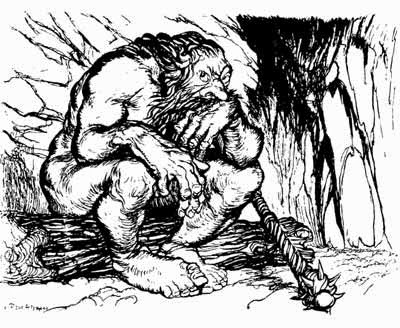
Jack the Giant-Killer Illustration by Arthur Rackham
Jack soon went searching for giants again, but he had not ridden far, when he saw a cave, near the entrance of which he beheld a giant sitting upon a block of timber, with a knotted iron club by his side. His goggle eyes were like flames of fire, his countenance grim and ugly, and his cheeks like a couple of large flitches of bacon, while the bristles of his beard resembled rods of iron wire, and the locks that hung down upon his brawny shoulders were like curled snakes or hissing adders. Jack alighted from his horse, and, putting on the coat of darkness, went up close to the giant, and said softly: 'Oh! are you there? It will not be long before I take you fast by the beard.' The giant all this while could not see him, on account of his invisible coat, so that Jack, coming up close to the monster, struck a blow with his sword at his head, but, missing his aim, he cut off the nose instead. At this, the giant roared like claps of thunder, and began to lay about him with his iron club like one stark mad. But Jack, running behind, drove his sword up to the hilt in the giant's head so that it fell down dead. This done, Jack cut off the giant's head, and sent it, with his brother's also, to King Arthur, by a waggoner he hired for that purpose.
Jack now resolved to enter the giant's cave in search of his treasure, and, passing along through a great many windings and turnings, he came at length to a large room paved with freestone, at the upper end of which was a boiling caldron, and on the right hand a large table, at which the giant used to dine. Then he came to a window, barred with iron, through which he looked and beheld a vast number of miserable captives, who, seeing him, cried out: 'Alas! Young man, art thou come to be one amongst us: in this miserable den?'
'Ay,' quoth Jack, 'but pray tell me what is the meaning of your captivity?'
'We are kept here,' said one, 'till such time as the giants have a wish to feast, and then the fattest among us is slaughtered! And many are the times they have dined upon murdered men!'
'Say you so,' quoth Jack, and straightway unlocked the gate and let them free, who all rejoiced like condemned men at sight of a pardon. Then searching the giant's coffer, he shared the gold and silver equally amongst them and took them to a neigbouring castle, where they all feasted and made merry over their deliverance.

Jack the Giant Killer Concept Art by John Dickenson
But in the midst of all this mirth a messenger brought news that one Thunderdell, a giant with two heads, having heard of the death of his kinsmen, had come from the northern dales to be revenged on Jack, and was within a mile of the castle, the country people flying before him like chaff. But Jack was not a bit daunted, and said: 'Let him come! I have a tool to pick his teeth; and you, ladies and gentlemen, walk out into the garden, and you shall witness this giant Thunderdell's death and destruction.'The castle was situated in the midst of a small island surrounded by a moat thirty feet deep and twenty feet wide, over which lay a drawbridge. So Jack employed men to cut through this bridge on both sides, nearly to the middle; and then, dressing himself in his invisible coat, he marched against the giant with his sword of sharpness. Although the giant could not see Jack, he smelt his approach, and cried out in these words:
'Fee, fi, fo,fum!
I smell the blood of an Englishman!
Be he alive or be he dead,
I'll grind his bones to make me bread!'
'Say'st thou so,' said Jack; 'then thou art a monstrous miller indeed.'
The giant cried out again: 'Art thou that villain who killed my kinsmen? Then I will tear thee with my teeth, suck thy blood, and grind thy bones to powder.'
'You'll have to catch me first,' quoth Jack, and throwing off his invisible coat, so that the giant might see him, and putting on his shoes of swiftness, he ran from the giant, who followed like a walking castle, so that the very foundations of the earth seemed to shake at every step. Jack led him a long dance, in order that the gentlemen and ladies might see; and at last to end the matter, ran lightly over the drawbridge, the giant, in full speed, pursuing him with his club. Then, coming to the middle of the bridge, the giant's great weight broke it down, and he tumbled headlong into the water, where he rolled and wallowed like a whale. Jack, standing by the moat, laughed at him all the while; but though the giant foamed to hear him scoff, and plunged from place to place in the moat, yet he could not get out to be revenged. Jack at length got a cart rope and cast it over the two heads of the giant and drew him ashore by a team of horses, and then cut off both his heads with his sword of sharpness, and sent them to King Arthur.
After some time spent in mirth and pastime, Jack, taking leave of the knights and ladies, set out for new adventures. Through many woods he passed and came at length to the foot of a high mountain.
Jack the Giant-Killer Illustration by Arthur Rackham
Here, late at night, he found a lonesome house, and knocked at the door, which was opened by an aged man with a head as white as snow. 'Father,' said Jack, 'can you lodge a benighted traveller that has lost his way?' 'Yes,' said the old man; 'you. are right welcome to my poor cottage.' Whereupon Jack entered, and down they sat together, and the old man began to speak as follows: 'Son, I see by your belt you are the great conqueror of giants, and behold, my son, on the top of the mountain is an enchanted castle; this is kept by a giant named Galligantua, and he, by the help of an old conjurer, betrays many knight and ladies into his castle, where by magic art they are transformed into sundry shapes and forms. But above all, I grieve for a duke's daughter, whom they fetched from her father's garden, carrying her through the air in a burning chariot drawn by fiery dragons, when they secured her within the castle, and transformed her into a white hind. And though many knights have tried to break the enchantment, and work her deliverance, yet no one could accomplish it, on account of two dreadful griffins which are placed at the castle gate and which destroy everyone who comes near. But you, my son, may pass by them undiscovered, where on the gates of the castle you will find engraven in large letters how the spell may be broken.' Jack gave the old man his hand, and promised that in the morning he would venture his life to free the lady.

Jack the Giant-Killer Illustration by John D. Batten

In the morning Jack arose and put on his invisible coat and magic cap and shoes, and prepared himself for the fray. Now, when he had reached the top of the mountain he soon discover the two fiery griffins, but passed them without fear, because of his invisible coat. When he had got beyond them, he found upon the gates of the castle a golden trumpet hung by a silver chain, under which these lines were engraved:
'Whoever shall this trumpet blow,
Shall soon the giant overthrow,
And break the black enchantment straight;
So all shall be in happy state.'
Jack had no sooner read this but he blew the trumpet, at which the castle trembled to its vast foundations, and the giant and conjurer were in horrid confusion, biting their thumbs and tearing their hair, knowing their wicked reign was at an end. Then the giant stooping to take up his club, Jack at one blow cut off his head; whereupon the conjurer, mounting up into the air, was carried away in a whirlwind. Then the enchantment was broken, and all the lords and ladies who 'had so long been transformed into birds and beasts returned to their proper shapes, and the castle vanished away in a cloud of smoke. This being done, the head of Galligantua was likewise, in the usual manner, conveyed to the Court of King Arthur, where, the very next day, Jack followed, with the knights and ladies who had been delivered.
Whereupon, as a reward for his good services, the king prevailed upon the duke to bestow his daughter in marriage on honest Jack. So married they were, and the whole kingdom was filled with joy at the wedding. Furthermore, the king bestowed on Jack a noble castle, with a very beautiful estate thereto belonging, where he and his lady lived in great joy and happiness all the rest of their days.

Another story from Cornwall tells of the giant Bolster, who fell in love with Saint Agnes.  The story itself is re-enacted every year in Cornwall on May 1st using giant puppets and local performers.

The giant Bolster puppet
The Giant Bolster

This mighty man held especial possession of the hill formerly known as Carne Bury-anacht or Bury-anack, "the sparstone grave," sometimes called St Agnes' Ball and St Agnes' Pestis, but which is now named, from the use made of the hill during the long war, St Agnes' Beacon. He has left his name to a very interesting, and undoubtedly most ancient earthwork, which still exists at the base of the hill, and evidently extended from Trevaunance Porth to Chapel Porth, enclosing the most important tin district in St Agnes. This is constantly called "The Bolster."
Bolster must have been of enormous size: since it is stated that he could stand with one foot on St Agnes' Beacon and the other on Carn Brea; these hills being distant, as the bird flies, six miles, his immensity will be clear to all. In proof of this, there still exists, in the valley running upwards from Chapel Porth, a stone in which may yet be seen the impression of the giant's fingers. On one occasion, Bolster, when enjoying his usual stride from the Beacon to Carn Brea, felt thirsty, and stooped to drink out of the well at Chapel Porth, resting, while he did so, on the above-mentioned stone. We hear but little of the wives of our giants; but Bolster had a wife, who was made to labour hard by her tyrannical husband. On the top of St Agnes' Beacon there yet exist the evidences of the useless labours to which this unfortunate giantess was doomed, in grouped masses of small stones.

St. Agnes Head, Cornwall
These, it is said, have all been gathered from an estate at the foot of the hill, immediately adjoining the village of St Agnes. This farm is to the present day remarkable for its freedom from stones, though situated amidst several others, which, like most lands reclaimed from the moors of this district, have stones in abundance mixed with the soil. Whenever Bolster was angry with his wife, he compelled her to pick stones, and to carry them in her apron to the top of the hill. There is some confusion in the history of this giant, and of the blessed St Agnes to whom the church is dedicated. They are supposed to have lived at the same time, which, according to our views, is scarcely probable, believing, as we do, that no giants existed long after their defeat at Plymouth by Brutus and Corineus. There may have been an earlier saint of the same name; or may not Saint Enns or Anns, the popular name of this parish, indicate some other lady?Be this as it may, the giant Bolster became deeply in love with St Agnes, who is reputed to have been singularly beautiful, and a pattern woman of virtue. The giant allowed the lady no repose. He followed her incessantly, proclaiming his love, and filling the air with the tempests of his sighs and groans. St Agnes lectured Bolster in vain on the impropriety of his conduct, he being already a 
The Giant Bolster and the Six Mile Stride by George Cruikshank
married man. This availed not; her prayers to him to relieve her from his importunities were also in vain. The persecuted lady, finding there was no release for her, while this monster existed, resolved to be rid of him at any cost, and eventually succeeded by the following stratagem:-- Agnes appeared at length to be persuaded of the intensity of the giant's love, but she told him she required yet one small proof more. There exists at Chapel Porth a hole in the cliff at the termination of the valley. If Bolster would fill this hole with his blood the lady would no longer look coldly on him. This huge bestrider-of-the-hills thought that it was an easy thing which was required of him, and felt that he could fill many such holes and be none the weaker for the loss of blood. Consequently, stretching his great arm across the hole, he plunged a knife into a vein, and a torrent of gore issued forth. Roaring and seething the blood fell to the bottom, and the giant expected in a few minutes to see the test of his devotion made evident, in the filling of the hole. It required much more blood than Bolster had supposed; still it must in a short time be filled, so he bled on. Hour after hour the blood flowed from the vein, yet the hole was not filled. Eventually the giant fainted from exhaustion. The strength of life within his mighty frame enabled him to rally, yet he had no power to lift himself from the ground, and he was unable to stanch the wound which he had made. Thus it was, that after many throes, the giant Bolster died !

The cunning saint, in proposing this task to Bolster, was well aware that the hole opened at the bottom into the sea, and that as rapidly as the blood flowed into the hole it ran from it, and did
"The multitudinous seas incarnadine,
Making the green one red."
Thus the lady got rid of her hated lover; Mrs Bolster was released, and the district freed from the presence of a tyrant. The hole at Chapel Porth still retains the evidences of the truth of this tradition, in the red stain which marks the track down which flowed the giant's blood.

Our next tale comes from Norfolk and tells of the Tom Hickathrift, almost a giant himself, who defeated the Giant of Smeeth, who was ‘so malicious that the local people would go twice the length that their journey should take in order to avoid crossing the common.’


Tom Hickathrift's grave, Tilney by Nicky Stockman
Tom Hickathrift and the Giant of Smeeth

In the churchyard of the church of All Saints, in the village of Tilney All Saints, lies a long narrow stone.  It’s about 7ft long and broken in two places.  It lies just beyond the eastern end of the church.  It has been worn smooth by wind and weather, but it’s said that years ago, carved into the stone, there was a circle with a cross inside it and beneath it a straight line.
The stone marks the grave of Tom Hickathrift, and it marks the end of a story that began many hundreds of years ago in the city of Ely.
In Ely, there once lived a man called Thomas Hickathrift.  He was married to a ramping girl called Joan.  They had a son, and they called him Tom, after his old father.  He grew up, and when he was old enough, he went to school.  But Tom had no head for his ABCs or his 123s.  All he wanted was to sit in front of the fire and warm his hands.
Old Thomas passed away, leaving poor Joan to raise the boy alone – and it wasn’t easy.  By the time Tom was ten years old, he stood 8ft tall in his stockinged feet.  His hands were the size of shoulders of mutton, and he’d eat enough mean in one day to satisfy five full-grown men.  His old mother had to work her fingers to the bone, and her bones to the marrow, to keep the boy alive.
One day she came into the parlour after a hard day’s work, and saw Tom’s enormous back hulking in the firelight.  His great red hands were stretched towards the heat.  He was whistling tunelessly between his teeth.  Joan flew into a fury: ‘Can’t you do something useful, Tom!  You’re a waste of your time!  You’re a waste of my time!  You go to Stamford’s barn and fetch some straw for the floor of the house!’
In those days they had straw on the floors of their houses as we have carpets today.  Tom lumbered to his feet.
‘All right then, Mother.’
He ducked under the lintel of the doorway.  He strode across the fields until he met Farmer Stamford: ‘My old mother asked me to fetch some straw from your barn.’
‘You take as much as you can carry, Tom.’
Famer Stamford soon regretted his words.  Tom went into the barn and piled stook upon stook until he’d got himself half a ton of straw.  He roped it round and swung it onto his shoulder.  Then he set off for home with the straw on his back, whistling all the way.  Farmer Stamford stood and stared in astonishment.

Tom Hickathrift Illustration - artist unknown
From that day onwards there was no more hulking in the firelight for Tom Hickathrift.  The story of his prodigious strength was out.  Soon the world and his wife wanted Tom to work for them.  At that time, there was a woodman living in Ely.  He’d felled a mighty oak tree and he needed some help to lift its trunk onto a cart.  He asked Tom and five other strong men to give him a hand.  All morning Tom stood with his arms folded, and watched the five men as they set to with levers and winches – but the oak wouldn’t budge.  In the middle of the day, when he’d eaten his baggin and wiped the grease from his mouth with the back of his hand, Tom said: ‘Stand you aside.’He reached down, curled the fingers of one hand around the stump of a branch, lifted the trunk, swung it round, and lowered it onto the cart.  The woodman was amazed.
‘Well, Tom!  What can I give you as payment for your trouble?’
‘I’ll tell you what,’ said Tom, ‘I’ll have a twig for my old mother’s fire.’
Beside the tree that had been felled was another still standing.  Tom wrapped his arms around the trunk and heaved it out of the ground, roots and all.  He lifted it onto his shoulder and set off striding across the fields towards Ely, whistling as he went.
It wasn’t long before Tom Hickathrift was famous the length and the breadth of the Fens.  At every fair, from Swaffham to Spalding, from Cottenham to Kings Lynn, he was a champion at the wrestling, boxing, tossing the cannonball, and all the other sports of the time.  Even today, in a field in the parish of Terrington St. Clement, a millstone lies half-buried in the ground that Tom is said to have thrown for a wager from the Tuesday Market place in Kings Lyn, some 6 miles away.
A brewer in Kings Lynn needed a man to bring barrels of beer from Kings Lynn to Wisbech.  When he saw Tom Hickathrift at a hiring fair, he seemed to be the very man for the job.
‘Now then Tom,’ said the brewer, ‘If you’ll work for me, you can have as much beer as you can drink, as much meat as you can eat… and a new suit of clothes besides.’
That was a payment after Tom’s heart, and he readily agreed.  The brewer told him how he was to lead his horses pulling the great brewer’s cart, piled high with barrels, from Kings Lyn to Wisbech.  Tom listened and nodded.
The World's Legends: He was the strongest man in England by Mike Lea
Now, at that time, between Kings Lynn and Wisbech, on the Smeeth – the great common that belonged to the ‘seven towns of the Marshland’, Walpole St. Peter, Walsoken, West Walton, Terrington, Clenchwarton, Emnett and Tilney – there lived a giant.  He’d made his home in a cave on a low hill in the middle of Smeeth.  Tom Hickathrift stood tall, but this was a real giant.  He towered as high as a house.  His eyes were like barber’s basins.  His favourite sport was twisting the heads from his victims, and hanging them from the branches of an oak tree that grew on the top of his hill.  All that was left of them he would devour, crunching their bones and licking their blood from his fingertips.
On account of this giant, the brewer gave Tom one last piece of advice: ‘Now then Tom, when you lead the horses pulling my cart, don’t take the short cut over the Smeeth.  You go the long way, by road, d’ye understand?’
Tom nodded, ‘All right then.’
The next day Tom started work, and for a few weeks, he did what he was told.  But on his diet of strong meat and strong beer he grew stronger and bolder than he’d ever been before.  One day, he was leading the horses out of Kings Lynn when he saw the track that led to Smeeth.  He thought to himself: ‘Well, why not give it a try… gain the horse or lose the saddle, as the saying goes…’
He pushed open the gate and led the horses through.
When he came to the Smeeth, the giant nosed him.  (A giant’s nose is always more fine-tuned than his eyes or his ears.)
He came sauntering out of his cave, with a great gap-toother grin stretched across his face.  If there was one thing he loved more than human flesh, it was a barrel of ale.
‘How now rogue, what brings you here so bold, in throwing open the gate and leaving the road?  I’ll make an example of you to all the rogues under the sun.’
He pointed to the spreading oak on the height of his hill.  It was festooned like a Christmas tree, with grisly trophies.  Severed heads were hanging by their hair, some old with white bone jutting through blotchy blackened skin, some fresh with red blood dripping and dribbling still.
‘D’ye see this tree?  I’ll hang your head the highest of them all!’
Tom reached under the back of one of the brewer’s horses.  He picked up a handful of horse-muck.
‘You will, will ye?’ he said, ‘I’ll tell you what… you can have a turd in the teeth for all your taunting talk!’
He hurled it and struck the giant’s cheek.  The giant bellowed with rage.  He ran into his cave, and returned with a club in his hand as big as a mill-post.
‘Here’s the twig that’ll make you see sense!’
He strode down towards Tom… and it was at that moment that Tom Hickathrift realised his mistake.  
Tom Hickathrift and the Giant of Smeeth - artist unknown
He’d come without a weapon.  All he had was the whip for driving the horses.  He looked to left and right.  There were no young trees he could pull up by the roots.  What was he to do?  Then, all of a sudden, he had an idea.  He unharnessed the horses.  He ran to the side of the brewer’s cart.  He curled his fingers under it an lifted.  The cart toppled over and the barrels rolled across the ground.  From the underside of the cart he snapped one of the iron axles.  From the end of the axle he broke away the wheel.  With the axle in one hand as a club and the wheel in the other as a shield, he stepped forward to the fight.

The giant brought his club swinging down through the air, but Tom jumped aside so that it caught the rim of his wheel and cracked it.  The giant dropped to his knees with the strength of the stroke.  Tom jumped into the air and gave him such a thwack on the side of the head with the axle that the giant was sent staggering left and right.
‘What!’ shouted Tom, ‘Are you drunk on my strong beer already?’
Then they set to like hammer and tongs.  All day they fought, making the hard ground soft, and the soft ground hard, with the fury of their fighting.  By the end of the afternoon the giant was wet with sweat and blood.
‘How now rogue,’ he roared, ‘let’s have a little pause and drink some of that beer of yours.’
‘I may be a fool,’ said Tom, ‘but I ain’t such a dolt as all that.’
And he gave him another hefty whack.  By the time the sun set, the giant was lying with his face in the grass, bellowing and begging for mercy.  But Tom gave him no quarter.  With the whip and the axle as noose and tourniquet he tore the giant’s head from his shoulders.  Then he fitted the axle and the cracked wheel to the cart.  He pulled it upright, piled up the barrels and harnessed the horses.  Soon he was leading them into Wisbech, whistling as he went.
The story of Tom’s triumph spread like wildfire.  The people of Wisbech lifted him onto their shoulders and carried him to the Smeeth.  The people of the seven towns of the Marshland came swarming to their common.  Sure enough, they found the giant’s body… and then they found his grimacing head.  They lit a huge bonfire, and all that day there was feasting, dancing and celebration.
Village sign depicting Tom with the wheel and axle by Nicky Stockman
At the end of the day, when everyone had gone home, Tom ventured into the giant’s cave.  There he found amongst a huge pile of gnawed bones, a great quantity of gold, silver and copper coins; the emptied pockets of the giant’s victims.  There was treasure enough to make him rich for life.
With the money, he paid for the building of a beautiful house called Hickathrift Hall.  His old mother came to live with him.  And from that day onwards, he was no longer known as Tom Hickathrift, but as Mr. Thomas Hickathrift, gentleman.
It’s said that years later he killed another giant, on the island of Thanet in Kent, and that afterwards the King himself dubbed him ‘Sir Thomas Hickathrift’.  It’s also said that it’s thanks to Tom that there are no lions, bears or wolves on British soil.
That’s a maybe… but what certainly is true is that, for all his strength and courage, Tom proved no match for old age.  When he was 100 years old, and felt that his time had come, he hobbled out of his all.  A huge stone ball was lying on the ground.
‘Wherever this ball falls, there you must lay my bones to rest.’
Tom threw the boulder which hit this face of the church wall. His grave lies under the left hand side of the window. by Nicky Stockman
He gave it a tremendous kick.  It flew through the air and cracked the east wall of Tilney church.  Where the ball fell to the ground is where Tom is buried.  Over his grave a stone was set.  Carved into the stone were no words, for Tom had never mastered his ABCs.  Instead, there was just a circle for the cartwheel and a straight line for the axle with which he’d fought the giant and saved the Smeeth all those years ago.
And Tom has never been forgotten.  Throughout the marshland and the fens, if there’s a dew-pond in a field, the chances are it’ll be known as Tom Hickathrift’s washbasin.  If someone puts up a grandiose pair of gateposts, they’ll be known as Tom Hickathrift’s candlesticks.  If a building is somehow in the wrong place (like the tower of West Walton church), it will have been lifted by Tom for a wager and put down slightly askew.  If you want to catch a glimpse of Tom, you can go to Walpole St. Peter; there’s a small carving of him on the outside wall of the north chancel.  But the best place of all is not in Norfolk at all: it’s in Saffron Walden, where Tom and the giant are modelled in plaster on the outside gables of the Sun Inn, on the brink of doing battle.

Useful Resources

English Fairy Tales by Joseph Jacobs
Popular Romances of the West of England by Robert Hunt
Mythology of the British Isles by Geoffrey Ashe
Norfolk Folk Tales by Hugh Lupton
Giants, Monsters & Dragons: An Encyclopedia of Folklore, Legend, and Myth by Carol  Rose

Friday, 13 March 2015

Mythical Creatures: The Giants of England - Part One


Gog and Magog by TimeCrash07
Stories of giants in Britain may be a legacy from our Celtic ancestors who arrived in Britain in around 300 BC.  Seeing the great stone circles left by those who inhabited the land before their arrival, the Celtic people imagined them to have been constructed by some superhuman race.  Helping to colour their legends of ogres and giants, who were often credited with cannibalism, was their perception of the native Britons, who they believed were cannibalistic savages.  As time passed so their legends grew, with the heroes of the Celtic people growing in size to match the terrible foes who they hoped to vanquish.  These tales survived to be written down, and embellished, by Geoffrey of Monmouth.  In his History of the Kings of Britain, Monmouth writes of how the British Isles were first inhabited by a small number of ferocious giants who are brought down by the Trojans and their leader, Brutus.  The leader of these giants was called Gogmagog, also known as Goemagot.  The name is believed to have come from the biblical Gog and Magog – Gog being a giant from both Hebrew and Christian scriptures, and Magog being the place in which he originates.

Brutus of Troy
At that time the name of the island was Albion, and of none was it inhabited save only of a few giants.  Natheless the pleasant aspect of the land, with the abundance of fish in the rivers and deer in the choice forests thereof did fill Brute and his companions with no small desire that they should dwell therein.  Wherefore, after exploring certain districts of the land, they drove the giants they found to take refuge in the caverns of the mountains, and divided the country among them by lot according as the Duke made grant thereof.
… For nought gave him greater pleasure than to wrestle with the giants, of whom was greater plenty there than in any of the provinces that had been shared amongst his comrades.  Among others was a certain hateful one by name Goemagot, twelve cubits in height, who was of such lustihood, that when he had once uprooted it, he would wield an oak tree as lightly as it were a wand of hazel.  On a certain day when Brute was holding high festival to the gods in the port whereat he had first landed, this one, along with a score other giants, fell upon him and did passing cruel slaughter on the British.  Howbeit, at the last, the Britons collecting together from
Corineus, the Giant in Guildhall
all quarters prevailed against them and slew them all, save Geomagot only.  Him Brute had commanded to be kept alive, as he was minded to see a wrestling bout betwixt him and Corineus, who was beyond measure keen to match himself against such monsters.  So Corineus, overjoyed at the prospect, girt himself for the encounter, and flinging away his arms, challenged him to a bout at wrestling.  At the start, on the one side stands Corineus, on the other the giant, each hugging the other tight in the shackles of their arms, both making the very air quake with their breathless gasping.  It was not long before Geomagot, grasping Corineus with all his force, brake him three of his ribs, two on the right side and one on the left.  Roused thereby to fury, Corineus gathered up all his strength, heaved him up on his shoulders and ran with his burden as fast as he could for the weight to the seashore nighest at hand.  Mounting up to the top of a high cliff, and disengaging himself, he hurled the deadly monster he had carried on his shoulder into the sea, where, falling on the sharp rocks, he was mangled all to pieces and dyed the waves with him blood, so that ever thereafter that place from the flinging down of the giant hath been known as Lamgoemagot, to wit, ‘Goemagot’s Leap,’ and is called by that name unto this present day.


An account of Albion's stand against the Trojans appeared in The new history of the Trojan wars, and Troy's destruction by Elkanah Settle, published in 1791.  Here we are not only told of Albion's battle, but of how Gog and Magog, who are giants in the tale, are brought back to London as prisoners of Brute.


Trojan Warrior by travellerplanet
Brute, having thus got footing in Britain, was preparing to improve the same, when Albion, who had named this island after his own name, - by which it is sometimes called at this day, - having intelligence thereof, raised his whole power, being men of a gigantick stature, and vast strength, and bearing for their arms huge clubs of knotty oak, battle axes, whirlbats of iron, and globes full of spikes, fastened to a long pole by a chain; and with these encountering Brute, a bloody battle was fought, wherein the Trojans were worsted and many of them slain, and their whole army was forced to retire.
Brute hereupon considering the disadvantage between his men and the giants, devised a stratagem to overthrow them, by digging in the night a very long and deep trench, at the bottom impaling it with sharp stakes, and covering it with boughs and rotten hurdles, on which he caused to be laid dried leaves and earth, only leaving some firm passages, well known to his men by particular marks. 
Gog and Magog at the Guildhall by Sir Walter Besant
This being done, he dared the giants to a second battle, which Albion readily accepted; and the fight being begun, after some dispute, Brute seemed to retire; whereupon the giants pressed on him with great fury; and the Trojans retiring nimbly beyond their trench, made a stand, and ply’d them with a shower of darts and arrows, which manner of fight they were unacquainted with, whereby many of them were slain.  However, Albion encouraging his men to come to handy strokes with their enemies, they rushed forward, and the vanguard immediately perished in the trenches; and the Trojans continuing to shoot their arrows very thick, the giants were put to flight, and pursued into Cornwall; where, in another bloody fight, Albion was slain by Brute, fighting hand to hand; and his two brothers. Gog and Magog, giants of huge stature, were taken prisoners and led in triumph to the place where now London stands, and upon those risings on the side of the river Thames, founded a city, which he called Troy-novant, or New Troy, and building a palace where Guildhall stands, caused the two giants to be chained to the gate of it, as porters.  In memory of which it is held that their effigies, after their deaths, were set up as they now appear in Guildhall.


Albion by Mabus88
Albion, according to Holinshed, was the brother of Geomagot, or Gogmagog; also a giant and ‘a cruel tyrant’.  According to Holinshed’s Chronicles, he was a son of Neptune, or Poseidon.  In the following extract, Holinshed tells us of how Britain was once called Albion after the giant and of how Albion first came to Britain:

Afterward in processe of time, when desire to rule began to take hold in the minds of men, and ech prince endeavoured to enlarge his owne dominions: Albion the sonne of Nepturne… hearing of the commodities of the countrie, and plentifulnesse of soile here, made a voiage over, and finding the thing not onelie correspondent unto, but also farre surmounting the report that went of this Iland, it was not long after yer he invaded the same by force of armes, brought it to his subjection in the 29. yeare after his grandfathers decease, and finallie changed the name thereof into Albion, whereby the former denomination after Samothes did grow out of mind, and fall into utter forgetfulnesse.  And thus was this Iland bereft at on time both of hir ancient name, and also of hir lawfull succession of princes descended of the line of Japhet, under whom it had continued by the space of 341 yeres and nine princes, as by the Chronologie following shall easily appeere.

Hercules in Battle by wraithdt*
Albion, along with his brother Bergion, was, according to Holinshed, killed by Hercules:

…when the said Albion governed here in this countrie by the space of seven years, it came to passe that both he and his brother Bergion were killed by Hercules at the mouth of Rhosanus, as the said Hercules passed out of Spaine by the Celtes to go over into Itaie, and upon this occasion (as I gather among the writers) not unworthie to be remembred.  It happened in time of Lucus king of the Celts, that Lestrigo and his issue… did exercise great tyrannie, not onelie over his owne kingdome, but also in molestation of such princes as inhabited round about him in most intolerable maner…  To be short therefore, after the giants, and great obstacle unto them in their tyrannous dealing; Hercules his sonne… proclaimed open warres against them all, and going from place to place, he ceased not to spoile their kingdoms, and therewithal to kill them with great courage that fell into his hands…
In the meane time Albion understanding how Hercules intended to make warres against his brother Lestrigo, he thought good if it were possible to stop him that tide, and therefore sending for his brother Bergion out of the Orchades (where he also reigned as supreame lord and governour) they joined their powers, and sailed over into France.  Being arrived there, it was not long yer the met with Hercules and his armie, neare unto the mouth of the river called Roen (or the Rhodanus) where happened a cruell conflict betweene them, in which Hercules and his men were like to have lost the day, for that they were in maner wearied with long warres, and their munition sore wasted in the last viage that he had made for Spaine.  Hereupon Hercules… it came suddenlie into his mind to will each of them to defend himselfe by throwing stones at his enimie…  The policie was no sooner published than hearkened unto and put in execution, whereby they so prevailed in the end, that Hercules wan to field, their enimies were put to flight, and Albion and his brother both slaine, and buried in that plot.

White Cliff in Dover by Mihalik
According to Holinshed, even after the death of the giant, the name Albion, which some attribute to the White Cliffs of Dover, remained for quite some time before it was renamed:

But to go forward, albeit that Albion and his power were thus discomfited and slaine, yet the name that he gave unto this Iland died not, but still remained unto the time of Brute, who arriving here in the 1116 before Christ and 2850 after the creation of the world, not onelie changed it into Britaine (after it had beene called Albion by the space of about 600 yeares)…

While Albion met his demise at the hands of Hercules, he was not the last giant of Britain.  Geoffrey of Monmouth also mentions giants when Merlin instructs Aurelius that a memorial for the ‘many noble warriors that had died for their country.’  The stones which were used to create Stonehenge were, according to Merlin, called ‘the Giant’s Dance’ and had been taken by giants from Africa to Ireland.

Giant's Dance by vikingjon
'If thou be fain to grace the burial-place of these men with a work that shall endure for ever, send for the Dance of the Giants that is in Killaraus, a mountain in Ireland.  For a structure of stones is there that none of this age could raise save his wit were strong enough to carry his art.  For the stones be big, nor is there stone anywhere of more virtue, and, so they be set up round this plot in a circle, even as they be now there set up, here shall they stand for ever.'
At this words of Merlin, Aurelius burst out laughing… ‘Laugh not so lightly, King, for not lightly are these words spoken.  For in these stones is a mystery, and a healing virtue against many ailments.  Giants of old did carry them from the furthest ends of Africa and did set them up in Ireland what time they did inhabit therein…’

Jack and the Beanstalk is a story which can be found throughout the world, with oral versions having been collected from Jamaica to Australia.  The oldest allusion to the story, however, can be found in the second edition of ‘Round About Our Coal-Fire: On Christmas Entertainments’ which was published in 1734, with the story itself appearing under the heading ‘Enchantment Demonstrated in the Story of Jack Spriggins and the Enchanted Bean’.  Later versions of the story are completely different to the original tale – Jack does not sell the family cow for five beans, there is no golden egg laying chicken, nor the magic harp, nor is the Giant called Holdfast.  In this original version, the giant is known as Gogmagog, and the magic, or enchanted, bean comes from Jack’s Grandmother, who is a witch.

Jack and the Magic Bean by Hoshii-K
Enchantment Demonstrated in the Story of Jack Spriggins and the Enchanted Bean

Gaffer Spriggins, who was an acute old farmer, who could leer of one eye and crack a joke, began to tell about a comical lad of his family, of the name of Spriggins, for he admired every one of his name, because he had no children of his own; and this boy’s name was Jack, as we shall call him now.
Good folks, says Gaffer Spriggins, there never was such a dirty, lazy, tatter-de-mallion dog as Jack in the world; he was elevated in his Garret o’nights, and had the Curse of Small Beer in his kitchen o’days, with an old enchantress for his Grandmother and companion.  When I mention his apartment, I ought in justice to let you know that the house was no more than a hovel or a cottage; it consisted but of two rooms, if we may call them so, for really the upper apartment, which was the next storey to the ground floor, was next to the thatch, in which place he had often the benefit of contemplation; for though he was a smart, large boy, his Grandmother controlled him, and between whiles the good old woman instructed Jack in many things, and among the rest, Jack, says she, as you are growing up to manhood, I must tell you, I have a bean in my house which will make you a fortune; you shall be richer than an emperor, you shall have the whole world at your command; and as you now grow strong and lusty, I design to give it thee, my boy, one day or other.  Oh! says Jack Dear Grandmother give me now that bean, that I may try how rich I can be, and then how much I shall love my dead Grandmother!  No, child, says she, should I do that, you would grow rich and turn rake, and you would never think of your poor Grandmother again: But Sirrah, says she, if I was to know you would play such tricks, I’d smack your saucy face for you.  Nay, says Jack, Grandmother, don’t hurt me.  No, answers the Grandmother, you lusty boy, you know I love you too well to hurt you: I love you as becomes me, and you ought to take notice on’t; and so Jack made no words about the matter.
The Cat Familiar by FerelwingB
In the morning as Jack was making his Grandmother’s fire, puss scratching among the ashes, clawed out the enchanted bean, which his Grandmother had dropped out of her leathern purse by accident.  Odds Budd, says Jack, I’ll set it in our garden, and see what it will come to, for I always loved beans and bacon; and then, what was wonderful! the bean was no sooner put into the ground, but the sprout of it jumped out of the earth, and grew so quick, that it gave Jack a fillip on the nose, and made him bleed furiously: In he runs to his Grandmother, crying out, Dear Grandmother save me, I am killed: No, says she, I now have only time to tell you, my enchantment will be broke in an hour’s time, I know it, you have got my bean, and this impertinence of yours will occasion my being transformed; yet if I am able I will sufficiently thrash your jacket: but away runs Jack, and up the bean he climbs, and the old woman after him, with the birch-broom in her hands.  The bean was then about a mile high, and by the time she got at it, Jack was straddled up near half a mile; and through her vengeance and ill-nature, not being able to reach the boy, she fell down in a fit for a time, and as soon as her hour was out, was turned into a monstrous toad, and crawled into some neighbouring mud or cellar, in her way to the shades: but Jack went on his gallop, though the bean grew more than a mile an hour.  In truth, the bean grew forty miles high, and while it was growing,
The Beanstalk by JoshCorpuz85
some little towns were built upon the leaves as he went up, for him to refresh himself at: he calls at one for a pot of ale, at another for some bread and cheese, and at another which was near the Giant’s Castle, for what he could get: this had a very promising aspect, for the sign was as big as any on Ludgate-Hill: here he thought to rest for a time, and goes on strutting like a crow in a gutter; What have you to eat Landlord, says he; Everything in the world, Sir, says the Landlord: Why then, says Jack, give me a neck of mutton and brother: Alas, says the Landlord, tomorrow is market-day; how unfortunate it is I cannot get you a neck of mutton tonight if it was to save my soul: Well then, get me something else, says Jack; Have you any veal?  No indeed, Sir, not at present; but there is a fine calf fatting at Mr Jenkinson’s that will be killed on Saturday next: But have you any beef in your house, says Jack; Why, truly, Sir, says the Landlord, if you had been here on Monday last, I believe, though I say it that should not say it, you never saw so fine a sirloin of beef as we had, and plumb-pudding too, which the justices who dined here, and their clerks and constables, entirely demolished; and though I got nothing by them, yet their company was a credit to my house.  Zounds, says Jack, have you nothing in the house?  I am hungry, I am starving; but I hear a cock crow, and from thence I am sure you have some poultry; kill one of them and broil it: Yes Sir, says the Landlord but that cock is the squire’s, he would not take forty guineas for it.  Well then, replied Jack, you may kill a hen or a chicken.  O Lord, Sir, I have not chicken, answers the Landlord, and the two hens that I have belong to the game cock, and they have incubated as I may say, their eggs a fortnight; but I believe we shall have chickens a Wednesday hence.  Have you no eggs in the house, says Jack: No Sir, indeed, answers the landlord, but nest-eggs, which we make of chalk.  Why then, says Jack, what the Devil have you got?  Why to tell you the truth, Sir, I don’t know that I have anything in the house to eat, for the squire and his huntsman called here this morning and devoured what we had, all our bacon, all our cheese, and all our bread; but I could have got you some fine trouts from the miller’s, only a little before you came in he sent all his fish up to Sir John’s.  Why then, says Jack, I find I must go to bed supperless.  Aye, master, answers the host.  Then give me some drink, says Jack.  That I can do, for I have just brewed; and if you love new drink, I can fit you to a tittle, for it has not been in the tun half an hour.

Thus was poor Jack plagued by the enchantment of his Grandmother, who was resolved to lay him under her ill tongue so long as her power lasted.  But just as he fell in with this starving prospect, off goes the top of the house; the host was turned into a beautiful lady, and in pops a dozen pretty youths, drest like pages in green satin, laced with silver and white feathers in their caps, each of them
Empress by Carlo-Marcelo*
mounted upon an hobby-horse finely bedecked with ribbons, tinsel and feathers; they dismounted immediately, and in full chorus most harmoniously addressed themselves to Jack, saluting him with the titles of Sovereign Lord of the Mannor, and Invincible Champion; ‘Tis this instant, great Sir, that your supposed Grandmother the Queen of Pomonkey has taken her passage to the shades, her enchantment is broke, and we bring you the full power of possessing all the pleasures you desire: The fair lady that stands before you in Emp’ress of the Mountains of the Moon; young as she seems to be, was your Grandmother’s black cat, and by enchantment has worn that shape four hundred years: It was she that put it in your mind to plant this wonderful bean by scratching in the ashes, and she is now entirely at you Highness’s disposal whether she shall live or die: You have a thousand Jack Catches now attending you without, with Halters and Hatchets to make an end of her, when your Honour pleases to direct her execution; or else you have a fiery dragon gaping for her, if you give but once the signal for her death: This box, great Sir, bears you the absolute power over her, over us, over Old Scratch or Nicholas the Ancient.  Your Grandmother, illustrious Sir, when she found the loss of her bean, and the shortness of her power, invoked an assembly of inquietudes to attend you, and so transformed this miracle of nature into the host you have been talking with.  Why in troth, says Jack, I thought it was a woman by filling me so full of expectation: But gentlemen, have you got any bread and cheese in your pockets, for I am exceeding hungry? but since it is all enchantment, as I begin now to find by alteration of my body, I feel sprinklings of generosity flow in my veins for Grandmother’s dear pussy, who has so often pur’d about me; I have nobleness of spirit to excuse my innocent Landlord, and I now solemnly take this fair lady to be my lawful and wedded wife.


Ruby Ring
It requires no more than, exalted Monarch, say the pages, but to put on the ring inclosed in that box, and you will instantly possess five wishes, and on the top of the ring your Highness will find a marble red stone given to your Grandmother by the King of Strombola.  If you are engaged in combat turn the stone to the north, and you may conquer Giants, Dragons, and Basilisks; and while you keep it to the south you will flow in plenty, and enjoy everything you desire. Is that all you have to say, says Jack; Yes and please your Honour, replied the pages; and then put on the ring; at which moment the remaining part of the inn was changed with a terrible crack into a delightful summer-house or pavilion, where a table was spread with the most elegant dishes, and the sideboard furnished with the richest wines.  This says Jack, pleases me above all things in the world; it is my first wish completely: But then he espied his lady to be badly dressed; I wish Madam, says Jack, you was as well cloathed as the greatest Queen in the world; when immediately she was adorned in the gayest princely robes.  Now, says Jack, I wish for some good musick; and in an instant down came a dozen or two of excelled fiddlers.  He then wished them to play the Black-Joke, and so they went on for an hour ‘till he had crammed his carcass.  And for the fifth wish, as he was now sleepy, and as the laws of enchantment order it, a wish is no sooner thought on but executed, so were our couple enchanted into a crimson velvet bed, embroidered with gold and pearls; the room illuminated with an hundred wax perfumed lights placed in glass sconces; the marble tables covered with jessamine and orange flowers, and the small ones made of mahogany and other fine wood, adorned with pyramids of sweetmeats and refreshing drams from the true Barbadoes citron to the 
The Empress Eugénie Surrounded by her Ladies in Waiting by Franz Xaver Winterhalter
humble gin.  I should have observed that when the Princess was conjured into the wonderful apartment, she was attended by twelve damsels cloathed in silver tissue, who flew to her assistance mounted upon as many rose-buds: These were followed by an impudent shoe-boy, whose business it was to clean her ladyship’s shoes against the morning: so that there was nothing wanting to complete the happiness of the illustrious couple.  He soon fell asleep with fatigue and dreamt a dream, in which the patroness of the enchantment appeared to him; and after having touched him and his Princess three times with a wand, struck out of their memories all thoughts of what they had been, and confirmed them in princely graces: Then whisking her wand three times over her head, whispered Prince John of his progress to the top of his bean, and how he should come to the Castle of Giant Gogmagog, by whom, himself and his Princess should be favourably received, and entertained for three days without danger, but he must be sure to keep the stone in is ring inclining to the north, and his Princess on his north side, that then he should be in seeming great danger of his life as well as his Princess; but by turning the stone of his ring under the bent of his finger, the Princess should immediately change into a basilisk, and kill all that were in reach of her eyes except himself; and then as soon as he could assume himself of safety, it was only to turn up his ring as it had been before, and then the Princess would resume her shape, and he become master of all the Giant’s treasure.  In the mean time she placed an enchanted fly upon the Princess’s left arm to convey her as a flying-horse would do, when she happened to be weary with climbing, and so departed.

Top of the Beanstalk by Ih8orangepezzz
Then Prince John began to rub his eyes, and stretching himself with a yawn or two, turned to his dear Princess, who just waked from the same dream he himself had; there was the fly upon the arm of the lady, which they carefully took off and put into a little gold cage, which they found placed on a table by them; and after a merry joke or two, they disposed themselves for getting up, and were immediately attended with pages and virgins.  They had a delightful breakfast, went dressed sumptuously, and set out for a walk towards the enchanted castle, the pages leading their hobby-horses in their hands, with one of an extraordinary kind and workmanship; for the Prince and the virgins had each hold of their rose-buds; and as for the Princess’s enchanted fly, she had hung it in its cage to the chain of her watch.  In their progress it happened that the company by means of the enchanted air, had got appetites like horses, and by agreement the Prince and Princess set down under the side of an hill covered with orange-trees and myrtles, the banks adorned with cowslips, primroses, hyacinths, and violets; before them was a purling stream, and the woods resounded with the harmonious notes of nightingales, linnets, canary and other fine singing birds, when on a gentle breeze were wafted an hundred cupids, each bearing a salver of gold furnished with the richest and most delicate meats; while on the other hand the trouts, salmons, carp, and other inhabitants of the stream leaped upon the banks; with a proper supply of nectar, ambrosia, burgundy, champaign, hermitage, frontigniac, and tokay wines, not forgetting a dram or two for the virgins of honour.

The Prince and Princess were delightfully regaled, whilst the zephirs attended them with refreshing air; and when their company had satisfied themselves, the remainder of the entertainment vanished: And as it is not proper to walk much after a hearty repast, the Prince judged it convenient to ride the rest of the way towards the castle.
And now no sooner was the fly let out of its cage, but itself and all the hobby-horses and rose-buds were changed into palfreys, adorned with the richest trappings, and away they go in the grandest manner, passing by many knights and ladies, and were informed that there were many more before them; when on a sudden they heard a voice cry out (for the could hear many miles further than any one else),

Fee-Faw-Fum!
I smell the blood of an English-Man;
Whether he be alive or dead,
I’ll grind his bones to make my bread.

The Giant's House by jbrown67
But this did not trouble either the Prince or his lady or attendants; they all knew they had safety enough in their hands, and gallop’d on ‘till they arrived at the Castle of Wonders, when they soon espied the Giant Gogmagog, who was picking his teeth with a great tree.  His tooth-pick case was such another thing as the Monument in London; he had a bowl of punch as big as St. Paul’s Church, and the cup that he drank out of was about the size of the dome of St. Paul’s; for his tobacco-pipe he 
Jack and Beanstalk by NogalWag
had the exact model of the piramidical building near the water-side in Southwark, where the damaged tobacco is burnt; and his tobacco-stopper was like the water-engine belonging to the York-Buildings Company; and his tobacco-box was about the size of Westminster-Hall: But however, he rose up when the Prince and his retinue appeared, and saluted them, bid them welcome, and offered them the best entertainment he could give them, whilst the Prince for safety’s sake turned the stone of his ring to the north; for he had never seen so huge a man before.
They were introduced into the castle through the richest apartments imaginable; and what was extraordinary the great Giant shrunk into a common size, and appeared like other men.  The furniture was vastly rich, the attendants without number, and the equipage magnificent, and nothing was wanting to entertain our illustrious couple with splendour befitting their rank.  The gardens were splendid as those at Versailles, the parks of vast extent, and in a word, so well furnished with all sorts of game, that no other could parallel them; which pleased the young couple extreamly, knowing full well they would be soon at their own disposal.
But they had now passed near the three days with the Giant, who grew desperately in love with the Princess, and resolved to have her at any rate, even at the expence of devouring her husband; which he could have done at a mouthful well enough, if he had been a common man.  But enchantment is a great help to men in such distress, and the Prince and his lady went to bed well satisfied:  They were no sooner laid down on their pillows, but they heard a mighty sobbing and moaning of many virgins sighing and grieving at their hard fortunes, that the giant was to make a breakfast of them the next morning.
Basilisk by MysteryOne617
Now you must know, the stone in the Prince’s ring being turned to the south, he could see and know what he pleased; and having consulted with the Princess about the destruction of the Giant, my dear (says he) shall I make the proof of changing you into a cockatrice or basilisk, for there is a mouse in the room, and if your looks kill the animal we shall be sure of the rest, for it may be multum in parvo.  The experiment was made in an instant, and the Princess, her eyes and whole body became so bright, that it was even dazzling to her husband; and the mouse no sooner beheld her, but burst with a prodigious crack.  Then the ring was turned again, and all wishes were in the Prince’s power; he immediately slipt through the key-holes of doors and narrow crannies, ‘till he came to a large gallery, where several thousand young ladies were tied up like calves o’fatting, and bemoaning their hard case, alas, dear Prince, (say they) tomorrow early shall we be broiled and crushed between the Giant, Gogmagog’s monstrous teeth, if you do not save us; and there are ten thousand knights below in as bad a condition.  You are then all safe (says the Prince) for the Giant will be destroyed as soon as the sun rises, and I shall then take possession of my dominions.

He had no sooner said this, but he released the ladies from their bridles, and summoned the Princess’s virgins to attend them with such necessaries as they wanted.  Then he whisked through the cracks and key-holes, ‘till he reached the place where the knights were confined; and they like the ladies were tied up to their good behaviour, and were moreover restrained the use of their hands, which he soon changed to their satisfaction, and gave them the assistance of his pages, with the promise to release them the next morning.  Then were the rooms where these prisoners of both sexes were kept, illuminated and furnished with every refreshing liquor; while the Prince returned to his lady and related what had passed.

Cockatrice by Cibana*
The day no sooner broke, but up got the Prince and Princess, and walking into a bower, refreshed themselves with some fruits, and the Giant appeared with a sword in his hand; says he with an hoarse voice, Thou Prince of Pitty, this moment you die, and he next instant will I solace myself in the delights of my gory breakfast.  The Prince and Princess immediately got from their seats, and while the Prince was turning his ring towards the north, the Giant his him a thundering stroke with his sword; but he might as well have hit a rock of diamonds as wound the Prince; for by this time the ring was in a proper station, and the Princess was changed into a cockatrice or, basilisk.  The Giant at this gave a great groan, fell on his knees, trembled, and fell down dead: Then there was a great shout in the castle, the doors flew open, the knights and ladies sallied forth to congratulate their Highnesses; and proclaim them as their Sovereigns; they became their vassals, and attended them, in their delightful palaces and royalty in the most perfect happiness. And so far for the enchantment, which some old women first set afoot to amuse children, and is now finished by the Author, with no other view but to assure his readers, that enchantment proceeds from nothing but the chit-chat of an old nurse, or maggots in a madman’s brain.

Useful Resources

The Oxford Handbook of Holinshed’s Chronicles by Paulina Kewes, Ian W. Archer &Felicity Heal
Histories of the Kings of Britain by Geoffrey of Monmouth
1740 Christmas Entertainments