Enuma Elish
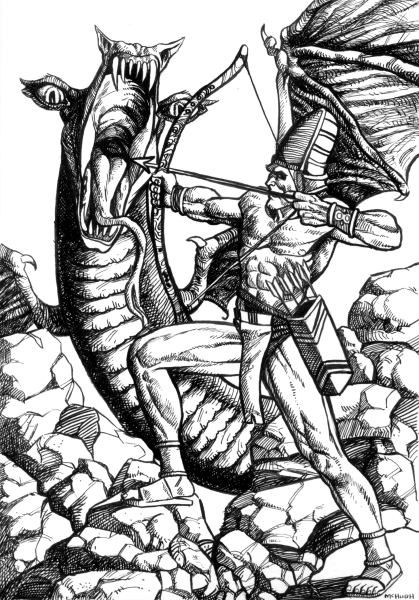
Aspu, the First Begetter, and Tiamat, the First Mother, made a generation of dragons from Chaos. Some time later, another generation rose, one of which was Ea, the god of wisdom. Ea soon killed Aspu, and Tiamat, wishing to avenge his death, with the help of one of her sons, Kingu, made another race - scorpion-tailed monsters. Tiamat, with eleven of these monsters, went to do battle with Ea's son, Marduk. However, Marduk was armed with seven winds, a storm chariot, and a strong coat of mail. He wore upon his lips a red paste and, on his wrist, a herb protecting him from poison, and his head was crowned with flames.
When the two met, Marduk captured Tiamat in a net, sending the wind into her belly which tore her open. Then Marduk shot her full of arrows and beat her about the head until she was dead. Following this, he bound Tiamat's body and stood on it, before shackling the eleven monsters which he imprisoned beneath the ground. These monsters became the gods of the underworld.
The battle between Tiamat and Marduk (
Original)
Marduk then split Tiamat's corpse in two, using one half to hold back the waters from above, and using the other half as a foundation for the earth and the sea. He made the sun, moon, constellations and planets, going on to kill Kingu, whose blood he used to create the human race.
The Sumerian-Babylonian hero Gilgamesh was one of the first of the humans to encounter the underworld gods. He sought a magical herb which would make him immortal, only to find his way blocked by two fearsome monsters, one male, one female. These monsters, which were part human, part dragon and bore scorpion-like tails, recognized that Gilgamesh was part divine and allowed him to pass. Gilgamesh soon found himself in a heavenly garden, where he met a woman who was making wine. However, he didn't find the herb of immortality.
So, Gilgamesh spoke with Utnapishtim, the Sumerian Noah, who himself had already attained immortality. At last, he learned that the herb could be found beneath the sea and went to retrieve it. Now that he had the herb in his possession, Gilgamesh believed that he no longer needed to fear death. Unfortunately, a serpent stole the herb and Gilgamesh was forced to accept the inevitability of death.
E
numa Elish is one of the earliest creation myths, dating from
around 2000 BC and being Babylonia-Assyrian in origin. Many of the
themes found in this myth
- scorpion-tailed dragon monsters, the underworld, a heavenly garden, magical plants, and women bringing mischief into the world - are seen consistently through 4000 years of occult belief. For example, Aztec mythology echoes Sumerian themes when describing a heavenly garden which is guarded by a serpent, and the Norse beliefs tell of a great snake which coils around the world tree,
Ygdrasil. The role of the serpent in Eden is another well known similarity to these ancient beliefs, as well as the weakness of Eve, who brought suffering to the world.
Less well known is the Jewish teaching where Eve is created from Adam's barbed tail, rather than Adam's rib, showing us how the demonic element of Adam is converted into the female form. This is probably the first evidence of misogyny, which presents itself in late medieval portrayals of the serpent in Eden, which was given the face of a woman.

While Eve brought suffering, she was considered an improvement on the Jewish Lilith, Adam's first wife. Lilith was the original loose woman. First she objected to her supine role in intercourse, asking Adam, ''Why must I lie beneath you?'' Adam tried to force her, so she left him to live beside the Red Sea with the more compatible wanton demons. Before leaving Adam, Lilith bore Asmodeus and other demons, with some saying that she went on to be the queen of Zmargad and Sheba. Apparently King Solomon believed that the Queen of Sheba was a night-demon as she had hairy legs. Lilith can also be found as the Babylonian-Assyrian wind-demoness Lilitu, and in Sumerian writings as Lillake. She was believed to strangle children and was also a succubus which preyed on sleeping men.
Famous relief from the Old Babylonian period, believed to be Lilitu or Lilith (
Original)
In Isaiah 24:11-15 Lilith, who is referred to as ''screech-owl'' in the King James Bible, was believed to suck the blood of children, and was related to s
triga, a word meaning witch. She was simply a ''night-demon'' in the Hebrew Bible, and lived in the ruined desert of Edom. Lilith was believed to keep company with pelicans, hedgehogs, owls, ravens, jackals, ostriches, kites, wildcats, hyenas, vipers, and satyrs, many of which were attributed to ''Devil worshippers'' in later times. Lilith can also be found in the book of Job 18:13-15, where she is seen as domestic, but she also kept company with what sounds like the Devil.
He [the wicked man]
is torn from the shelter of his tent, and dragged before the King of Terrors.
Then Lilith makes her home under his roof, while people scatter brimstone on his holding.
Satan identifying with the serpent of Eden and with Lucifer was not established until the end of the first century AD, with the Book of Revelations telling us:
The great dragon, the primeval serpent, known as the devil or Satan, who had deceived all the world, was hurled down to the earth and his angels were hurled down with him.
From this point on, the scaly-tailed, claw footed, bat or dragon-winged representation of Satan becomes an important point of Christianity and develops as a fundamental
preoccupation of those hunting witches.
Yahweh made sorcery and divination something which should by punishable by death, with Exodus 22:18 telling us, ''You shall not allow a sorceress to live.'' The Greek Septuagint translates ''sorceress'' to ''pharmakos,'' meaning ''poisoner.'' Leviticus 20:27 tells us, ''Any man or woman who is a necromancer or magician must be put to death by stoning; their blood shall be on their own heads.'' And Deuteronomy 18:10-11 tells us, ''There must never be anyone among you... who practices divination, who is a soothsayer, augur or sorcerer, who uses charms, consults ghosts or spirits, or calls up the dead.''
However, the Egyptian Exodus could not have been achieved if not for numerous acts of authorised magic. The most famous of these acts involved a contest with Egyptian magicians, and can be found in Exodus 7:9-13:
Yahweh said to Moses and Aaron, ''If Pharaoh says to you, 'Produce some marvel,' you must say to Aaron, 'Take your staff and throw it down in front of Pharaoh, and let it turn into a serpent.'
To Pharaoh then Moses and Aaron duly went, and they did as Yahweh commanded. Aaron threw down his staff in front of Pharaoh, and it turned into a serpent.
Then Pharaoh in his turn called for the sages and the sorcerers, and with their witchcraft the magicians of Egypt did the same.
Each threw his staff down and these turned into serpents. But Aaron's staff swallowed up the staffs of the magicians.
Yet Pharaoh's heart was stubborn and, as Yahweh had foretold, he would not listen to Moses and Aaron.
Moses and Aaron follow further instructions given by Yahweh, using the staffs to impose plague upon Egypt. Pharaoh's magicians match this, turning the rivers into blood and creating a plague of frogs. But they find themselves outdone when Moses and Aaron bring plagues of mosquitoes and gadflies, the death of livestock, an affliction of boils, locusts, darkness and the death of Egypt first-born children. Moses later uses his staff to make water flow from a desert rock and during the Israelites battle with the Amalekites they would prevail as long as Moses held his staff aloft.
In critical situations it was extremely important that freelance diviners and magicians not be allowed to obstruct legitimate policies. When King Saul were pushed by the Philistines, he enforced the ban on necromancy and expelled the sorcerers. He then asked Yahweh for advice but, when Yahweh didn't answer, he was forced to find himself a witch, who raised the ghost of Samuel. Samuell then correctly predicted Saul's approaching death.
Apart from necromancy and wand-power, other magical practices were well known in the ancient middle east, including the interpretation of dreams, the casting of lots (
urim and
thummin), and forms of sympathetic magic involving magical models, the ''poppets'' that are traditionally part of the witch's armoury.
One of the most influential and successful magicians found in the ancient world was the pharaoh Nekhtanebt II, who was said to have protected his kingdom with witchcraft from 359 to 342 BC. He did this in the following way. News of an attack comes : an invading fleet is standing off the Nile delta. The King is unconcerned, soon going to his secret room where he practices magic. He pours water into a huge bowl. On its surface floats small wax ships of his own and the enemy fleet. He says the magical words to summon demons of the wind and other elements. The waxen fleets begin to move, meeting one another on the surface of the wave roughened water. Soon the enemy's wax fleet begin to founder and, as they do, their counterparts also founder and sink in the Mediterranean, and Egypt is once again saved.
However, a day comes when a Persian army gather against Egypt. The pharaoh again goes to his secret room and tries the magical words, but finds that his power is insufficient. He foresees his army's defeat, sees Egypt taken by Artaxerxes Ochus, the butcher. Nekhtanebt has no further choices, so he puts on a disguise, packs up his gold and books of magic and runs away. In time he crosses the Mediterranean, settling in Macedonia. Here his reputation as a seer and a doctor spreads. He has brought the Egyptian art of magic and divination to Greece.
God Horus Protecting King Nekhtanebt II (
Original)
This story includes three elements which are seen throughout the subject's history- political crisis, the use of supernatural powers, and an exploitation of a mystical connection between things which are similar yet different - in this case , the wax models and the real ships they represent.
The basic political element of ancient witchcraft was divination, with state oracles being well established throughout the classical world. Among the Mesopotamians, haruspication, or the study of the internal organs of sacrificed animals, seems to have been the most common method of prophecy. However, abnormal births of both a human and animal nature, were also closely examined by entrail specialists known as
baruas. Dreams were also studied for their predictive power. And so the earliest method of divination required either ritual sacrifice or the invocation of supernatural beings.
In China, amongst other places, similar techniques were used to predict future events. They would do this by reading the lines on tortoise shells, the flight of birds, the cracks appearing in burned bones or the way in which a handful of sticks and stones fell. We can see this technique used today when we have our tea-leaves or playing cards read. In all methods of divination, either a connection with the cosmological or with some superior being is assumed.
All major oracles of Ancient Greece had enduring political or social weight behind them. The Oracle of Apollo at Delphi is probably the most famous today, but there were others which were equally notable. What is now Libya was once known as the temple of Ammon, in the territory known as Nubia. This was one of the most famed. The oak grove at Dodona was sacred to Zeus and was just as acclaimed. Every oracle had their own priests and, while these were open to the public for a fee, they were also subsidised to some degree by the state. Their methods of divination varied. At Dodona, the most popular form was kleromancy, in which a question would be asked and a stripe of lead would be chosen, on which a yes or no answer would be written. An Ammon, the movements of the god's statues would be interpreted by a priest for an answer.
At Delphi, where the god of light, Apollo, is said to have defeated a great serpent, oracular statements were given by the Pythia, a priestess. In some accounts, the Pythia sat on a tripod above a crack in the ground, where she would inhale the volcanic fumes and the smoke from a burning mixture of barley, marijuana and chopped bay leaves. She would speak in verse and her words would be interpreted by a priest. During the fourth and fifth centuries BC, private citizens would pay a fee equal to two days' wages for the average Athenian for a consultation. The state could pay anywhere up to ten times as much. An emergency consultation could be arranged for a premium amount.

Non-institutional advice on hidden things was available, although the psychic risk was believed to be higher, with the witch or necromancer's procedures being dangerous. When the hero Odysseus needed prophetic advice, he was forced to go to the enchantress Circe who had turned several of his soldiers into pigs because the great seer Teriesias had died. Circe tells him that, if he wished to find Teiresias he first had to visit Persephone's groves of willow and black poplar which skirted the House of Hades. Odysseus followed Circe's advice, digging a pit one cubit square, before pouring a concoction of honey, milk, wine and water into it. Next he sprinkled white barley meal on top before filling the pit with the blood of a ram and ewe which had been sacrificed to Hades and Persephone.
The oracles of Apollo and Zeus were relatively typical of established Greek religion. However, another impulse, this one being personal, chaotic and elated, was expressed in the worship of Dionysus, the horned god of wine and fertility. Dionysus was as important to Greek religion as Hecate, the patron of necromancers. During this religious worship, rather than the careful removal of animal entrails, devotees tore living creatures, including humans, to pieces with their teeth and hands.

Dionysus was god of the earth, specifically of the vine. His name means ''sprout (or shoot) of god, with his main festivals taking place at the end of a harvest. Dionysus was half human, half divine, having a mortal mother, Semele, and a divine father, Zeus. In all of the myths about Dionysus, we again find recurrent themes - this time of a god with strong connections to humans, who experiences violent outbursts and who goes through great suffering (he is dismembered and resurrected, like the crops whose fertility he oversees). He is usually horned and is followed by horned familiars, with his main follows being wild women, worshipping the fields, woods and ravines instead of the temple.
In the Eleusinian mysteries, which were dedicated to Dionysus and Demeter, a mystifying religion was established which gave its followers faith and confidence in the afterlife. As late as 80 BC, Plutarch the historian wrote soothing words to his wife when their daughter passed away:
About that which you have heard, dear heart, that the soul once departed from the body vanishes and feels nothing, I know that you give no belief to such assertions because of those sacred and faithful promises given in the mysteries of Bacchus (the Roman name for Dionysus)
which we who are of that religious brotherhood know. We hold it firmly for an undoubted truth that our soul is incorruptible and immortal. We are to think that they pass into a better place and a happier condition. Let us behave ourselves accordingly, outwardly ordering our lives, while within all shall be purer, wiser, incorruptible.
Dionysus, unlike many other ancient gods, was powerful and popular enough to survive until modern times, although only in rural and unfamiliar fragments, as a type of horned, anarchic god, much like Satan.
As you can see, many of the factors found in ancient myths have found their way into modern religion, although perhaps not in the form they were once known as. The themes that we have seen here have been twisted and changed throughout history to fit in with newer religions, such as Christianity.
Next time: I will tell you about the Burning Times.