Showing posts with label Greece. Show all posts

Wednesday, 25 March 2015

Mythical Creatures: Giants of Greece and Rome - Part Three

Today is the final post on the Giants of Greece and Rome, which will cover the Cyclopes, the giant one-eyed beings born of Gain and Ouranos, the Gigantes, born of Gaia and the blood of Uranus, and Typhon, the offspring of Gain and Tartaros.

FENIX - Brontes by ZEBES
Cyclopes

The Cyclopes, sometimes spelled Kyklopes which means ‘Round Eyes’, were the children of Gaia and Ouranos, or Uranus, with their siblings being the Hundred-Handed Giants.  The names of this first generation of Cyclopes were Brontes, meaning ‘Thunder,’ Steropes, meaning ‘Lightning’, and Arges, meaning ‘Thunderbolt’.  Hesiod’s Theogony tells us:

She further bore the Kyklopes with exceeding forceful hearts,
Brontes and Steropes and Arges mighty of spirit,
Who gave to Zeus the thunder sound and fashioned the thunderbolt.
They were like the gods in all respects except
The single eye that lay in the middle of their foreheads.
They are named Kyklopes from this feature,
Because one circular eye lay in the forehead of each.
Strong is their brute force, and designs are upon their deeds.

Cyclopes at the forge of Hephaestus
The Cyclopes, like the Hundred-Handed Giants, were imprisoned by the Titans inside Tartaros and were freed by Zeus before the battle between the gods and the Titans.  They repaid this kindness by giving Zeus the thunderbolt and its sound.  After the battle, they were given forges beneath Mount Etna, where they forged weapons for the gods.  They are mentioned again in Apollodorus’ Library, where they are killed by Apollo to avenge the death of his son, Aesculapius, at the hands of Zeus.

…Leucippus begat Arsinoe: with her Apollo had intercourse, and she bore Aesculapius…  And having become a surgeon, and carried the art to a great pitch, he not only prevented some from dying, but even raised up the dead; for he had received from Athena the blood that flowed from the veins of the Gorgon, and while he used the blood that flowed from the veins on the left side for the bane of mankind, he used the blood that flowed from the right side for salvation, and by that means he raised the dead.
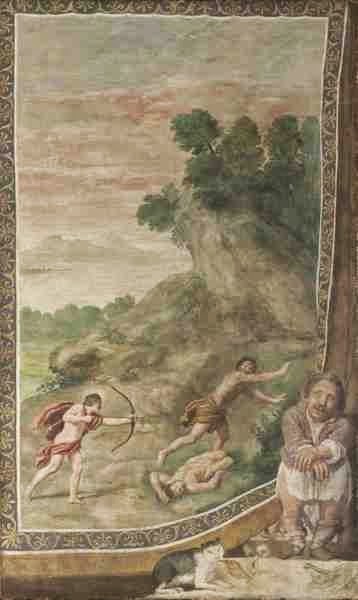
Apollo killing the Cyclops by Domenichino and assistants
But Zeus, fearing that men might acquire the healing art from him and so come to the rescue of each other, smote him with a thunderbolt.  Angry on that account, Apollo slew the Cyclopes who had fashioned the thunderbolt for Zeus.  But Zeus would have hurled him to Tartaros; however, at the intercession of Latona he ordered him to serve as a thrall to a man for a year.  So he went to Admetus, son of Pheres, at Pherae, and served him as a herdsman, and caused all the cows to drop twins.


The Odyssey, an epic tale written by Homer, tells of the hero Odysseus as he journeys home after the Trojan War – a journey which takes him ten years to complete.  Within this myth we find Polyphemus – possibly the most well-known Cyclops of Greek mythology.  Polyphemus, the son of Poseidon and the nymph Thousa, is of the second generation of Cyclops.

Odysseus and Polyphemus

The war at Troy was over.  The Achaeans had burnt the great city of Priam; and Odysseus and all the other princes set out in their ships to go home.  But the winds and storms carried them away to many lands.  Only a few reached the countries which they had left to go to Troy; and these were tossed about for a long time on the sea, and went through great toil and many dangers.
Odysseus and Poseidon by faolainIllustration
At first the ships of Odysseus went on merrily with a fresh breeze: and the men thought that they would soon come to rocky Ithaca, where their homes were.  But Athena was angry with Odysseus, and she asked Poseidon, the lord of the sea, to send a great storm and scatter his ships.  So the wind arose, and the waters of the sea began to heave and swell, and the sky was black with clouds and rain.  Many days and many nights the storm raged fiercely; and when it was over, Odysseus could only see four or five of all the ships which had sailed with him for Troy.  The ships were drenched with the waves which had broken over them, and the men were wet and cold and tired; and they were glad indeed when they saw an island far away.  So they sat down on the benches, and took the great oars and rowed the ships towards the shore: and as they came near, they saw that the island was very beautiful, with cliffs and rocks, and bays for ships to take shelter from the sea.  Then they rowed into one of these quiet bays, where the water was always calm, and where they was no need to let down an anchor, or to tie the ship by ropes to the ship by ropes to the sea shore, for the ship lay there quite still of itself.  At the head of the bay a stream of fresh water trickled down from the cliffs, and ran close to the opening of a large cave, and near the cave some willow trees drooped their branches over the stream, which ran down towards the sea.

Polyphemus, detail from fresco
So they made haste to go on shore; and when they had landed, they saw fine large plains on which the corn might grow, but no one had taken the trouble to sow the seed; and sloping hills for grapes to ripen on the vines, but none were planted on them.  And Odysseus thought that the people who lived there must be very strange, because they had no corn and no vines, and he could see no houses, but only sheep and goats feeding on the hill-sides.  So he took his bow and arrows, and shot many of the goats, and he and his men lay down on the ground and had a merry meal, and drank the rich red wine which they had brought with them from the ship.  And when they had finished eating and drinking they fell asleep, and did not wake up till the morning showed its bright rosy light in the eastern sky.

Then Odysseus said that he would take some of his men and go to see who lived on the island, while the others remained in the ship close to the sea-shore.  So they set out, and at last they came to the mouth of a great big cave, where many sheep and goats were penned up in large folds; but they could see no one in the cave or anywhere near it; and they waited a long while, but no one came.  So they lit a fire, and made themselves merry, as they ate the cheese and drank the milk which was stored up round the sides of the cave.
Presently they heard a great noise of heavy feet stamping on the ground, and they were so frightened that they ran inside the cave and crouched down at the end of it.  Nearer and nearer came the Cyclops, and his tread almost made the earth shake.  At last he came, with many dry logs of wood on his back; and in came all the sheep, which he milked every evening; but the rams and the goats stated outside.  But if Odysseus and his men were afraid when they saw Polyphemus the Cyclops come in, they were much more afraid when he took up a great stone, which was almost as big as the mouth of the cave, and set it up against it for a door.  Then the men whispered to Odysseus, and said, ‘Did we not beg and pray you not to come into the cave?  But would you listen to us; and now how are we to get out again?  Why, two-and-twenty waggons would not be able to take away that huge stone from t
The One-Eyed Polyphemus - artist unknown
he mouth of the cave.’  But they were shut in now, and there was no use in thinking of their folly for coming in. So there they lay, crouching in the corner of the cave, and trembling with fear lest Polyphemus should see them.  But the Cyclops went on milking all the sheep, and then he put the milk into the bowls round the sides of the cave, and lit the fire to cook his meal.  As the flame shot up from the burning wood to the roof of the cave, it showed him the forms of Odysseus and his companions, where they lay huddled together in the corner; and he cried out to them with a loud voice, ‘Who are you that dare to come into the cave of Polyphemus?  Are you come to rob me of my sheep, or my cheese and milk that I keep here?’
Then Odysseus said, ‘Oh! No, we are not come to do you any harm: we are Achaeans who have been fighting at Troy to bring back Helen, whom Paris stole away from Sparta, and we went there with the great King Agamemnon, who everybody knows.  We are on our way home to Ithaca, but Poseidon sent a great storm, because Athena was angry with me; and almost all our ships have been sunk in the sea, or broken to pieces on the rocks.’ When he had finished speaking, Polyphemus frowned savagely and said, ‘I know nothing of Agamemnon, or Paris, or Helen;’ and he seized two of the men, and broke their heads against the stones, and cooked them for his dinner.  That day Polyphemus ate a huge meal, and drank several bowls full of milk; and after that he fell fast asleep.  Then, as he lay there snoring in his heavy sleep, Odysseus thought how easy it would be to plunge his sword into his breast and kill him; and he was just going to do it when he thought of the great stone which 

Odysseus in the Cave of Polyphemus by Jacob Jordaens
Polyphemus had placed at the mouth of the cave; and he knew that if Polyphemus were killed no one else could move away the stone, so they would all die shut up in that dismal place. So the hours of the night went slowly son, but neither Odysseus nor his friends could seep, for they thought of the men whom Polyphemus had eater, and how they would very likely be eaten up themselves.  At last they could tell, from the dim light which came in between the top of the stone and the roof of the cave, that the morning was come: and soon Polyphemus awoke and milked all the sheep again; and when he had done this, he went to the end of the cave and took up two more men and killed and ate them.  Then he took down the great stone from the mouth of the cave, and drove all the cattle out to graze on the soft grass of the hills; and Odysseus began to hope that they might be able to get away before Polyphemus came back.  But the Cyclops was not so silly as to let them go, for, as soon as the cattle were gone out, he took up the big stone again as easily as if it had been a little pebble, and put it up against the mouth of the cave; and there were Odysseus and his friends shut up again as fast as ever.
Then Odysseus began to think more and more how they were to get away, for if they stayed there they would soon be all killed, if Polyphemus went on eating four of them every day.  At last, near the sheep-fold, he saw a club of Polyphemus, which Polyphemus was going to use as a walking stick.  It was the whole trunk of an olive tree, fresh and green, for he had only just cut it and left it to dry, that he might carry if about when it was fit for use.  There it lay like the mast of a ship, which twenty men could hardly have lifted; and Odysseus cut off a bit from the end, as much as a man could carry, and
Odysseus and Polyphemus by 2HeadedMonster
told the men to bring it to a very sharp point; and when they had done this he hardened it in the fire, and then hid it away till Polyphemus should come home.  By and by, when the sun was sinking down, they heard the terrible tramp of his feet, and felt the earth shake beneath his tread.  Then the great stone was taken down from the mouth of the cave, and in he came, driving the sheep and goats and the great rams before him, for this time he let nothing stay outside.  So he milked the sheep and the goats, as he had done the day before; and then he killed two more men, and began to eat them for his supper.  Then Odysseus went toward him with a bottle full of wine, and said, ‘Drink this wine, Polyphemus; it will make your supper taste much nicer; I have brought it to you, because I want you to do me some kindness in return.’  So the Cyclops stretched out his hand to take the wine, and he drank it off greedily and asked for more.  ‘Give me more of this honey-sweet wine,’ he said; ‘surely no grapes on this earth could ever give such wine as this: tell me your name, for I should like to do you a kindness for giving me such wine as this.’  Then Odysseus said, ‘O Cyclops, I hope you will not forget to give me what you have promised: my name is Nobody.’  And Polyphemus said, ‘Very well, I shall eat up Nobody last of all, when I have eaten up all his companions; and this is the kindness which I mean to do for him.’  But by this time he was so stupid with all that he had been eating and drinking that he could say no more, but fell on his back fast asleep; and his heavy snoring sounded through the whole cave.  Then Odysseus cried to his friends, ‘Now is the time; come and help me, and we will punish this Cyclops for all that he has done.’  So he took the piece of the o
Polyphemus blinded by Odysseus and His Men - artist unknown
live tree, which had been made sharp, and put it into the fire, till it almost burst into a flame; and then he and two of his men went and stood over Polyphemus, and pushed the burning wood into his great eye as hard and as far down as they could.  It was a terrible sight to see; but the Cyclops was so stupid and heavy in sleep that as first he could scarcely stir; but presently he gave a great groan, so that Odysseus and his people started back in fright, and crouched down at the end of the cave: and then the Cyclops put out his hand and drew the burning wood from his eye, and threw it from him in a rage, and roared out for help to his friends, who lived on the hills round about.  His roar was as deep and loud, and they heard him shouting out so loud, and they said, ‘What can be the matter with Polyphemus?  We never heard him make such a noise before: let us go and see if he wants any help.’  So they went to the cave, and stood outside the great stone which shut it in, listening to his terrible bellowings; and when they did not stop, they shouted to him, and asked him what was the matter.  ‘Why have you waked us up in the middle of the night with all this noise, when we were sleeping comfortably?  Is any one taking away your sheep and goats, or killing you by craft and force?’  And Polyphemus said, ‘Yes, my friends, Nobody is killing me by craft and force.’  When the others heard this they were angry, and said, ‘Well, then, if nobody is killing you, why do you roar so?  If you are ill, you must bear it as best you can, and ask our father Poseidon to make you well again;’ and then they walked off to their beds, and left Polyphemus to make as much noise as he pleased.

It was of no use that he went on shouting: no one came to him any more; and Odysseus laughed because he had tricked him so cunningly by calling himself Nobody.  So Polyphemus got up at last, moaning and groaning with the dreadful pain, and groped his was with his hands against the sides of the cave until he came to the door.  Then he took down the great stone, and sat with his arms stretched out wide; and he said to himself, ‘Now I shall be sure to catch them, for no one can get out without passing me.’

Ulysses Escaping from Polyphemus the Cyclops by I.G. Walker
But Odysseus was too clever for him yet; for he went quietly and fastened the great rams of Polyphemus together by threes, and under the stomach of the middle one he tied one of his men, until he had fastened them all up safely.  Then he went and caught hold of the largest ram of all, and clung on with his hands to the thick wool underneath his stomach: and so they all waited in a great fright, lest after all the great giant might catch and kill them.  At last the pale light of morning came into the Eastern sky, and very soon the sheep and the goats began to go out of the cave.  Then Polyphemus passed his hands over the backs of all the sheep as they passed by, but he did not feet the willow bands, because their wool was long and thick, and he never thought that any one would be tied up underneath their stomachs.  Last of all came the great ram to which Odysseus was clinging: and when Polyphemus passed his hand over his back, he stroked him gently and said, ‘Well, old sheep, is there something the matter with you too, as there is with your master?  You were always the first to go out of the cave, and now today for the first time you are the last.  I am sure that horrible Nobody is at the bottom of all this.  Ah, old man, perhaps it is that you are sorry for your master, whose eye Nobody has put out.  I wish you could speak like a man, and tell me where he is.  If I could but catch him, I would take care that he never got away again, and then I should have some comfort for all the evil which Nobody has done to me.’  So he sent the ram on; and when he had gone a little way from the cave, Odysseus got up from under the ram, and went and untied all his friends: and very glad they were to be free once more; but they could not help crying, when they thought of the men whom Polyphemus had killed.  But Odysseus told them to make haste and drive as many of the sheep and goats as they could to the ships.  So they drove them down to the shore and hurried them into the ships, and began to row away: and soon they would have been out of the reach of the Cyclops, if Odysseus could only have held his tongue.  But he was so angry himself, that he thought he would like to make Polyphemus also still more angry; so he shouted to him, and said, ‘Oh, cruel Cyclops, did you think that you would not be punished for eating up my friends?  Is this the way in which you receive strangers who have been tossed about by many storms upon the sea?’

Odysseus And Polyphemus by Arnold Boecklin
Then Polyphemus was more furious than ever, and he broke off a great rock from the mountain, and hurled it at Odysseus.  On it came whizzing through the air, and fell just in front of the ship, and the water was dashed up all over it; and there was a great heaving of the sea, which almost carried them back to the land.  Then they began to row again with all their might; but still, when they had got about twice as far as they were before, Odysseus could not help shouting out a few more words to Polyphemus.  So he said, ‘If any one asks you how you lost your eye, remember, O Cyclops, to say that you were made blind by Odysseus, the plunderer of cities, the son of Laertes, who lives in Ithaca.’

The Cyclops Polyphemus tosses rocks at the fleeing Odysseus and his crew by Louis Frédéric Schützenberger
Terrible indeed was the fury of Polyphemus when he heard this, and he said: ‘Now I remember how the wise Telemus used to tell me that a man would come here named Odysseus, who would put my eye out.  But I thought he would have been some great strong man, almost as big as myself; and this a miserable little wretch, whom I could almost hold in my hand if I caught him.  But stay, Odysseus, and I will show you how I thank you for your kindness, and I will ask my father Poseidon to send you a pleasant storm to toss you about upon the dark sea.’

Then Polyphemus took up a bigger rock than ever and hurled it high into the air with all him might.  But this time it fell just behind the ship of Odysseus and all his people, and almost sunk the ship under the sea.  But it only sent them further out of the reach of the Cyclops; and though he hurled more rocks after them, they now fell far behind in the sea and did them no ham.  But even when they had rowed a long way, they could still see Polyphemus standing on the high cliff, and shaking his hands at them in rage and pain.  But no one came to help him for all his shouting, because he had told his friends that Nobody was doing him harm.


The Gigantes, Gegeneis, or Ge Geneis, from which the word ‘giant’ is derived and which is translated as ‘earth-born’, are said to be the offspring of Gaia, or Ge, and the blood of the wounded Uranus, or Ouranos, as in Hesiod’s Theogony.  In this case, later versions of the Theogony simply call them Giants, with them being born already wearing armor and armed with spears:

As many drops of blood spurted forth,
all of them Gaia received.  In the revolving years,
she bore the… great Giants,
gleaming in their armor, holding long spears in their hands,…

The names of these Gigantes are variously given as Agrius, meaning ‘Untameable’; Alcyoneus, meaning ‘Brayer’; Aloeus, meaning ‘Of the Threshing Floor’; Clytius, meaning ‘Renowned’; Enceladus, meaning ‘Buzzer’; Eurytus, meaning ‘Rapids’; Grathium, meaning ‘Grater’; Hippolytus, meaning ‘Stampede’; Mimas, meaning ‘Mocker’; Pallas, meaning ‘Handsome’; Polybutes, meaning ‘Cattle-lord’; Porphyrion, meaning ‘Purple One’; Thoas, meaning ‘Fast’; and Titys, meaning ‘Risker’.  The story of the Gigantes, however, does not appear in the Theogony and is instead covered by Apollodorus in his Library.  Here we are told of the battle between the Gigantes and the Olympian gods after the Titans defeat.  Apollodorus’ Gigantomachy tells us of how these Gigantes were defeated by the Olympian gods with the help of Heracles.


But Ge, angry about what happened to the Titans, produced the Giants by Ouranos, unsurpassed in bodily size, in power unconquerable.  They looked frightful in countenance, with thick hair hanging from their backs and chins, and they had serpent coils for legs.  According to some they were born in Phlegrai, but according to others in Pallene.  They hurled rocks and flaming trees into heaven.  Greatest of them all were Prophyrion and Alcyoneus.  Alcyoneus was immortal as long as he fought in the same land where he was born, and he even drove the cattle of Helios out of Erytheia.  It had been prophesied to the gods that none of the Giants could be killed by gods, but that is a mortal fought as their ally, the Giants would die.  When Ge learned of this, she sought a magic plant to prevent them from being killed even by a mortal, but Zeus forbade Eos, Selene, and Helios to shine. 
Giants Battle with the Gods by Joseph Anton Koch
Then he himself cut the plant before Ge could and had Athena call Heracles to help them as an ally.  Heracles first shot Alcyoneus, but when he fell onto the earth, he was reinvigorated.  At Athena’s direction, Heracles dragged him outside of Pallene.  That, then, is how he died; but Prophyrion moved against Heracles and Hera in the battle.  Zeus put desire for Hera into him.  She called for help when the Giant was tearing her clothes in his desire to rape her, and after Zeus hit him with a thunderbolt, Heracles shot and killed him with his bow.  As for the other Giants, Apollo shot Ephialtes’ left eye out; Heracles shot out the right.  Dionysos killed Eurytos with his thyrsus.  Hecate killed Clytios with torches.  Hephaistos killed Mimas by hitting him with molten metal.  Athena threw the island of Sicily onto Encelados as he fled, and she cut the skin off of Pallas and covered her own body with it during the battle.  Polybotes was pursued by Poseidon across the sea and came to Cos.  Poseidon broke off a pieces of the island (called Nisyron) and threw it on him.  Hermes, wearing Hades’ cap, killed Hippolytos in the fight, while Artemis killed Gration.  The Moirai, fighting with bronze clubs, killed Agrios and Thoas.  Zeus destroyed the rest by hurling his thunderbolts.  Heracles shot all of them as they died.

It is said that those Gigantes who survived after this made a final attack at Trapezus.  Here they were defeated and put into great chasms within the earth.  Their bodies were then covered by mountains and volcanoes to stop them from regenerating.  It is said that, when they stir, they cause earthquakes and tremors.  Some believe that ‘these myths were the creation of an explanation for quantities of dinosaur bones that have been found continuously in the region of Trapezus.’ 

Typhon by notdanmartin
While the Gigantes were defeated by the Olympian gods and Heracles, they were not the last.  Typhon, who is also known as Typhoeus, Typheus, Typhaon, and Typhois, was created by Gaia, or Ge and Tartaros according to Apollodorus, after the defeat of the Gigantes.  Apollodorus describes him as ‘a mix of man and beast…taller than all the mountains’ which ‘bested in size and strength everything that Ge had produced.’  This giant man-beast had ‘a hundred dragon heads’ sprouting from his arms and ‘gigantic viper coils’ from the thighs down.  He was ‘covered in wings’ and ‘belched a great blast of fire from his mouth.’  Typhon fought against Zeus and was eventually defeated and buried beneath Mount Etna (Aima) where he is still said to cause eruptions.
 

Typhon

When the gods had defeated the Giants, Ge became more angry, copulated with Tartaros, and bore Typhon in Cilicia.  He had a form that was a mix of man and beast.  He bested in size and strength everything that Ge had produced.  As far as the thighs he was man-shaped and of such immense size that he was taller than all the mountains, and his head often touched the stars.  One of his hands stretched out to the west and one to the east, and from them stood out a hundred dragon heads.  From the thighs down he had gigantic viper coils that, when stretched out, reached as far as the very top of his head and produced a great hissing.  His whole body was covered in wings, his coarse hair was whipped away from his head and chin by the wind, and fire flashed from his eyes.  [Such was Typhon, so great was Typhon when he threw flaming rocks as he moved against heaven itself with hissing noises and shouting, and he belched a great blast of fire from his mouth.]
Typhon rising by Demodus
When the gods saw him attacking heaven, they took refuge in Egypt and, being pursued, changed their forms into animals.  But Zeus threw thunderbolts when Typhon was far off and cut him down with an adamantite sickle when he came close.  He doggedly pursued him as he fled to Mount Casios, which looks over Syria.  There Zeus saw that Typhon was seriously wounded and engaged him hand-to-hand.  But Typhon wrapped his coils around Zeus and got him in a hold.  He stripped away the sickle and cut out the sinews of his hands and feet.  Lifting Zeus onto his shoulders, he carried him across the sea to Cilicia, and when he arrived, he put him into the Corycian cave.  Likewise, hiding the sinews in a bearskin, he stowed them there.  He set the dragoness Delphyne to guard him.  This girl was half-beast.  But Hermes and Aigipan stole the sinews and put them back in Zeus without being caught.  Zeus, having gotten his strength back, suddenly flew down from heaven in a chariot pulled by winged horses and threw thunderbolts at Typhon as he pursued him to the mountain called Nysa, where the Moirai deceived him as he fled, and, persuaded that he would be reinvigorated, he tasted the ephemeral fruits.  When the pursuit began again, he came to Thrace and, fighting around Mount Haimos, hurled whole mountains.  But these were forced back on him by the thunderbolt, and blood [‘haima’] gushed out onto the mountain, and they say that it is from this that the mountain is called Haimos.  As Typhon tried to flee across the Sicilian sea, Zeus threw Mount Aima in Sicily on him.  This mountain is enormous, and down to this day they say that the eruptions of fire from it come from the thunderbolts that were hurled.  But enough about that.


And that completes the Giants of Greece and Rome.  In the next post we will explore the Giants of Norse mythology. 

Useful Resources

Odyssey by Homer
Theogony by Hesiod
Tales from Greek Mythology by George William Cox
Anthology of Classical Myth: Primary Sources of Translation by Stephen M. Trzaskoma, R.Scott Smith, Stephen Brunet & Thomas G. Palaima
Giants, Monsters & Dragons: An Encyclopedia of Folklore, Legend, and Myth by CarolRose

Wednesday, 25 February 2015

Mythical Creatures: The Giants of Greece and Rome - Part Two


Today we are going to learn about the second generation of Titans and look at some of the myths in which they appear.  According to Hesiod’s Theogony:

Iapetos led the daughter of Okeanos, beautiful-ankled
Klymene and went with her up to the same bed.
She gave birth to Atlas and produced
The exceedingly glorious Menoitios and Prometheus,
Changeful, slippery-counseled, and erring minded Epimetheus
Who proved an evil for men who each what the soil yields.
 
Prometheus Creating Man from Clay by Constantin Hansen
Prometheus

Prometheus is probably the most well-known second generation Titan, first appearing in Hesiod’s Theogony and Works and Days, and is credited by Apollodorus for the creation of man from clay.  As the Theogony tells us, Prometheus, meaning ‘forethought’, was born of Iapetos and Klymene, also spelled Clymene, or Themis.  Unlike most of the Titans, he fought with the gods and was rewarded for his part in the war.  Hesiod tells us that Prometheus helped to establish sacrifice amongst mankind by tricking Zeus: 

For when gods and mortal men were making a settlement
at Mekone, at that time Prometheus divided with eager spirit
a great ox and set it before him, seeking to beguile the mind of Zeus.

For him, Prometheus covered flesh and innards rich in fat
with the ox’s stomach and set them down wrapped in the hide.
For them, he covered the ox’s white bones with shining fat
and, well arranging them for his cunning trick, set them down.
Then the father of men and gods addressed him:
‘Son of Iapetos, most conspicuous of all lords,
dear sir, how partially you divide the portions.’
Thus spoke Zeus who knows imperishable counsels, chiding him.
Again, Prometheus of crooked counsel addressed him,
smiling slightly, and he did not forget his cunning trick:
‘Very noble Zeus, greatest of the gods who are for always,
choose whichever of these the spirit in your breast bids you.’
He spoke, planning cunning.  Zeus who knows imperishable counsels
recognized and was not ignorant of the cunning, but he eyed evils
with his mind for mortal men, that he intended to fulfil.
With both hands, he took the white fat,
and grew angry around his breast, and bitter bile entered his mind
when he saw the ox’s white bones in a cunning trick.
From then on, for the immortals the tribes of men on earth
burn white bones on fragrant altars.

Prometheus by Jean Delville
Zeus is infuriated by Prometheus’ trickery, but does not punish him until Prometheus steals fire for humans.

From this time, always mindful of his wrath,
He would not give the strength of weariless fire
To the ash trees for mortal men who dwell on earth.
But good son of Iapetos deceived him,
Stealing the far-seen beam of weariless fire
In a hollow fennel stalk.  It stung anew Zeus
High thunderer in his spirit, and he raged in his heart
When he saw among men the far-seen beam of fire.

The theft of fire was a wrong that Zeus could not ignore and he sought to punish Prometheus, who was chained and repeatedly attacked by an eagle, which pecked out his liver.  Being immortal, Prometheus' liver regrew, allowing the eagle to remove it again and again.

  He bound
The changeful-planning Prometheus with unbreakable fetters,
Painful bonds, and drove them through the middle of a pillar.
And he sent a long-winged eagle upon him.  Further, it ate
His deathless liver, but there grew back all over during the night
As much as the bird of long wings had eater during the whole day.

The Liberation of Prometheus by Carl Bloch
Prometheus is later granted his freedom when he helps Heracles in his eleventh labour:

The stout son of Alkmene of the beautiful ankles,
Heracles, slew it, and warded off the evil sickness
For Iapetos’s son and released him from troubles,
Not against Olympian Zeus’s will, who was contriving on high
In order that the renown of Theban-born Heracles
Might be more than before over the much-nourishing earth.
So respecting him, he honoured his conspicuous son.
Although angry, he let off the wrath he had before against
Prometheus because he rivalled the very mighty Kronios in designs.

The following myth tells us of Prometheus’ theft of fire.

Prometheus and the Theft of Fire

There once lived a race of huge giants called Titans.  These giants were fierce, turbulent, and lawless – always fighting among themselves and against Jupiter, the king of the gods.
One of the Titans, whose name was Prometheus, was wiser than the rest.  He often thought about what would be likely to happen in the future.
The Battle Between the Gods and the Titans 1600 - Joachim Wtewael
One day, Prometheus said to his brother Titans: ‘What is the use of wasting so much strength?  In the end, wisdom and forethought will win.  If we are going to fight against the gods, let us choose a leader and stop quarrelling among ourselves.’

The Titans answered him by a shower of great rocks and uprooted trees.
Prometheus, after escaping unhurt, said to his youngest brother: ‘Come, Epimetheus, we can do nothing among these Titans.  If they keep on, they will tear the earth to pieces.  Let us go and help Jupiter overcome them.’
Epimetheus agreed to this, and the two brothers went over to Jupiter, who called the gods together and began a terrible battle.  The Titans tore up enormous boulders and cast them at the gods, while Jupiter hurled his thunderbolts and his lightnings in all directions.  Soon the sky was a sheet of flame, the sea boiled, the earth trembled, and the forests took fire and began to burn.
At last the gods – partly by the help of the wise counsel of Prometheus – conquered the Titans, took them to the ends of the earth, and imprisoned them in a deep underground cavern.  Neptune, the sea-god, made strong bronze gates with heavy bolts and bars, to keep the giants down, while Jupiter sent Briareus and his brothers, three giants with fifty heads and a hundred hands each, to stand guard over them.
All but one of the Titans who had fought against the gods were imprisoned in this cavern.  This one who was not shut in with the others was Atlas, whose enormous strength was greater than that of his brothers, while his disposition was less quarrelsome.  He was made to stand and hold up the sky on his head and hands.
As the Titans could now make no more trouble, there was comparative peace and quiet on the earth.  Nevertheless, Jupiter said that, although the men who remained on the earth were not so strong as the Titans, they were a foolish and wicked race.  He declared that he would destroy them - sweep them away, and have done with them, forever.
When their king said this, none of the gods dared to say a word defence of mankind.  But Prometheus, the Titan, who was earth-born himself, and loved these men of the earth, begged Jupiter so earnestly to spare them, that Jupiter consented to do so.
Gift of the Titans by alprz
At this time, men lived in dark, gloomy caves.  Their friend, Prometheus, taught them to build simple houses, which were much more comfortable than the caves had been.  This was a great step forward, but men needed more help yet from the Titan.  The beasts of the forest, and the great birds that built their nests on the rocks, were strong but men were weak.  The lion had sharp claws and teeth; the eagle had wings; the turtle had a hard shell; but man, although he stood upright with his face towards the stars, had no weapon with which he could defend himself.

Prometheus said that man should have Jupiter’s wonderful flower of fire, which shone so brightly in the sky.  So he took a hollow reed, went up to Olympus, stole the red flower of fire, and brought it down to earth in his reed.
After this, all the other creatures were afraid of man, for this red flower had made him stronger than they.  Man dug iron out of the earth, and by the help of his new fire made weapons that were sharper than the lion’s teeth; he tamed the wild cattle by the fear of it, yoked them together, and taught them how to draw the plough; he sharpened strong stakes, hardening them in its heat, and set them around his house as a defence from his enemies; he did many other things besides with the red flower that Prometheus had made to blossom at the end of the reed.

Prometheus by midoriharada
Jupiter, sitting on his throne, saw with alarm how strong man was becoming.  One day he discovered the theft of his shining red flower, and knew that Prometheus was the thief.  He was greatly displeased at this act.

‘Prometheus loves man too well,’ said he.  ‘He shall be punished.’  Then he called his two slaves, Strength and Force, and told them to take Prometheus and bind him fast to a great rock in the lonely Caucasian Mountains.  At the same time he ordered Vulcan, the lame smith-god, to rivet the Titan’s chains – in a cunning way that only Vulcan knew.
There Prometheus hung on the rock for hundreds of years.  The sun shone on him pitilessly, by day – only the kindly night gave him shade.  He heard the rushing wings of the sea-gulls, as they came to feed their young who cried from the rocks below.  The sea-nymphs floated up to his rock to give him their pity.  A vulture, cruel as the king of the gods, came daily and tore him with its claws and beak.
But this frightful punishment did not last forever.  Prometheus himself knew that some day he should be set free, and this knowledge made him strong to endure.
At last the time came when Jupiter’s throne was in danger, and Prometheus, pitying his enemy, told him a secret which helped him to make everything safe again.  After this, Jupiter sent Hercules to shoot the vulture and to break the Titan’s chains.  So Prometheus was set free.

 
Atlas, meaning ‘the Bearer’ or ‘Daring’ or ‘Sufferer’, was the son of Iapetus and Clymene and himself fathered the Pleiades, Hyades, and Hesperides by Aethra, a daughter of Oceanos.  During the war between the Titans and the gods, Atlas was the ruler of Atlantis, which was flooded and destroyed by the newly emerging gods.  In vengeance, Atlas fought against the gods and, when the Titans lost, Zeus punished Atlas by ordering him to bear the weight of the world on his shoulders.

Atlas holds wide Heaven beneath powerful necessity,
Standing on the boundaries of the Gaia before the clear-toned
Hesperides, on his head and weariless arms.  This portion
Counsellor Zeus distributed to him.

While Atlas was punished for his role in the war, he does gain brief freedom from his duties when he appears in the eleventh labour of Heracles, in which Heracles is given the task of obtaining the golden apples of the Herperides.

Heracles by Jumbod
Eleventh Labour: the apples of the Hesperides

The eleventh task imposed by Eurystheus was to bring him the golden apples of the Hesperides, which grew on a tree presented by Gaea to Hera, on the occasion of her marriage with Zeus.  This sacred tree was guarded by four maidens, daughters of Night, called the Herperides, who were assisted in their task by a terrible hundred-headed dragon.  This dragon never slept, and out of his hundred throats came a constant hissing sound, which effectually warned off all intruders.  But what rendered the undertaking still more difficult was the complete ignorance of the hero as to the locality of the garden, and he was forced, in consequence, to make many fruitless journeys and to undergo many trials before he could find it.
Apples of Hesperides by RavenclawRadiance
He first travelled through Thessaly and arrived at the river Echedorus, when he met the giant Cycnus, the son of Ares and Pyrene, who challenged him to single combat.  In this encounter Heracles completely vanquished his opponent, who was killed in the contest; but now mightier adversary appeared on the scene, for the war-god himself came to avenge his son.  A terrible struggle ensued, which had lasted some time, when Zeus interfered between the brothers, and put an end to the strife by hurling a thunderbolt between them.  Heracles proceeded on his journey, and reached the banks of the river Eridanus, where dwelt the Nymphs, daughters of Zeus and Themis.  On seeking advice from them as to his route, they directed him to the old sea-god Nereus, who alone knew the way to the Garden of the Hesperides.  Heracles found him asleep, and seizing the opportunity, held him so firmly in his powerful grasp that he could not possibly escape, so that notwithstanding his various metamorphoses he was at last compelled to give the information required.  The hero then crossed over to Libya, where he engaged in a wrestling-match with king Anteos, son of Poseidon and Gaea, which terminated fatally for his antagonist.


Hercules.2 by LauraTolton
From thence he proceeded to Egypt, where reigned Busiris, another son of Poseidon, who (acting on the advice given by an oracle during a time of great scarcity) sacrificed all strangers to Zeus.  When Heracles arrived he was seized and dragged to the altar, but the powerful demi-god burst asunder his bonds, and then slew Busiris and his son.
Resuming his journey he now wandered on through Arabia until he arrived at Mount Caucasus, where Prometheus groaned in unceasing agony.  It was at this time that Heracles… shot the eagle which had so long tortured the noble and devoted friend of mankind.  Full of gratitude for his deliverance, Prometheus instructed him how to find his way to that remote region in the far West where Atlas supported the heavens on his shoulders, near which lay the Garden of the Hesperides.  He also warned Heracles not to attempt to secure the precious fruit himself, but to assume for a time the duties of Atlas and to despatch him for the apples.
On arriving at his destination Heracles followed the advice of Prometheus.  Atlas, who willingly entered into the arrangement, contrived to put the dragon to sleep, and then, having cunningly outwitted the
The Golden Apples of the Hesperides by Jun-Pierre Shiozawa
Herperides, carried off three of the golden apples, which he brought to Heracles.  But when the latter was prepared to relinquish his burden, Atlas, having once tasted the delights of freedom, declined to resume his post, and announced his intention of being himself the bearer of the apples to Eurystheus, leaving Heracles to fill his place.  To this proposal the hero feigned assent, merely begging that Atlas would be kind enough to support the heavens for a few moments whilst he contrived a pad for his head.  Atlas good-naturedly threw down the apples and once more resumed his load, upon which Heracles bade him adieu, and departed.

When Heracles conveyed the golden appled to Eurystheus the latter presented them to the hero, whereupon Heracles placed the sacred fruit on the altar of Pallas-Athene, who restored them to the garden of the Hesperides.

Menoitius, during the War of the Titans - artist unknown
Menoitios

Like Atlas, Menoitios fought against the gods in the war against the Titans.  This titan is somewhat obscure.  Very little is known about him and the little that is known comes from Hesiod's Theogony.  The Theogony tells us that Zeus punishes him for his role in the war, by sending condemning him to the eternal darkness of Erebus.  Most scholars tend to assume that Menoitios' imprisonment was due to his part in the war between the gods and the Titans.  Unfortunately later authors haven't provided any further information.

  Wide-seeing Zeus sent insolent Menoitios down
Into Erebos, striking him with smoldering lightning,
Because of his rashness and excessive manliness.

Epimetheus

Epimetheus is credited with having endowed the creatures of the earth with certain attributes, such as speed and strength.  He also helped his brother Prometheus with forming the attributes of humans, as well as encouraging Prometheus to steal fire from the gods.  Epimetheus was married to Pandora and, according to Hesiod, was in part responsible for the damage wrought by Pandora's curiosity.
 
...changeful, slippery-counselled, and erring-minder Epimetheus
who proved an evil for men who eat what the soil yields.
He was first to receive under his roof Zeus's molded woman
virgin.

Epimetheus Receiving Pandora by Henry Howard
Epimetheus can be found in the following myth of Pandora and the box of troubles.

How Troubles Came into the World

A very long time ago, in the Golden Age, everyone was good and happy.  It was always spring; the earth was covered with flowers and only gentle winds blew to set the flowers dancing.
No one had any work to do.  People lived on mountain strawberries, which were always to be had for the gathering, and on wild grapes, blackberries, and sweet acorns, which grew plentifully in the oak forests.  Rivers flowed with milk and nectar.  Even the bees did not need to lay up honey, for it fell in tiny drops from the trees.  There was abundance everywhere.
In all the whole world, there was not a sword, nor any weapon by means of which men might fight with one another.  No one had ever heard of any such thing.  All the iron and the gold were buried deep underground.
Hermes bears Pandora to Epimetheus by Jean Alaux
Besides, people were never ill; they had no troubles of any kind; and never grew old.

The two brothers, Prometheus and Epimetheus, lived in those wonderful days.  After stealing the fire for man, Prometheus knowing that Jupiter would be angry, decided to go away for a time on a distant journey; but before he went, he warned Epimetheus not to receive any gifts from the gods.
One day, after Prometheus had been gone for some time, Mercury came to the cottage of Epimetheus, leading by the hand a beautiful young woman, whose name was Pandora.  She had a wreath of partly opened rosebuds on her head, a number of delicate gold chains twisted lightly around her neck, and wore a filmy veil which fell nearly to the hem of her tunic.  Mercury presented her to Epimetheus, saying the gods had sent this gift that he might not be lonesome.
Pandora had such a lovely face that Epimetheus could not help believing that the gods had sent her to him in good faith.  So he paid no heed to the warning of Prometheus, but took Pandora into his cottage, and found that the days passed much more quickly and pleasantly when she was with him.
Soon, the gods sent Epimetheus another gift.  This was a heavy box, which the satyrs brought to the cottage, with directions that it was not to be opened.  Epimetheus let it stand in a corner of his cottage; for by this time he had begun to think that the caution of Prometheus about receiving gifts from the gods was altogether unnecessary.
Pandora's Box by LMessecar
Often, Epimetheus was away all day, hunting or fishing or gathering grapes from the wild vines that grew along the river banks.  On such days, Pandora had nothing to do but to wonder what was in the mysterious box.  One day her curiosity was so great that she lifted the lid a very little and peeped in.  The result was similar to what would have happened had she lifted the cover of a beehive.  Out rushed a great swarm of little winged creatures, and before Pandora knew what had happened, she was stung.  She dropped the lid and ran out of the cottage, screaming.  Epimetheus, who was just coming in at the door, was well stung, too.

The little winged creatures that Pandora had let out of the box were Troubles, the first that had ever been seen in the world.  They soon flew about and spread themselves everywhere, pinching and stinging whenever they got the chance.
After this, people began to have headaches, rheumatism, and other illnesses; and instead of being always kind and pleasant to one another, as they had been before the Troubles were let out of the box, they became unfriendly and quarrelsome.  They began to grow old, too.
Nor was it always spring any longer.  The fresh young grasses that had clothed all the hillsides and the gay-coloured flowers that had given Epimetheus and Pandora so much pleasure, were scorched by hot summer suns, and bitten by the frosts of autumn.  Oh, it was a sad thing for the world, when all those wicked little Troubles were let loose!

Pandora's Hope by BloodMoonEquinox
All the Troubles escaped from the box, but when Pandora let the lid fall so hastily, she shut in one little winged creature, a kind of good fairy whose name was Hope.  This little Hope persuaded Pandora to let her out.  As soon as she was free, she flew about the world, undoing all the evil that the Troubles had done, that is, as fast as one good fairy could undo the evil work of such a swarm.  No matter what evil thing had happened to poor mortals, she always found some way to comfort them.  She fanned aching heads with her gossamer wings; she brought back the colour to pale cheeks; and, best of all, she whispered to those who were growing old that they should one day be young again.

So this is the way that Troubles came into the world, but we must not forget that Hope came with them.

That's all for today.  In the next post, we will look at the last of the giants of Greek mythology.

Useful Resources

Yetis, Sasquatch & Hairy Giants by David Hatcher Childress
Myths and Legends of Ancient Greece and Rome by E.M. Berens
Theogony by Hesoid
Ancient Greek Beliefs by Perry L. Westmoreland
Giants, Monsters, and Dragons: An Encyclopedia of Folklore, Legend, and Myth by Carol Rose