There are a wealth of tales about fabulous places
- cities built entirely of gold
, gardens which can only compare with paradise, castles of mythical kings, islands inhabited by advanced civilisations, and whole continents - which have disappeared from living memory. Yet these places live on in, immortalised in mythology and legend, some of which we'll explore here.
El Dorado - A City Paved With Gold
Eldorado by Edgar Allan Poe
Gaily bedight,
A gallant knight,
In sunshine and in shadow,
Had journeyed long,
Singing a son,
In search of Eldorado.
But he grew old -
This knight so bold -
And o'er his heart a shadow -
Fell as he found
No spot of ground
That looked like Eldorado.
And, as his strength
Failed him at length,
He met a pilgrim shadow -
'Shadow,' said he,
'Where can it be -
This land of Eldorado?'
'Over the Mountains
Of the Moon,
Down the Valley of the Shadow,
Ride, boldly ride,'
The shade replied, -
'If you seek for Eldorado!'
Man's lust for gold spans the centuries and the discovery of gold only increased the insatiable desire to have more of it. This lust for wealth gave rise to one of the most enduring legends in memory. That of the fabled lost city of Eldorado, where the very streets are paved in gold. Throughout the 16th and 17th century numerous explorers have gone in search of this gilded city, wasting money and lives in the process, yet none have found it. And for good reason.
The legend of Eldorado or El Dorado, meaning 'the gilded one' or 'the gilded man' in Spanish, can be traced back to the 1530s when the Spanish conquistador Gonzalo Jimenex de Quesade discovered the Muisca tribe. And here he met the Gilded Man. Quezada returned with this fabulous story and, in 1541, Francisco Orellana and Gongzalo Pizarro left Quito to find El Dorado. Only they didn't find a city paved with gold. Instead, they documented the following ceremony:
The ceremony took place on the appointment of a new ruler. Before taking office, he spent some time secluded in a cave, without women, forbidden to eat salt and chill pepper, or to go out during daylight. The first journey he had to make was to go to the great lagoon of Guatavita, to make offerings and sacrifices to the demon which they worshipped as their god and lord. During the ceremony which took place at the lagoon, they made a raft of rushes, embellishing and decorating it with the most attractive things they had. They put on it four lighted braziers in which they burned much moque, which is the incense of these natives, and also resin and many other perfumes. The lagoon was large and deep, so that a ship with high sides could sail on it, all loaded with an infinity of men and women dressed in fine plumes, golden plaques and crowns... As soon as those on the raft began to burn incense, they also lit braziers on the shore, so that the smoke hid the light of day.

At this time they stripped the heir to his skin, and anointed him with a sticky earth on which they placed gold dust so that he was completely covered with this metal. They placed him on the raft ... and at his feet they placed a great heap of gold and emeralds for him to offer to his god. In the raft with him went four principal subject chiefs, decked in plumes, crowns, bracelets, pendants and ear rings all of gold. They, too, were naked, and each one carried his offering.... when the raft reached the center of the lagoon, they raised a banner as a signal for silence. The gilded Indian then... [threw] out all the pile of gold into the middle of the lake, and the chiefs who had accompanied him did the same on their own accounts. ... After this they lowered the flag, which had remained up during the whole time of offering, and, as the raft moved towards the shore, the shouting began again, with pipes, flutes, and large teams of singers and dancers. With this ceremony the new ruler was received, and was recognized as lord and king.

With every telling the story grew and grew until the ceremony transformed and the Gilded One became the Gilded King of a city where everything was built of gold. A city so rich that that King could wear the the dust of gold, seeing all other ornaments or fine clothing as vulgar. And so the legend of the lost City of Eldorado was born.
He went about all covered with powdered gold as casually as if it were powdered salt. For it seemed to him that to wear any other finery was less beautiful, and that to put on ornaments or arms made of gold worked by hammering, stamping, or by other means was a vulgar and common thing.
However, the location of this mythical land shifted from place to place and, no matter where the explorers and gold hunters searched, it always seemed to be out of reach. Attempts to drain Lake Guatavita, which was believed to be the same as that used during the ceremony, occurred twice in the 16th century and twice again in the 1800s. However, all attempts were fruitless. And to this day the endless riches of El Dorado remain a legend.
If you would like to know more about the legend of El Dorado and the origins of that legend, take a look at some of the following sources:
Conquistadors: Searching for El Dorado, the terrifying Spanish conquest of the Aztec and Inca empires by John Pemberton
Sir Walter Ralegh and the Quest for El Dorado by Marc Aronson
Eldorado! The Archaeology of Gold Mining in the Far North edited by Catherine Holder Spude, Robin O. Mills, Karl Gurcke, and Roderick Sprague
Travel Amazing South America
Ancient History Encyclopedia
National Geographic - El Dorado Legend
NewMyths.com
The Castle of Camelot
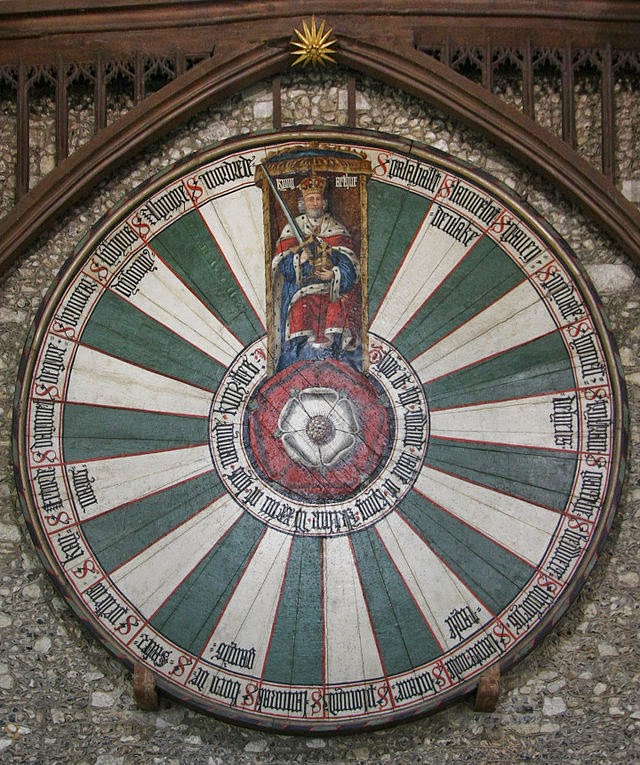
Camelot is the famous legendary castle of the medieval stories of King Arthur. It is said that it was where Arthur held his court, where he sat with his Knights of the Round Table, where the quest for the Holy Grail first began. Camelot has come to symbolise the very centre of the world of King Arthur.
Upon a certain Ascension Day King Arthur had come from Caerleon, and had held a very magnificent court at Camelot as was fitting on such a day.
Chrétien de Troyes
This is the first mention of the mythical city of Camelot and comes from Chrétien de Troyes
Lancelot or 'Knight of the Cart', written between 1170 and 1185. From this one sentence, an entire legend was created. The famous Camelot castle, where legend states King Arthur held his court, is regarded by most scholars as being entirely fictional. However, arguments for the 'real Camelot' have been ongoing since the 15th century. And one has to wonder how such a small mention of Camelot turned into a full blown legend.
The answer: Embellishment, embellishment and more embellishment!
The next time we hear of Camelot, it is within the literature of Thomas Malory, first published in 1485. Here he mentions 'a castle called Camelot' where 'the king would let make a council-general and a great jousts.' In the same literature it becomes 'the city of Camelot' and before long it has a location: 'the City of Camelot, that is in English Winchester.' And before you know it, Camelot becomes more than a city and turns into 'the land of Camelot,...' Despite the many mentions of this legendary place within Malory's
Le Morte D'Arthur, there's not a single detailed description of Camelot.
Within the minds of those that have searched for this legendary place, the image of Camelot is drawn from Geoffrey of Monmouths Historia Regum Britanniae, written in around 1136
Historia Regum Britanniae, where he writes:
...the City of Legions (Caerleon) as a proper place for his purpose. For besides its great wealth above the other cities, its situation.... was most pleasant... For on one side it was washed by that noble river, so that the kings and prince from the countries beyond the seas might have the convenience of sailing up to it. On the other side, the beauty of the meadows and groves, and magnificence of the royal palaces with lofty gilded roofs that adorned it, made it even rival the grandeur of Rome. It was also famous for two churches, whereof one was build in honour of the martyr Julius, and adorned with a choir of virgins... but the other.... was the third metropolitan church of Britain. Besides, there was a college of two hundred philosophers.... In this place, therefore, which afforded such delights, were preparations made for the ensuing festival.

Through embellishment and the combining of different stories Camelot has become a most enduring legendary place which, despite countless searches and many, many theories of the possible locations - Camboglanna, Cadbury Castle and Winchester to name a few -, has not and may never be found.
If you're interest in finding out about the possible locations of Camelot and the legends of King Arthur, it's worth looking at some of the following sources:
The Official Graham Phillips Website
Castles and Palaces of the World
Revealing King Arthur: Swords, Stones and Digging for Camelot by Christopher Gidlow
Finding King Arthur by Adam Ardrey
Arthur and the Lost Kingdoms by Alistar Moffat
The Hanging Gardens of Babylon
Babylon is the most famous city of ancient Mesopotamia, whose ruins lie in modern Iraq and owes its fame to the many references contained within the Bible. While we know without doubt that Babylon existed, the same cannot be said about it's hanging gardens.
The Hanging Gardens of Babylon have been described as one of the Seven Wonders of the Ancient World and is believed to have been built on the banks of the river Euphrates in around 600BC. However, it is the only Wonder which is yet to be located, if it existed at all. With contradictory documentation and no remaining evidence of these gardens to be seen, some would say that the Hanging Gardens of Babylon are nothing but myth and imagination.
The Hanging Gardens of Babylon were first described in the 3rd century BC by Berossus. Unfortunately the original account no longer exists. However, his description of the gardens was copied by later historians, including Flavius Josephus, in his books
Contra Apionem or Against Apion, and Antiquities of the Jews. The following quote it taken from the Contra Apionem:
In this palace he (Nebuchadnezzar II) erected very high walks, supported by stone pillars; and by planting what was called a pensile paradise, and replenishing it with all sorts of trees, he rendered the prospect an exact resemblance of a mountain country. This he did to gratify his queen, because she had been brought up in Media, and was fond of a mountainous situation.
The Hanging Gardens are mentioned again in the 23 volume Persica by Ctesis of Cnidus in around 400 BC. Again, this literature no longer exists, but was copied in detail by Diodorus Siculus in Book II of Bibbiotheca historica (Historical Library), a
quote of which follows:
Beside the citadel was the building known as the Hanging Garden. This wooded enclosure was square in shape with sides four hundred feet long, and sloped like a hillside with terrace built on terrace as they are in a theater. During the building of the terraces galleries were built underneath them which carried the entire weight of the gardens, each rising a little above the one before it on the ascent. The uppermost gallery, which was 75 feet high, supported the highest level of the garden, and this was the same height as the battlements of the city-wall. The walls of this structure, which cost a fortune to build, were 22 feet thick, and were separated by passages 10 feet wide. The galleries were roofed with stone beams 16 feet long and 4 feet wide. Above these beams there was first a layer of reeds set in great quantities of bitumen, then two courses of baked brick bounded with cement, and then a covering of lead so that moisture from the soil would not be able to sink through. On this was piled earth, deep enough to contain the roots of the largest trees, and when it was leveled over, the garden was planted with all sorts of trees which would appeal to those who saw them either by their great size or by the beauty of their appearance. Because of their arrangement the galleries were all open to the light, and contained royal apartments of all kinds. One gallery had shafts leading from the highest level and machinery for raising water in great quantities from the river and supplying it to the gardens. This machinery was entirely enclosed, and so could not be seen from the outside.

And then, in around 310-301 BC, Clitarchus, in his History of Alexander which only today survives in fragments, gave the following account of the Gardens, which was later reproduced by Quintus Curtius Rufus in 31-41 AD:
The Babylonians also have a citadel 3,7 kilometers in circumference. The foundations of its turrets are sunk ten meters into the ground and the fortifications rise 24 meters above it at the highest point. On its summit are the hanging gardens, a wonder celebrated by the fables of the Greeks. They are as high as the top of the walls and owe their charm to the shade of many trees. The columns supporting the whole edifice are built of rock, and on top of them is a flat surface of squared stones strong enough to bear the deep layer of earth placed upon it and the water used for irrigating it.

While it's impossible to say with absolute certainty that the Hanging Gardens of Babylon did once exist, the above accounts along with many others make it very difficult to say that they are pure imagination. However, there is not a single mention of the Hanging Gardens of Babylon in the Babylon cuneiform records, and this makes scholars question its very existence. While many will conclude that the Hanging Gardens once existed, physical evidence remains elusive, with many believed that they were destroyed by several earthquakes in around 226BC, making them the stuff of legend.
For detailed information on the Hanging Gardens of Babylon, check out the following sources:
Art History with Michelli
The Mystery of the Hanging Garden of Babylon: An Elusive World Wonder Traced by Stephanie Dalley
Legends of the Ancient World: The Life and Legacy of King Nebuchadnezzar II by Charles River Editors
Ancient History Encyclopedia
Iram - The Atlantis of the Sand
And the 'Ad, they were destroyed by a furious Wind,
exceedingly violent;
He made it rage against them seven nights and eight days
in succession: so that thou couldst see the (whole) people
lying prostrate in its (path),
as they had been roots of hollow palm-trees tumbled
down!
Then seest thou any of them left surviving?
(Surat al-Haaqqa: 6-8,
The Qur'an)
Iram of the Pillars, also known as Ubar amongst other names, is a mythical lost city said to reside somewhere in the Rub' al Khali desert, also known as the Empty-quarter. Associated with the people of Ad, this Atlantis of the Sands was believed to consist of castles made of gold, silver and precious gems with rivers flowing beneath them. First appearing in the Quran, Iram of the Pillars was later described in the book Arabian Nights.
Muhammad, preaching in Mecca in around 640-650 said of the destruction of the people of Ad and with them Iram of the Pillars:
Arrogant and unjust were the men of 'Ad. 'Who is mightier than we?' they used to say. Could they not see that Allah, who had created them, was mightier than they? Yet they denied our revelations. So over a few ill-omened days, We let loose on them a howling gale, that they might taste a dire punishment in this life; but more terribled will be the punishment of the life to come.'
In the Quran the following is written of the destruction of Iram of the Pillars and its people: 'When morning came there was nothing to be seen besides their ruined dwellings. Thus We reward the wrongdoers.
By medieval times, the tale of the rise and fall of Iram had been told and retold countless times and were soon written into the fabric of Arabian Nights with many addition details. The following is an extract from Sir Richard Burton's 1850 translation of
The Arabian Nights:
IT is related that Abdullah bin Abi Kilabah went forth in quest of a she-camel which had strayed from him, and as he was wandering in the deserts of Al-Yaman and the district of Saba, behold, he came a great city girt by a vast castle around which were palaces and pavilions that rose high into middle air. He made for the place thinking to find there folk of whom he might ask concerning his she-camel. But when he reached it, he found it desolate, without a living soul in it. So (quoth he) I alighted and, hobbling my dromedary, and composing my mind, entered into the city.
Now when I came to the castle, I found it had two vast gates (never in the world was seen their like for size and height) inlaid with all manner jewels and jacinths, white and red, yellow and green. Beholding this, I marveled with great marvel and thought the case mighty wondrous. Then, entering the citadel in a flutter of fear and dazed with surprise and affright, I found it long and wide, about equaling Al-Medinah in point of size. And therein were lofty palaces laid out in pavilions all built of gold and silver and inlaid with many colored jewels and jacinths and chrysolites and pearls. And the door leaves in the pavilions were like those of the castle for beauty, and their floors were strewn with great pearls and balls, no smaller than hazelnuts, of musk and ambergris and saffron.
Now when I came within the heart of the city and saw therein no created beings of the Sons of Adam, I was near swooning and dying for fear. Moreover, I looked down from the great roofs of the pavilion chambers and their balconies and saw rivers running under them, and in the main streets were fruit-laden trees and tall palms, and the manner of their building was one brick of gold and one of silver. So I said to myself, "Doubtless this is the Paradise promised for the world to come." Then I loaded me with the jewels of its gravel and the musk of its dust as much as I could carry, and returned to my own country, where I told the folk what I had seen.
The Arabian Nights Translated by Sir Richard Burton 1850
It is believed that Iram or Ubar was destroyed suddenly by some great cataclysmic event. However, accounts of this destruction vary. Some speak of an 'icy gale, turbulent with dust', with the 'Barren Wing that is ultimately unleashed [being] supremely violent'. This has 'the characteristics of a tornado, an all-but-unknown phenomenon in southern Arabia.'
Other accounts tells us that Iram/Ubar was destroyed by a 'Divine Shout', and others tells us that destruction came when 'suddenly the earth opened around it and Iram, bathed in a strange twilight, began to sink slowly down until the whole city was completely swallowed up. All that remained was an endless wilderness of empty, shifting sands across which the winds moaned and howled.'
Whatever the case, Iram or Ubar or even the Atlantis of the Sands remains a legend and the location, for now, remains a mystery.
If you want to know more about the lost city of Iram, check out the following sources:
Perished Nations by Hârun Yahya
The A to Z of Prophets in Islam and Judaism By Scott B. Noegel, Brannon M. Wheeler
The Road to Ubar: Finding the Atlantis of the Sands by Nicholas Clapp
That's it for today. Tomorrow we will look at more Lost Places of Legend. Until next time..
Other Useful Resources
Encyclopedia of Imaginary and Mythical Places by Theresa Bane
Seven Wonders of the Ancient World