Friday, 19 December 2014

The Origin of Santa Claus and the Customs of Christmas: Part One

Santa Claus with Little Girl by MeeranUhm
 Everyone loves Santa Claus - the jolly bearded man dressed in red and white who comes down the chimney to deliver presents on Christmas Eve.  He has many names,  Saint Nicholas, Father Christmas and Kris Kringle to name a few.  But where did Santa Claus come from and how did the tradition of Christmas begin?  Lets look back through time and trace the origins of Santa Claus and the customs of Christmas.

Popular opinion states that Santa Claus was inspired by Saint Nicholas - a kind hearted and generous bishop.  So this is where we will start our search for the origin of Santa. 

The Legend of Saint Nicholas

     'Long ago, in a far off land known today as Turkey, there was a boy named Nicholas.  Nicholas was a person who created numerous miracles and accomplished many good deeds.  As a teenager, Nicholas inherited a vast fortune, but he had no idea what to do with it.  Wanting to help those less fortunate than himself, Nicholas set out to make the wishes of others come true.  While Nicholas knew the townspeople needed his held, he was also aware that they were a very proud people, so Nicholas decided to help his friends secretly.
    Each night, Nicholas would disguise himself and deliver such items as food, clothing, and money to the people of his village.  Of all the townspeople, Nicholas felt the closest bond with one specific family.  In this family, there were three daughters.  Sadly, the family was very poor and the father felt much pain over the fact that he couldn't afford the weddings of each daughter.  In his desire to help the family, Nicholas left a bag of gold on the father's doorstep as the wedding of the eldest daughter approached.
Saint Nicholas of Myra by Vicki Shuck
    When it was time for the second daughter to marry, Nicholas again visited the family.  He threw another bag of gold into the family's chimney.  The family greatly appreciated the individual who was providing them with such a fortune, but they had no idea who this person could be.  As the third daughter's wedding neared, the father decided to stand guard so he could identify this generous stranger who had given his family such happiness.  Nicholas arrived and tossed a bag of gold through an open window and, upon hearing the bag of gold land on the floor, the father chased Nicholas until he caught him
    Nicholas didn't want the father to make his identity known and had the man promise to keep it a secret.  However, the father's gratitude was so great that he was unable to keep his promise and soon the whole town knew that Nicholas was responsible for the acts of generosity which had been happening throughout the entire town.
    Every year, in December, Nicholas took it upon himself to reward all the girls and boys who had been good during the year by giving them gifts.  And he is still remembered today for his kindness, generosity and love for the children.  In honour of this great saint, countries across the world give gifts to children on the day of Saint Nicholas, December 6th.

Who was Saint Nicholas?

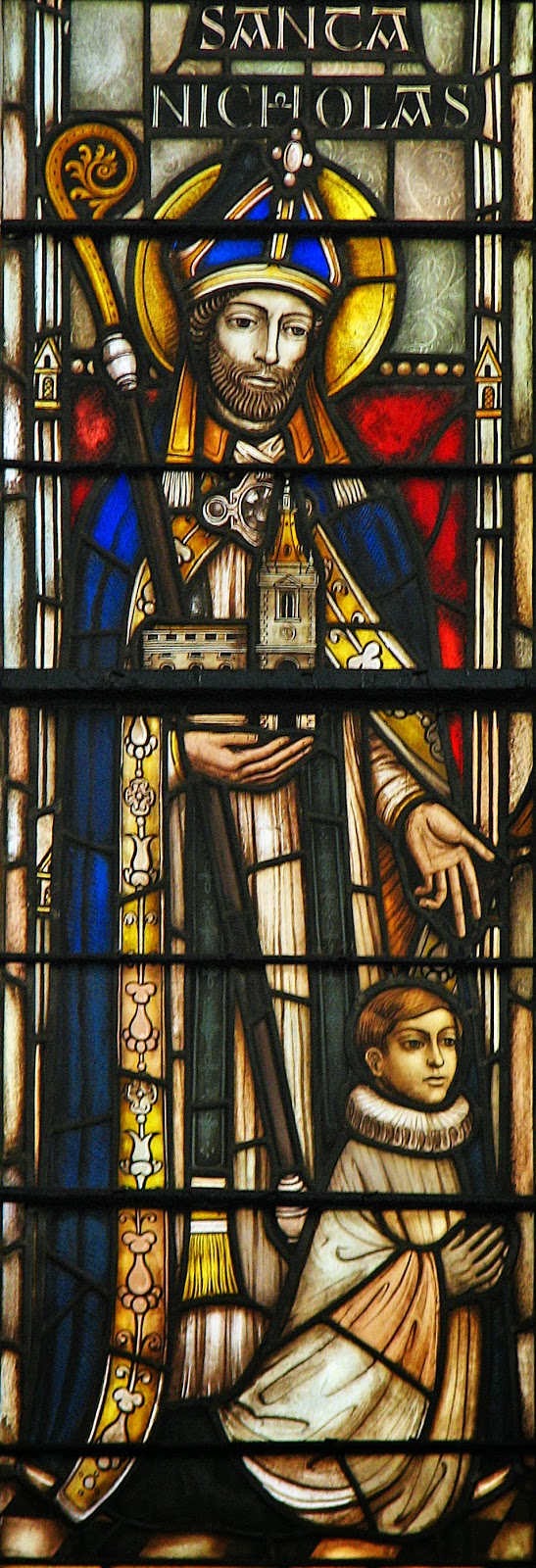
Stained Glass Window of St. Nicholas & a Chorister
While the legend of Saint Nicholas is prevalent throughout the world, there are very few surviving documents of Saint Nicholas.  Much of what we think we know is little more than legend, passed down through the generations and growing with every telling.  But what do we really know about Saint Nicholas?

The first known reference of Saint Nicholas dates back to between 510 and 515, with the writer Theodor, lector of Byzantinum, in the book 'Tripartite History.  This literature is entirely dependant on three 5th century historians: Socrates, Sozomen, and Theodor.  His name appears within Theodor's list of participants of the Council of Nicaea, where it says, 'Nicholas of Myra of Lycia.'

Several churches were built in his name - Emperor Theodosius II (401-550) had a church constructed in Myra which became known as the Church of St. Nicholas, while the Roman Emperor Justinian (527-565) restored a St. Nicholas church just outside of the summer palace of Blachernes.  The most significant documentation of Saint Nicholas appears in the biography of bishop Nicholas of Sion, where we are told, 'And going down to the metropolis of Myra, he went off to the martyrium of the glorious Saint Nicholas.'  This is considered to be 'confirmation that the man who would become Santa once existed.' 

While we know that he existed, Saint Nicholas remains elusive, even to the scholars who dedicate much of their life to studying him.  It is believed that Saint Nicholas served as a bishop in the 4th century in the town of Myra.  The first known 'biography' of this saint dates to the 8th or 9th century, long after his death, when a collection of tales about him was compiled by a Greek monk known as Michael the Archimadrite.

Those that have attempted to piece his life together have little to go on and rely on traditions and the few clues which remain from the times in which he lived.  Most of what we think we know is legend with no historical record. 

Other Legends of the Good Saint Nicholas

Santa Claus
Now that we at least know that Saint Nicholas was a real man, lets take a look at the other legends detailing the generosity of this saint.  The most well-known legend of Nicholas's generosity is the one I have detailed in the legend of Saint Nicholas above: that of the gifts of gold he left for a father who could not afford to give his daughters a dowry.  Some say that the daughter's father was preparing to sell his children into slavery and that Nicholas wished to save them from this fate.  In some accounts one of the bags of gold rolled into a stocking, while another was thrown down the chimney, and this is said to be the origin for Santa Claus coming down the chimney and filling a stocking or shoes with gifts.  The image of Santa Claus carrying a sack of presents is also said to originate with this legend.

Another legend explains how Nicholas became a bishop.  It is said that Nicholas believed that God would want him to live amongst the people, so he travelled to Myra, where the Archbishop had recently died.  Here the bishops were trying to choose a successor.  According to the legend the oldest bishop dreamed that he had been commanded to watch the doors of the cathedral the following morning and the first person to enter with the name Nicholas should be made bishop.  On the following morning Nicholas entered the cathedral and was immediately consecrated as Archbishop of Myra.

Throughout much of Europe Nicholas is known as the patron saint of schoolboys.  According to one legend, the devil came to the gates of a school in the middle of Saint Nicholas's feast day disguised as a beggar and a father, who honoured Saint Nicholas, sent his son to give this beggar money.  However, the boy was strangled by the demon.  Heartbroken, the father took his dead son into the house, crying, 'Saint Nicholas, is this my reward for the honours I have given you?'  Saint Nicholas heard the man and resurrected his son.

Nicholas of Myra
Another tale tells of how Nicholas brought three dismembered students back to life.  An Asian father sent his sons to a school in Athens, telling them to stop in Myra to receive blessings from Nicholas.  However, during a night's stay at an inn in Myra, the innkeeper and his wife killed the boys, cut up their bodies, and his the pieces inside barrels intended for salting meat.  They meant to sell them as pickled pork.  But Nicholas somehow sensed what had happened and accused the couple of murder.  The innkeeper and his wife were overwhelmed by this great saint and immediately felt remorse for what they had done.  Nicholas forgave the couple and the boys rose from the brine, whole and alive.

Other legends of Saint Nicholas are set during a trip by sea to Egypt and Palestine.  During a storm, Nicholas is said to have calmed to ocean.  When a sailor fell from a ship's mast and died, he was brought back to life by Nicholas.  Another tale tells of how an immoral sea captain tried to kidnap Nicholas but failed when a storm pushed the ship towards Myra, where Nicholas simply stepped off the ship and walked across the water back to land.

And the legends of his kindness don't end with his death.  The Crusaders from over seven hundred years after the death of Saint Nicholas credited him with freeing them from prison, restoring their health, and form blessing them with visions when they prayed to him.
St. Nicholas Saving Those in Danger at Sea

So Nicholas became the patron saint of children and, in addition, he is also said to have watched over seafarers, with 'several stories about him... [sounding] remarkably like activities previously attributed to Poseidon or Neptune.'  As seafarers were most often both travellers and merchants, Nicholas 'also became the patron saint of travellers in general, and merchants, and bankers, and even pawnbrokers.'

Throughout his life, Nicholas gained a reputation for his acts of kindness.  He is said to have saved the people of the city from famine and, when he died on December 6th 343, the people believed him to be a worker of miracles.  During the years following his death, Nicholas gained in popularity.  In around 1000 AD the legends of Saint Nicholas were taken to Russia, Lapps and Samoyeds.  He became the patron saint of Russia, amongst other countries and the custom of giving gifts on Nicholas' saint day, December 6th and the day of his death, came into being.

Judgement and Punishment

While Saint Nicholas is most often portrayed as generous and kind, some of the legends tell us that he was also a stern disciplinarian.  In 14th century French monastic schools, a monk dressed as Saint Nicholas would question and reprimand children, rewarding good children with sweets and cane the bad children with traditional birch twigs.  Over the next century this tradition of judgement, reward, and punishment spread to common households. 

Naughty children were often left a birch rod, with the people of Holland giving the following explanation: 'The monks of a certain church wanted the responses of Saint Nicholas sung in church.  The abbot refused, saying, 'I consider this music worldly and profane, and shall never give permission for it to be used in my church.'  The good saint, long dead and living in heaven, heard these words.  Nicholas... was so angered by the abbot's words that he descended from heaven in a rage, dragged the abbot out of bed by the hair, and beat him with a birch rod until he was nearly dead.  The point was well taken: from that day, the responses were included in the service.'

Sinterklaas and Black Pete
The Dutch people called Saint Nicholas Sinterklaas, who would arrive on December 5th, the eve of Saint Nicholas's Day.  The children probably viewed this time with both trepidation and fear.  Their Christmas-season ritual would begin with the preparation for a visit from Saint Nicholas.  The children would be drilled on their church lessons with a hope that they would be able to answer any questions the saint had for them.  The reward would be sweets or gifts, while the punishment for wrong answers was sticks and pieces of coal.  The children in Holland would sing a song to give thanks for his goodness and to welcome him, then sweets were thrown through the doorway to signal his arrival.  Saint Nicholas would enter, followed by his servant, Black Peter, who the Dutch called Zwarte Piet.

The Saint's Companion by Nashoba-Hostina
This was the source of the children's fear, for Black Peter was terrifying to behold.  He was a 'hairy, chained, horned, blackened, devilish monster' and he  had a very simple job.  While the children were drilled on their knowledge of the Bible, Black Pete would glare at the children, holding a gaping sack in his hairy claws and, every now and again, he would flash his enormous, razor-sharp canines at the children.  Then he would leap towards the children, growling and threatening to beat them with his rod.  If a child was particularly naughty, Nicholas would warn them that Black Pete might stuff him in his sack and carry them off to some hell until the following Christmas.  While Saint Nicholas always rescued the naughty children, giving them sticks or ashes as a punishment, this did not make for a lighthearted festival.

So far Saint Nicholas seems to have little connection with Christmas.  Legend states that he was generous but was also judgemental of naughty children, and would punish them, whether it was with a birch stick or a piece of coal.  We also have something of an origin for sitting on Santa's knee while he asks you if you've been good or bad.  However, he is connected with the eve and day of December 6th, not December 25th, with the only connection being the month of December.  And what of the red suit, the beard, the reindeer, the elves, and Santa's sleigh?  And what of Black Peter? 

It is commonly believed that the Dutch brought Saint Nicholas with them to America.  However, Saint Nicholas did not appear in America until after Santa Claus became established and the legend that the Dutch brought this figure with them to America was 'invented by Washington Irving in an 1809 satire, the fictional 'Knickerbocker History', and has no basis in fact.'  Evidently there are aspects of the legends of Saint Nicholas within modern Christmas customs, but we are still missing many of the details. 

Next time we will further explore the origins of Santa and our modern Christmas customs and traditions, including a closer look at Zwarte Piet and some of the other figures who may factor into our modern perception of Santa Claus.

Useful Resources

Saint Nicholas by Joe Wheeler
The True Saint Nicholas: Why He Matters to Christmas by William J. Bennett
Bad Santas: and other creepy Christmas characters by Paul Hawkins
Christmas: A Candid History by Bruce David Forbes
Explorers, Fortunes and Love Letters by New Netherland Institute
Christmas: Its Carols, Customs and Legends by Ruth Heller
Santa Claus, Last of the Wild Men by Phylis Siefker

Wednesday, 17 December 2014

Creatures of the Deep: Five Stories of the Sea

There are many folk and fairy tales about the creatures of the deep.  Some are well known and loved,  like The Little Mermaid and Jonah and the Whale.  Some stories which contain the mythological creatures of the sea are lesser known and contain a lesson for the reader.  Today I hope to share some of those stories with you.

The Fisherman, the Maiden, and the Sea Monster - A Korean Folktale

'In which an overlooked detail counts for everything.'

Destined for Valhalla by BAKART
    There was once a young fisherman who lived in a village by the sea and was engaged to marry a beautiful maiden.  The fisherman made a good living from the plentiful ocean and the couple hoped that their marriage would be long and happy.
    But one day a fierce sea monster appeared in the ocean and ate all of the fish.  The fishermen were unable to make their catch and the people went hungry.
    'What can we do?' the fishermen asked one another.
    'You must sacrifice a beautiful maiden to the sea monster!' an old man of the village answered.  'The sacrifice will satisfy the monster and it will leave.  Then you will be able to catch fish and the people will not go hungry.'  But the young fisherman was distraught for he would have to sacrifice the maiden he was soon to marry.
    'No!' The young fisherman cried.  'There must be another way!'
    'But how?' the other fishermen asked.
    'I will slay the monster!' the young fisherman told them.  'Then we will be able to fish once more and I will keep my bride.'
    'But what will happen if he fails?' the villagers asked the old man.
    'Then you must sacrifice the maiden!' the old man replied.
    So the young fisherman took to his boat and went to sea to slay the great sea monster.  He left in a boat with a white sail, but took two sails with him: one white and one red.  The young fisherman had told the people to await the return of his boat, for then they would know if he had succeeded by the colour of the sail.  'If I slay the monster, you will see a white sail.  But if it is red, I have failed.'
    The young fisherman soon found the sea monster, gorging itself on fish.  It was so engrossed that it failed to notice the approaching boat, giving the young fisherman the opportunity to strike first.  Swinging a great sword, the young fisherman decapitated the monster.  The sea monster's blood sprayed, soaking the young fisherman and his boat.  But all was well, for the sea monster was dead.
Elater, the fisherman sailed for home.
    The villagers awaited the return of the fisherman anxiously on the beach.  The fisherman's bride,
Waiting by quixoticbelle33
who was constantly searching the horizon for the sign of a white sail, suddenly scream and fell dead on the sand.  The villagers rushed over and, finding the maiden dead, cried out in anguish.
    The young fisherman made it to the shore and wondered why the people were crying.  'Where is my bride?' he asked.
    'She is dead.' the villagers replied.
    'But how can this be?  I killed the sea monster.  See, I am covered in its blood.'  Upon saying this, the fisherman turned and saw that his once white sail was stained with the blood of the sea monster, and the reason for his bride's death became clear.  She would have believed that he had failed at his task and had died of despair.
    So the village was saved and the people no longer went hungry.  But the young fisherman's bravery was not rewarded.  He lost his bride, who was buried on a hilltop overlooking the ocean. 
    'Even if you slay monsters, the little things that can still kill you... or the one you love.'


The Sea Monster Salt-Chuck Oluk - A Squamish Legend

'There is one vice that is absolutely unknown to the red man; he is born without it, and amongst all the deplorable things he has learned from the white races, this, at least, he has never aquired.  That is the vice of avarice.  That the Indian looks upon greed of gain, miserliness, avariciousness, and wealth accumulated above the head or his poorer neightbour as one of the lowest degradations he can fall to is perhaps more aptly illustrated than anything I could quote to demonstrate his horror at what he calls 'The white man's unkindness.''

    When the gold craze first came, many of the young men would act as guides to the white man, taking them far up the Fraser.  Always when they returned they would bring back tales of greed and murder.  The old people and women would shake their heads, saying that nothing but evil could come of it.  But all of the young men returned as they had left.  They continued to be kind to the poor and those that were without food, and would share whatever they had.
    But one man, a man called Shak-shak (the Hawk), came back with hoards of golden nuggets and chickimin.  He was rich like the white man and, like the white man, he kept his riches.  Everyday he counted his chickimin and his golden nuggets.  He would gloat over them, toss them in his hands, rest his head upon them as he slept, and kept them about him wherever he went.  He loved his riches more than food, more than his tillicums, more than his life.
    The tribe soon noticed and said that Shak-shak had the disease of greed.  To cure it, he would have to divide his riches, share them with the poor, the old, the sick, and those without food.  But Shak-shak just laughed at them and continued on as before, loving and gloating over his riches.
Sisiutl: Lake and Moon by Zelphyre
    The Sagalie Tyee spoke from the sky, saying, 'Shak-shak, you have made yourself into a loathsome thing.  You listen not to the cry of the hungry, nor to the call of the old and the sick.  You will not share you riches and have made yourself an outcast from your tribe by disobeying the ancient laws of your people.  Now I will make you loathed and hated by men, white and red.  You will have two heads, for your greed has two mouths to bite.  One bites the poor and one bites your own evil heart.  And the fangs of these mouths are poison which kills the hungry and the poor and it will kill your own manhood.  The one that pierces the evil heart which lies in the centre of your foul body will kill the disease of greed forever from amongst his people.'
    When the sun rose the next morning, the tribe saw a great sea serpent streching across the surface of the water.  One hideous head rested on the bluffs of Brockton Point, while the other rested on the rocks below the mission, on the western edge of North Vancouver.  The tribe were horrified.  They loathed this creature, hated it, feared it.  Day after day it lay there, its hideous heads raised above the water, its mile long body blocking the way.
    The chiefs made council, the medicine-men chanted and danced, but the Salt-Chuck Olak never moved for it could not.  It was the hated totem of what rules the white man's world - the love and greed of chickimin.  No one can hope to move the love of chickimin from the white man's heart and no one can force him to share it.
    After the chiefs and medicine men had done all they could and still the Salt-Chuck Olak lay there, a handsome boy of sixteen reminded them of the words of the Sagalie Tyee.  'The one who pierces the evil heart which lies in the centre of your foul body will kill the disease forever from amongst his people.'
    'Let me try to find his evil heart, oh great men of my tribe,' he cried.  'Let me try to rid my people of this pestilence.'  The boy was brave and the tribe called him Tenas Tyee (Little Chief).  They loved him for all the fish, furs, game and hykma which came to him, he shared with the boys who had none.  He hunted food for the old and gave to those in need.
    'Let him try!' cried the tribe.  'The unclean and greedy monster can only be destroyed with cleanliness and generosity.  Let him try!'  The chiefs and medicine-men listened to the people and consented .
    Tenas Tyee told his mother that he would be gone for four days.  'I shall swim all the time for I must be clean.  Put fresh furs on my bed everyday, even if I am not here to lie on them, for if my bed, my body, and my heart are clean, I can overcome the serpent.'  Then Tenas Tyee stripped and, taking only a hunting knife, jumped into the sea to go in search of the centre of the serpent, where its evil and selfish heart lay.
    After four days Tenas Tyee did not return.  Weeks passed, then months, but still Tenas Tyee searched.  The seasons passed, summer to winter, winter to summer and Tenas Tyee's mother did his bidding each day, laying clean furs upon his bed.  But it was four years before Tenas Tyee found the serpent's centre and plunged his knife into the great Salt-Chuck Olak's heart. 
swimming in your blood by yourxheartxache
    Salt-Chuck Olak writhed in agony through the Narrows, leaving behind it a trail of black.  It's massive body began to shrink until nothing was left but the bones of its back, which soon sank to the bottom of the ocean.  As Tenas Tyee swam for home, through the blackness left by the Salt-Chuck Olak, the waters became clean and blue, for the boy's cleanliness overcame even the serpent's trail of darkness.
    And so Tenas Tyee defeated not just the sea-serpent Salt-Chuck Olak, but the disease of greed and avarice.

The Fisherman and the Fish - A Russian Folktale

Golden Fish by amazoncanvas
    There was once an old man and his wife, who lived on the shore of the deep blue sea.  They were very poor and lived in an old mud hut.  The man made his living by fishing, while his wife spun cloth.  One day the man caught a small golden fish in his net.  'Please let me go, old man,' begged the fish, 'and I will reward you for your kindness by giving you anything you desire.'  The fisherman was both frightened and surprised.  He had never heard a fish speak before.  But he let the fish go, saying kindly, 'May God bless you, golden fish, but I need nothing from you.'
    So the fisherman went home and told his wife of the wonderful golden fish which he had set free.  But his wife cursed him, shouting, 'Go back to the fish, you old fool, and ask for a watering-trough, for ours is broken.'
    The old man returned to the shore and called to the golden fish.  She soon swam up and asked him, 'What is it you need, old man?'  The old man bowed his head and told her of how his wife had cursed him for a fool because she needed a new watering-trough.  The golden fish comforted the old man and promised to grant his wish.
    When the old man returned home a new watering-trough stood outside the hut.  But still the old man's wife cursed him.  'Go back to the fish you old fool and ask for a new house.  The man went back to the shore, where the water and sky had become cloudy and overcast.  He called to the golden fish, who swam to him and listened as the old man told the fish that his wife had cursed him for a fool for not asking for a new house.  Again, the golden fish comforted the old man and promised to grant his wish.
   The man returned and saw a beautiful new cottage with a gate.  But still his wife cursed him, only louder, shouting, 'Go back to the fish you old fool.  I don't want to be a peasant.  I want to be a noblewoman!'  So the poor old man returned again to the shore where the waves rose high and beat against the shore and the sky was not almost black.  He called out to the golden fish, who swam over and listened as the old man repeated what his wife had said.  'Please, Your Majesty Golden Fish, don't be angry.  My wife has gone crazy and wants to be a noblewoman.'  Again the fish comforted him.
The old man arrived home, only the cottage was gone to be replaced by a great house.  The man's wife was dressed in expensive clothing and jewellery made of pearls and gold.  Servants moved around her, doing her bidding, but the man's wife was cruel and beat them.  'Greetings Milady,' said the old man.  'I hope you are satisfied now.'  His wife didn't answer him, instead sending him to live in the stables.
    Weeks passed in this way and the old man's wife ordered him to go again to the sea.  'I'm nothing but a subject to those who rule.  I want to be the queen of all the land.'  By now the old man was frightened but he said, 'You must be crazy, old woman.  You have no idea of courtly manners.  The people will laugh at you.'  His wife flew into a rage, slapped him across the face and ordered him to follow her orders.
The Stormy Coast by Theophilia
    So the old man went again to the shore where the water roiled and the sky and sea were black.  He called to the golden fish,and bowed to her as she swam to him.  He told her of what his wife had said.  The golden fish once more comforted him and let him go home.
    When he reached home, the old man found a palace.  Inside he found his wife perched on a throne, surrounded by noblemen who acted as her servants and fierce looking guards.  By now the old man was terrified, but still he appraoched his wife  and said, 'Greetings Your Majesty.  I hope that you are satisfied now.'  But his wife didn't even deign to look his way and the old man was driven from the palace by the guards. 
    Many weeks passed until the queen called the old man before her.  She ordered him to return once more to the fish and to ask it to become her servant so she could become Empress of the Land and Sea.  The old man was so frightened that this time he didn't even protest, but submissively followed her orders.
    Giant waves crashed on the shore and a terrible storm raged.  The old man had to shout to be heard over the thunder and the golden fish rose out of the waves.  He told the fish of what his wife had demanded, only this time the golden fish did not reply.  It turned its back on the man and swam off into the ocean.  The old man waited in vain for an answer but none came and he was forced to turn for home.
    When the old man arrived, the palace was gone.  Instead, the fisherman found his old mud hut, his poor old wife and the old broken watering-trough.

Urashima Taro, The Fisher Lad - A Japanese Tale

Urashima Taro by thunderrainstorm
    Long, long ago there was a young fisherman named Urashima Taro.  He lived in the small fishing village, Mizu-no-ye in Japan.  Urashima Taro was the most skilled fisherman in the land and could catch more Bonito and Tai in a day than the others could catch in a week.  He was also known for his kindness and had, in his entire life, never harmed any creature whether it was great or small. 
    One summer evening Urashima Taro was returning home after a day of fishing when he saw a group of excited children and, when he drew nearer, he saw that they were mistreating a tortoise, pulling it this way and that and beating it with sticks and stones.
    Urashima felt very sorry for the tortoise and decided he would rescue it.  'That poor tortoise will die soon if you continue to treat it so badly,' he said to the boys.  The boys took no notice of Urashima and continued on as before.  One of the older boys turned and said, 'Who cares if it dies?'  And they carried on torturing it, only more so than before. 
    After a moments thought, Urashima said, 'I'm sure you're all good boys.  Won't you give the tortoise to me?  I would like it very much!'  But the boys refused.  'Why should we?  We caught it,' the boys said. 
    'That is true,' Urashima responded.  'But I will give you some money for it.  In other words the Ojisan [Uncle] will buy it from you.'  He held the money up, strung on a piece of string through a hole in the centre of each coin.  'You could buy anything you like and could do more with the money than with the tortoise.  See what good boys you are to listen to me.'  The boys, who weren't really bad but mischievous, were won over by Urashima's gentle words and gave him the tortoise.  'Very well, Ojisan.  We will give you the tortoise if you give us the money.'  So Urashima gave the boys the money and took the tortoise from them.
    The boys ran off and Urashima, stroking the tortoise's back, carried the creature back to the sea.  'You poor thing,' he said to the tortoise. 'You are safe now.  They say that a stork lives for a thousand years, but a tortoise for ten thousand years.  You are the longest lived of all creatures and were in great danger of having your life cut short.  Now I will take you back to the sea.  Do not let yourself get caught again, for there may be no one to save you next time.'  Reaching the sea shore, Urashima put the tortoise into the water and watched as the creature disappeared before returning home himself.
    The next morning Urashima went out to sea as he did each day.  He soon left the other fishing boats behind and drifted far out into the ocean.  On this day he felt unusually happy and couldn't help but wish that his life could be as long as that of the tortoise.  Suddenly Urashima was startled.  Someone was calling his name. 
Urashima Taro by JusticeVonBrandt
    He stood up and searched for the caller.  Surely another fishing boat must be nearby.  But all Urashima saw was the endless blue of the ocean.  Feeling confused, he looked in all directions until he spotted the tortoise floating beside his boat.  'Mr Tortoise, was it you that called my name?' 
    The tortoise nodded then said, 'Yes, it was me.  Yesterday in your honorable shadow my life was saved and I wish to offer my thanks to you and to tell you how much I appreciate your kindness.'
    'That is most polite of you. Do come into my boat.  I would offer you a smoke, but I don't believe that tortoise smoke,' Urashima said, laughing at his own joke.      The tortoise laughed along with him before telling Urashima that he didn't care for tobacco but that his favourite drink was sake.  'I'm sorry I have no sake to offer you, but you are welcome to come into my boat and dry your back in the sun - all tortoises enjoy that.'  So the tortoise was helped into the boat and asked, 'Have you ever seen Rin Gin, the Palace of the Dragon King of the Sea, Urashima?' 
    Urashima shook his head.  'No,' he replied.  'For many years the sea has been my home but, while I have heard of the Dragon King's realm beneath the sea, I have never laid eyes on that fabulous place. 
    It must be far away, if it exists at all.'  The tortoise seemed surprised.  'You have never seen the Sea King's Palace?' the creature asked.  'You have missed seeing the most wonderful of sights in the entire universe.  It is far away, but I could take you and we would soon reach it.  If you would like to, I will be your guide,' the tortoise offered.
    Of course, Urashima could not turn down such an offer and the tortoise told him to ride on its back.  'But how is it possible when your back is so small?' The tortoise laughed.  'It may seem absurd, but it can be done.  Try and you will see that it is not as impossible as you think.'  As the tortoise finished speaking, Urashima was astounded to see that the tortoise had grown so large that a man could easily ride on its back.
    Urashima climbed on and the strange pair set off.  They rose through the sea for a long time but Urashima never grew tired, nor did his clothes get wet.  At last they reached a magnificent gate and the sloping roofs of the palace could be seen on the horizon.  The tortoise told Urashima that this was the great gate of the Rin Gin Palace and that the sloping roofs were those of the Sea King's Palace.'
Here Urashima climbed off the tortoise's back and the tortoise spoke to the gatekeeper, a fish, who led Urashima through the gate.  Many fish came out to make courtly bows to welcome the stranger.   
    Soon they reached the palace, where Urashima met a beautiful princess, clothed in flowing garments of red and green threaded with gold.  Her sable hair streamed over her shoulders much like that of a king's daughter many hundreds of years ago and, when she spoke, her voice was like music over water.  Urashima was speechless but soon remembered that he ought to bow.  The Princess took him by the hand and led him into a beautiful hall, to the seat of honor, where she told him to sit.
Urashima Journeys to the Dragon Palace by nimirofox
    'It gives me the highest pleasure to welcome you to my father's kingdom, Urashima Taro,' the Princess said.  'Yesterday you freed a tortoise and I wished to thank you for saving my life, for I was that tortoise.  Now, if you wish, you may live here forever in the land of eternal youth, where summer never dies and sorrow never comes, and I will be your bride, if you wish it.'  Urashima was filled with wonder and joy, and of course he could think of nothing better than to spend forever in this wonderful place.
    A great wedding commenced, where a parade of fish brought all manner of delicacies.  The couple pledged themselves in the wedding cup of wine, three times three, music played and all rejoiced.  When the feast was done, the Princess took her bridegroom through the palace, which was made of coral and adorned with pearls.  Then they went to the gardens which Urashima thought more wonderful than the palace.  All at one time the scenery showed the four seasons: in the east were plum and cherry trees in bloom, where nightingales sang and butterflies flitted from flower to flower; to the south the trees were the green of summer; in the west the autumn maples were ablaze like the sun setting; and in the north the ground and trees were silvery white with snow.
    Each day brought new wonder to Urashima and he was so happy that he quite forgot everything from his old life: his home, his parents, his country.  Three days passed until he remembered who he was and that he did not belong here.  'I cannot stay,' he thought.  'How anxious my parents must have been when I didn't return.  I must return at once.'  So he prepared to leave before going to his wife, the Princess Otohime Sama.
    'I have been so happy with you, Otohime Sama,' he told her.  'But I must go back to my old parents.'
    'Is is not well with you here, Urashima, that you wish to leave me so soon?  Stay with me yet another day.'  But Urashima knew he could not. 
    'Let me go for one day,' he said.  'Then I will come back to you.'
Feeling much sorrow, the Princess said, 'If there is nothing to be done, I will send you back today to your parents.  But take hithis as a token of our love.'  And she gave him a beautiful lacquer box, tied with a silken cord with tassels of red silk.
    Urashima, though, felt that he should not take more from the Princess.  She had given him so much already.  'It doesn't seem right,' he told her, 'that I should take another gift from you after all you have done.  But as you wish it I will accept.  What is this box?'
    'This is a tamate-bako [Box of the Jewel Hand],' she told him.  'It contains something very precious but you must not open it, no matter what happens, for something dreadful will happen to you.  Promise you won't open it.'  Urashima promised and then, after saying goodbye, he found a large tortoise waiting to take him home.
    It took Urashima back to the bay and he stepped onto the shore.  But something was different.  While the shore and the hills remained the same, the faces of the people were different to those he had once known so well.  He walked quickly to him old home and even this seemed different.    'Father, I have returned,' Urashima called and was about to enter when a strange man walked out of the front door.
    'Excuse me,' he said to the man.  'My name is Urashima Taro and noly days ago I lived in this house.  Where are my parents?'  The stranger laughed, thinking this must be a joke.
    'You must not joke,' he said.  'It is true that a man named Urashima Taro once lived her, but that was three hundred years past.  He could not possibly be alive now.'  This frightened Urashima more than anything.
    'But I am Urashima Taro.  Please tell me what I want to know.'
    'You may or may not be who you say... I do not know.  Perhaps you are his spirit come to visit your old home?' 
    'Why do you mock me?' Urashima cried.  'I am Urashima Taro, a living man.  Do you not see my feet?' [Japanese ghosts have no feet]
    'But Urashima lived three hundred years ago and that is all I know,' said the stranger, finding himself unable to believe what this fisherman was saying.  Urashima felt bewildered and looked about himself.  Everything was different to how he remembered it.  It was like he was in some strange dream.  Could the three days he had spent at the Palace of the Sea King truly have been hundreds of years?  That would mean that his parents were dead along with all the people he had once known. 
    There was no point in staying here.  Urashima should return to his wife beyond the sea.  He made his way back to the shore, carrying the box in his hands.  But he didn't know the way and would never find the Palace on his own.
Urashima Taro by Uhheyguys
    He looked down at the tamate-bako and thought to himself, 'The Princess told me to never open it but now I have nothing.  I have lost everything that was once dear to me.  Surely if I open the box I will find something that might help me back to my Princess of the sea.'
    So Urashima allowed himself this one act of disobedience and untied the red silk before carefully lifing the life.  A beautiful cloud of purple rose from the box in three soft wisps and covered his face before floating away.  Up until this moment, Urashima was a strong and handsome man of twenty-four but, as the purple cloud dispersed, he suddenly became very, very old.  His back doubled up with age, his hair turned a silvery snowy white, his face became wrinkled and the fell dead upon the beach.
    Because of his disobedience, Urashima would never return to the Sea King's realm and his lovely Princess beyond the sea.  So, remember to never be disobedient to those who are wiser than you, for disobedience was the beginning of all the miseries and sorrows of life.

One Spared to the Sea - A Celtic Folktale

    One day, long ago, Willie Westness of Over-the-Watter was digging for lugworms on the island of Sanday.  By the time his pail was full, the tide had yet to turn and the trink was still safe to cross.  So Willie decided to search for driftwoord on the shore.  It was then that he head a cry comeing from the rocks, like the moan of a woman in pain.  The sound came from the geo, a small inlet which was hidden behind the rocks and covered at high tide. 
Selkie's by Victory-Girl
    Willie crept towards the geo where he first saw a seal in the water, just off the shore and he then found a large seal with a newborn pup.  The large seal quickly moved off into the water, but the newborn lay helpless.  Willie picked it up and it nuzzled at his hands.  Willie thought to take the seal home with him.  He could keep it in a small loach at Over-the-Water.  But the mother seal splashed about and sobbed in distress and, when Willie looked over, he saw the seal pull herself back onto land, where she lay moaning with tears in her eyes.  The pup also looked at him with blurred brown eyes and its head, sleek and round, reminded him of a child.
    'Ach, selkie, take thee bairn and be gone wi' ye!' Willie said aloud, putting the pup close to the water's edge.  He waited for the mother seal to reach her pup, then picked up his pail of lugworms and cross the trink where the tide was now turning.
    Nine years passed and Willie had a family of four.  One fine day the youngest three went wading for cockles in the little sandy bay.  They knew they must not cross the trink, where the water rushed in deep and fast when the tide turned.  But they had heard their father say that the cockles were better there than in the large bay and, after much discussion, the children crossed the trink. 
    'We won't stay long,' the eldest, Johnny, said.
    'We'll hurry back,' agreed his younger sister, Jeanie. 
    The cockles were plentiful across the trink and the children continued to gather them.  When their pail was almost full, they turned towards home.  The tide was coming in fast and the trink had widened.  'Hurry,' Johnny cried, but, despite their pulling and scolding, young Tam's fat little legs would not be hurried and the water deepened by the minute.  When the water lapped at their ankles, Jeanie and Tam began to cry and, clinging to one another, they backed into a corned made by the rocks.  Johnny called for help but no one came and the water continued to rise.
Selkie by Selina Fenech
   It was then that they heard a woman singing, the sound almost beside them.  Two grey cloaked women had come up behind them.  'Come away, bairns,' said the elder.  Her face was plump and friendly, and her brown eyes were kind.  'You must come away.  It will soon be too late,' the woman said, taking Tam and Jessie by the hand and leading them into the water, which now reached their knees.  Before long, the water reached their middles and then to their necks, but the woman held firm to their hands and they kept their footing.  Soon they were across safely and, looking back, they saw their brother being led by the smaller, slimmer woman, who had the bucket of cockles balanced on her head.
    'All's well,' the older woman said, looking at the children with her kind, brown eyes.  'Now take
thee father a word from me,' she said.  'Remember now, say to thee father, Willie Westness, to mind a day when he digged lugworm at the geo, nine summers gone.  And say to him that one spared to the sea is three spared to the land.'  She made them repeat the message until they remembered it word for word.  'One spared to the sea is three spared to the land.'
    'Now run hom, bairns,' she said.  'And dunno pass the trink again - I came for once only.  Run away home.'  The children ran obediently hom and, when the looked back, the tide poured through the trink, the water high over the rocks. 
    There were no grey-cloaked women in sight.  All they saw were the two seals which swam towards the point of Elsness.


Tigers in Disguise!  Wisdom for Living from Korean Folktales by Dongho Lee
The Sea Serpent Salt-Chuck Olak
Fisherman and the Fish
Urashima Taro, the Fisher Lad
One Spared to the Sea

Creation Mythology: Ancient Egypt

Nun by Naterifari
The mythology of Ancient Egypt is considered highly complex and there are several stories of creation, all of which follow the same main themes - order versus chaos, and creation versus destruction.  Out of all of these creation myths, the Heliopolitan creation story is one of the oldest and is believed to date back to the Old Kingdom period of Ancient Egypt, between 2686 and 2181 BC.  And they all begin in the primal ocean, before the start of time, where the creator first manifests himself into being.  This god is known as Atum, 'the all', Ra, the sun god, and Nebertcher, 'the lord without limit'.

ATUM . MYTHS OF EGYPT SERIES by Cruz-Arts
 In the vast ocean of nothingness known as Nun, which existed before the beginning, the spirit Atum-Ra lay and within Atum-Ra was the seed of all life yet to come.  Once Atum-Ra had emerged from the vast Nun he created the gods from within himself by the act of masturbation.  He sneezed out Shu, who was the god of dry air, and spat out Tefnut, who was the goddess of dew and rain and moist air.

TEFNUT by el-grimlock
 Then Atum-Ra used three elemental forces, which would one day become gods themselves, to create the world.  These forces were Heka, who was creative power or magic; Sia, who was perception; and Hu, who was pronouncement.  With these forces Atum-Ra called forth all the elements of creation and then he made a fourth power who was called Ma'at, the goddess of truth and universal harmony, to uphold balance within his creation.

Benben. Life is parallel.by domnotte
Next, Atum-Ra sent forth Shu and Tefnut, who travelled out across the vast primal ocean and caused Nun to receed.  An island appeared and here Atum-Ra stood as the primal mound, known as Benben Stone which would one day be the model for pyramids.  He debated within himself how life should be within his creation and, once decided, he called forth birds and plants and animals from the Nun.  He simply called their names and they came into being.

After the creation of the plants and the animals, Atum-Ra sent his eye, who was the goddess Hathor, to find Shu and Tefnut.  But, when she returned, Hathor was very angry, for another eye had grown upon Atum-Ra's face where she had once been.  She wept bitter tears and, as the tears hit the ground, they became the first human beings.  Atum-Ra placed Hathor on his brow in the shape of a cobra where she could rule over the world with him until the end of time, when the world would once again be covered by the vast and infinite flood of Nun.

Shu by Richard Cox
It was then that Shu and Tefnut came together as husband and wife, and from them a son and daughter were born.  They were called Geb and Nut, and they too came together as husband and wife.  

But Atum-Ra was not pleased with the brother and sister coming together in such a way and he sought to separate them.  Atum-Ra chose Shu to sever the connection between Geb and Nut.  Shu did as he was bid and forcibly separated the two.  Nut was hoisted up high above Geb, held overhead by Shu's outstretched arms, while Geb was left far below her, lying upon the ground.  Nut's hands were beside Geb's head, while her feet touched his, and her body covered his life a cup upturned on a saucer.  And their separation was the parting of heaven and earth with the space in between being filled with Shu's presence, for air fills all empty space.


Nut and Geb by nienor
 Atum-Ra then cursed Nut so she would bear no children on any day within any month of the year.  In this way, he sought to keep Nut a prisoner for all time.  However, the god Thoth sympathised with Nut and soon devised a plan to help her.  Thoth challenged the Moon to a game of draughts and, after several, he managed to win a small fraction of the Moon's light.  From this light he shaped five extra days and added them to the three hundred and sixty days which already made up the year.

Because these five days were not a part of the original year created by Atum-Ra, they were out of his control.  So, thanks to Thoth, Nut and Geb were able to reunite and, for each of the five days, Nut had a child.  The first was Osiris, the lord of fertility and light, whose eyes were the sun and the moon; the second was Horus, the falcon-headed god of the sky and vengeance; third came Set, the lord of the desert and the drought; fourth was Isis, the goddess of health, marriage, and wisdom; and the fifth and final child of Nut and Geb was Nephthys, the goddess of death and the night.

That's all for today.  Please remember to check out some of the artists featured here and be sure to leave a comment.  Until next time.

Useful Resources
DK Eyewitness Companions: Mythology by Philip Wilkinson & Neil Philip
Hamlyn History: Myths Retold by Diana Ferguson

The Origin of Santa Claus and the Customs of Christmas: Part Three

Yesterday we looked at some of the other characters who may have led to our modern Santa Claus.  Today we will be examining some of the festivals which may have helped to inspire Christmas and our modern traditions.

Yule

Nativity Scene by dashinvaine
 Yule was once celebrated for a month of every year.  It was called Thor's month and began on the longest night of the year, which was given the name 'Mother Night'.   Here we can find a scene much like that of the Christian Nativity.  A 'Norse Yule tradition has a manger scene depicting a birth of a Sacred Child from a Sacred Mother.'  The similarities between the Norse manger scene and the Christian manger scene make it plain how 'Christian beliefs were superimposed upon the pre-Christian beliefs.'

While 'Mother Day' took place between December 24th and 25th, Yule, or the Winter Solstice, took place around December 21st or 22nd, which was the shortest day and the longest night for those living in the Northern Hemisphere.  The festival was to mark the death and rebirth of the Sun god, Freyr, who was believed to become 'weak and sick' in the winter.  The Yule festival was a celebration which helped him to recover.

Yule was considered by the Northern races to be the greatest feast of the year.   It was a time for feasting and joy, for it heralded the return of the sun.  This festival was called Yule, meaning 'wheel', because, to the Norse, the sun resembled a wheel which rapidly revolves across the sky.  This belief inspired a custom in England and Germany, where the people assembled on a mountain and set fire to a huge wooden wheel, twined with straw.  Once it was on fire, the wheel was rolled down the hill into water at the base of the hill.

Wheel of fire by Monkeygrip
 'Some others get a rotten Wheele, all worn and cast aside,
Which, covered round with strawe and tow, they closely bide;
And carved to some mountaines top, being all with fire light,
They hurle it down with violence, when darke appears at night;
Resembling much to the sunne, that from the Heavens down should fal,
A strange and monstrous sight it seems, and fearful to them all;
But they suppose their mischiefs are all likewise throwne to hell,
And that, from harmes and dangers now, in saftie here they dwell.'
Naogeogus.


Traditionals Scandinavian Tree
Modern Christmas traditions find us decorating trees and hanging  holly and mistletoe to decorate our houses.  All of these traditions find their roots in the celebrations of Yule from long ago.  Evergreen trees were a reminder of summer, when the sun god was strong and healthy. 

Under the mistletoe by Nakiloe
Holly is the plant of the winter goddess, Frau Holle, and her lover is the winter god, 'green man', who is often linked with Odin.  It is a plant of good luck and it was believed that by placing holly in your  house you would bring luck into the home.  As well as linking the Frau Holle, this plant was also believed to embody the goddess Freia, who is sometimes referred to as 'the Great Mother.

Mistletoe was held in high esteem, apparently because 'it grew upon the Oak, and derived its nourishment from this king of the Forest, which is dedicated to their God Thor.'  It was considered to be a sign of 'human dependence upon Deity' and it was custom to place the mistletoe upon Thor's altar.  It was also custom that 'anyone with a grievance against another could offer the offending party a sprig of Mistletoe.'  If the offender was forgiven they went to they took it to the offender's house and nailed the Mistletoe to the doorjamb.  The offender would then come out of their house and embrace the offended.  This is the origin of kissing beneath the Mistletoe.

Bringing in the Yule Log
The Yule Log is another Norse custom which survived Christianity.  It was a 'celebration of the triumph of light over darkness and the rebirth of the sun.'  Months before Christmas, an oak tree was chosen and cut down.  After being dried, horses and oxen would haul the huge logs back.  The whole family took part in the hauling as it was believed to protect them from witchcraft.  Sometimes the family decorated their Yule Log with evergreen, ribbon, and paper flowers.  The family would sing Yuletide songs as they hauled the logs home.  Sometimes, once the Yule Log was put in the fireplace, wine would be poured over it.  Prayers were siad and each person was given the opportunity to make a wish.  After this the Yule Log would be lit.  Its purpose was to chase away evil spirits and it was to be kept burning for the entire Christmas season, roughly twelve days.  If the Yule Log stopped burning at any point the family would have bad luck for the entire year to come.  The Norse believed that every spark from the Yule Log fire represented a new pig or calf which would be born in the following year.  The ash from the Yule Log was kept and sprinkled on the land to 'ensure the fertility of crops and livestock.'

Boar's Head
 During the Norse celebrations the father of the family would lay his hand on 'the boar of atonement,' which was a sacred dish, and he would swear that to be faithful to his family as well as promising to fulfill all of his obligations.  This was followed by everyone present.  It was believed that the dish could only be carved by a man with an impeccable reputation and courage.  The boar's head was considered a sacred symbol intended to inspire fear, which is why many Northern kings and warrior heroes of unquestionable bravery used them as ornaments for their helmets.  Unlike today, boar was the meat of choice for the feast.  Boar symbolized Freya, the Norse goddess of fertility, the rebirth of life, and the sun.


Mosaic depicting Mithras, 1st Century Roman
Mithraism

In the second century another festival spread to Rome.  This was Mithraism, a celebration of the Persian sun god, Mithra.  The Persians called Mithraism 'the feast of lights', or 'the night of light, and the birth-day of Mithras'.  Mithra was believed to have been born of December 25th and was said to reign 'in the middle zone between heaven and hell.'  He was the god of light and defender of truth, said to help 'the faithful fight [against] the powers of darkness'.  Unlike Yule and Saturnalia, only the king feasted, while the people sacrificed horses 'to assuage their invincible god.' 


Saturnalia
The Triumph of Saturn

While the Norse played a huge role in the traditions of Yule, the Romans also helped to inspire our modern Christmas customs.  They called this holiday Saturnalia.  Saturnalia was one of the great Roman festivals which took place in December and celebrated, amongst a number of things, the triumph of Saturn over Jupiter.  According to this belief, the reign of Saturn 'heralded the Golden Age in Rome.'  While Saturn did lose to Jupiter, Saturnalia was believed to bring his return and Rome was able, for the duration of Saturnalia, to relive the Golden Age if only for a brief time.  Saturn was associated with the sun, so, much like Norse traditions, this celebration siginified the return of the sun.

The Roman Empire first officially adopted the festival of Saturnalia and the birth of the sun on December 25th in the 3rd century.  Generally the celebrations started on December 17th and lasted through to December 24th.  The Romans decorated their homes with greenery,fruit, and nuts, lit their fires and candles, gave gifts to one another, and played games which imitated a role reversal of the established order.  The Romans also decorated trees to honour their gods.  Evergreen trees were associated with everlasting life and were thought to connect people with nature and life.  Saturnalia was followed by the New Year festival of Kalendae, where the Romans would continue their celebrations during the first few days of January.  This festival took place 12 days after the winter solstice and may be the origin of the twelve days of Christmas.

Romans of the Decadence by Thomas Coutures
Throughout the celebration, no one worked except those that provided food, drink, or entertainment.  It was a time in which masters and slaves became equals and all took part in feasting, dancing and gambling.  Candles were used to chase away the darkness, ward off evil, to celebrate light, and to convince the sun to shine again. 

The Roman Goddess Strenia
Gifts were given in honour of Strenia, the goddess of vegetation.  The people believed that it was of the upmost importance to honour one of the gods who brought about the harvest during winter.  To begin with, gifts consisted of produce and baked goods.  Holly was believed to be a magical plant due to its shiny leaves and its ability to bear fruit even in the darkest winter.  Some believed that it contained a syrup which could cure a cough, while others believed that hanging it above the bed would bring about good dreams.  It was a popular gift among the Romans, who later brought the plant to England.  Other gifts included twigs from a sacred grove, statues of gods, bread, and alcohol.  Over time, inedible gifts became more popular and elaborate.

It is believed by some that a combination of the Roman Saturnalia and the Persian Mithraism were the main inspirations for our modern Christmas.  'The fool's dance, the disguising, the general spirit of feasting, were all adopted from the Romans and Persians.  All our Christmas sports and even the Christmas pantomine is thus connected with the Roman Saturnalia.  The feast and merriment survived the belief in the Saturnian system... Had not the Romans observed this Saturnalia, it may be reasonably doubted if any Christmas festival would have been known among the modern nations.'

So, as you can see, many of our modern Christmas traditions are rooted in ancient characters and old festivals.  Saint Nicholas and Zwarte Piet, Odin, and
Thor all give us the characteristics of Santa Claus.  Santa's sleigh and flying reindeer probably find their origin in Norse traditions: Odin's flying horse, Slepnir, and Thor's chariot pulled by Cracker and Gnasher.  The elves too find their origin with the Norse, as Thor's helpers and the maker's of his hammer.  Stockings hung above the fireplace come from Odin, who would replace the food left by the children with gifts, and Santa going up and down the chimney come from Thor, whose element was fire.  Thor is probably also responsible for Santa's home at the North Pole.  And then we have Old Man Winter, a personification of Odin, as our English Father Christmas.

Waiting for Santa by LindArtz
 The Romans and the Norse are responsible for many of our traditions: decorating with evergreen plants, kissing under the Mistletoe, the Yule log, and the twelve days of Christmas.  And Persian's celebrations of their sun god, Mithra give us the date of one of the most popular festivals in the world.

That's all for today.  Next time I will give you some of my favourite stories and poems of Christmas.


Useful Resources
Hammer of Thor - Norse Mythology and Legends by H. A. Guerber
An enquiry into the origin of Christmas-Day by Israel Worsley
Santa's Book of Knowledge by Santa Al Horton
Odin as Santa and the Norse influence Christmas by Samatha Luccese
Jesus Is Not the Reason for the Season by Cheryl Sanchez
The Fires of Yule: A Keltelven Guide for Celebrating the Winter Solstice by Montague Whitsel
The Christmas Encyclopedia by William D. Crump
The Everything Family Christmas Book by Yvonne Jeffrey
Holidays and Holy Nights: Celebrating Twelve Seasonal Festivals of the Christian Year by Christopher Hill
Teach Us to Number Our Days: A Liturgical Advent Calendar by Barbara Dee Baumgarten
The Christmas Book: Christmas in the Olden Time, Its Customs and Their Origin published by James Pattie